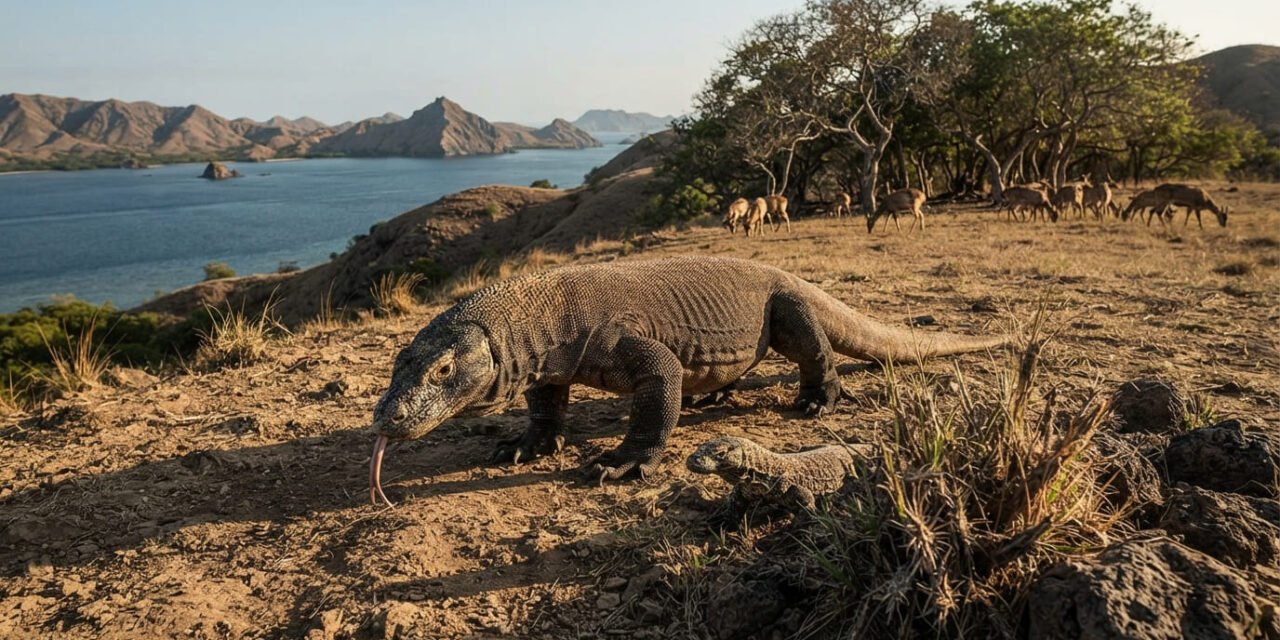
If you travel to a small group of islands in Indonesia, you might feel like you have stepped back in time. On the islands of Komodo, Rinca, and Flores, the grass is dry, the sun is hot, and the ground is ruled by a creature that looks like it belongs in a book of fairy tales. This is the Komodo Dragon.
The Komodo Dragon is the largest lizard on Earth. It can grow up to 10 feet long and weigh as much as a grown man. But they are more than just big lizards; they are survivors from an ancient world. While many other giant reptiles died out millions of years ago, the Komodo Dragon stayed. In this blog, we will explore the “inheritance” of the dragon—the secret tools and survival skills that have allowed them to rule their islands for thousands of years.
A Hunter from the Past
When you first see a Komodo Dragon, you notice its thick, armored skin. It looks like a suit of chainmail made of bone. In fact, scientists have discovered that underneath their scales are tiny bones called “osteoderms.” This is their first survival secret: they carry their own shield.
Unlike the dragons in movies, these dragons cannot fly, and they do not breathe fire. But they don’t need to. They are “apex predators,” meaning they are at the top of the food chain in their home. They hunt everything from small birds to large water buffalo. To do this, they have developed a set of skills that are both fascinating and a little bit scary.
The Secret of the Tongue: Seeing with Smell
One of the most famous sights of a Komodo Dragon is its long, yellow, forked tongue flicking in and out of its mouth. The dragon doesn’t use its tongue to taste food; it uses it to “smell” the air.
This is a brilliant survival tool. The dragon flicks its tongue to pick up tiny scent particles in the wind. Then, it presses the tongue against a special organ in the roof of its mouth called the “Jacobson’s organ.” This tells the dragon exactly where its next meal is.
Their sense of smell is so powerful that they can detect a dying animal from nearly six miles away. Imagine being able to smell a pizza from six miles away! For a dragon living on a dry island where food can be hard to find, this super-sense is the difference between life and death.
The Great Bite Mystery: Venom vs. Bacteria
For a long time, people believed a myth about how Komodo Dragons hunt. People thought the dragon’s mouth was so full of dirty bacteria that a single bite would cause a slow infection, and the dragon would simply follow the animal until it died.
However, in 2009, scientists used high-tech scans to look inside a dragon’s head. They found something amazing: Komodo Dragons have venom glands.
When a dragon bites, it isn’t just using its 60 sharp, serrated teeth (which look like steak knives). It is also injecting a complex venom. This venom does two things: it stops the prey’s blood from clotting, and it causes the animal’s blood pressure to drop very quickly. This sends the animal into shock.
This “inheritance” of venom allows a lizard to take down an animal as large as a buffalo. It shows that the dragon isn’t just a “brute” hunter; it uses advanced chemistry to win its battles.
The Patient Hunter: The Art of the Ambush
Despite their size, Komodo Dragons are not built for long-distance running. They are like sprinters, not marathon runners. Because of this, they have mastered the art of the “ambush.”
A dragon will find a game trail—a path where deer or pigs usually walk—and it will wait. Because their skin is the color of the earth and dried grass, they are almost invisible. They can stay perfectly still for hours. Their heart rate slows down, and they wait for the perfect moment.
When an animal walks by, the dragon explodes into action. It can run up to 12 or 13 miles per hour in short bursts. Most of the time, the struggle is over in seconds. This patience saves the dragon a lot of energy, which is important when you live in a place where you might go weeks without a big meal.
A Stomach Like a Suitcase
Speaking of meals, the Komodo Dragon has a very unusual way of eating. When they finally catch a meal, they don’t waste anything. They eat the meat, the skin, the feathers, and even the bones.
Because they are cold-blooded (ectotherms), they don’t need to eat every day like humans do. A Komodo Dragon can eat up to 80% of its own body weight in a single sitting. To put that in perspective, if a human could do that, they would eat about 100 large pizzas at once!
After a huge meal, the dragon will find a sunny spot to sit. The heat of the sun helps their stomach digest all that food. Because their metabolism is so slow, one big meal can keep a Komodo Dragon energized for a month. This is a perfect survival strategy for an island where the weather is unpredictable.
The Miracle of the “Virgin Birth”
Perhaps the most incredible secret of the Komodo Dragon is something scientists discovered recently called “Parthenogenesis.”
In 2006, a female Komodo Dragon in a London zoo laid eggs that hatched into healthy babies, even though she had never been with a male dragon. Scientists were shocked. They discovered that female Komodo Dragons have the ability to fertilize their own eggs if no males are around.
This is a “survival insurance policy.” If a single female dragon gets washed away to a new island where there are no other dragons, she can still lay eggs and start a whole new population. This ability has likely helped the species survive for millions of years, even when their populations were small or separated by the sea.
Why We Must Protect the Dragon
Today, the Komodo Dragon is in danger. There are only about 3,000 to 4,000 left in the wild. Their biggest threats are climate change and the loss of their habitat. As the sea levels rise, the small islands where they live are getting smaller. Also, the animals they hunt, like deer, are being hunted by humans, too, leaving less food for the dragons.
The Indonesian government has created the Komodo National Park to protect them. This is important because the Komodo Dragon is a living link to our planet’s past. When we look at a dragon, we are looking at a creature that has perfected the art of survival over millions of years.
Conclusion: Respecting the Ancient King
The Komodo Dragon is a reminder that you don’t need to be the fastest or the “newest” animal to be successful. You just need the right tools for your environment.
With their armored skin, their “chemical” bite, their super-smell, and their ability to wait patiently for the right moment, they are the true kings of their islands. They have inherited a world that changed many times, and yet, they remained the same.
By learning the secrets of the dragon, we move away from the “scary monster” stories and begin to see a smart, efficient, and resilient animal. They are a treasure of the natural world. Protecting them means protecting a piece of Earth’s history—a living, breathing dragon that still walks among us today.
The next time you think of a dragon, don’t think of fire and wings. Think of the patient lizard on a sun-drenched island, flicking its tongue and waiting for the wind to tell it a story. That is the true dragon’s inheritance.