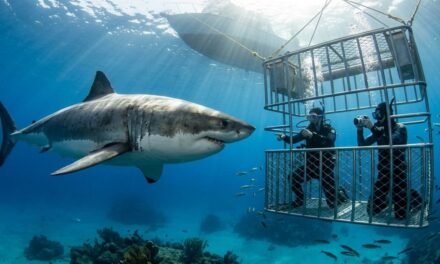
Close your eyes and think of a Great White Shark. For many of us, the first thing that comes to mind is a scene from a scary movie. We imagine a giant mouth full of sharp teeth and a “mindless” creature that only thinks about eating. But what if I told you that this image is completely wrong?
In the vast, blue wilderness of the ocean, the Great White Shark is not a monster. It is a highly intelligent, sensitive, and sophisticated creature. It has a brain that has been perfecting itself for millions of years. In this blog, we are going to dive deep into the blue to understand the “silent pulse” of the ocean the incredible intelligence of the Great White Shark.
More Than Just a Hunter
To understand shark intelligence, we first have to change how we define “smart.” In humans, we think of intelligence as solving math problems or writing books. In the animal kingdom, intelligence is about how well an animal understands its environment and makes decisions to survive.
A Great White Shark is like a high-tech computer. It doesn’t just swim around randomly, hoping to find food. It plans. It remembers. It learns. Scientists have spent years filming sharks in places like Guadalupe Island and South Africa, and they have seen something amazing: sharks have personalities. Some are shy and cautious, while others are bold and curious. This variety shows that they are individuals with their own ways of thinking.
The Sixth Sense: A World of Electricity
Imagine if you could feel the heartbeat of a person standing across the street from you. For a Great White Shark, this isn’t magic—it’s a daily reality.
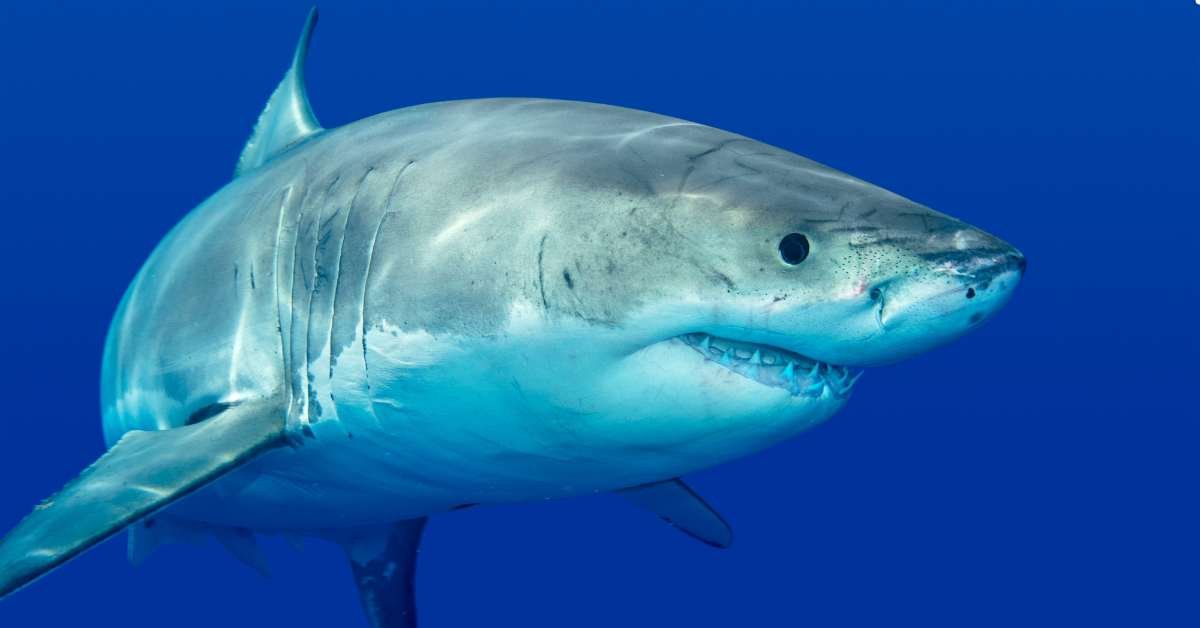
Sharks have five senses just like we do (sight, smell, hearing, touch, and taste), but they also have a “sixth sense.” If you look closely at a shark’s snout, you will see tiny black dots that look like pepper. These are called the “Ampullae of Lorenzini.”
These tiny pores are filled with a special jelly that can detect electricity. Every living creature—including you—gives off a tiny bit of electricity when their muscles move or their heart beats. The Great White Shark can feel these tiny pulses in the water. This is why it is so hard to hide from a shark in the ocean. Even if a fish is buried deep in the sand and perfectly still, the shark can “feel” its heart beating. This isn’t just a hunting tool; it’s a way of “reading” the world around them in total darkness.
The Strategy of the Hunt: Brains Over Brawn
A common mistake people make is thinking that sharks just bite anything they see. In reality, a Great White Shark is a master strategist.
Take the “breaching” sharks of Seal Island in South Africa, for example. To catch a seal, which is very fast and agile, the shark has to be perfect. They don’t just chase the seal. They hide in the dark depths near the seafloor, looking up. They use the low light of sunrise or sunset to stay hidden.
The shark calculates the speed of the seal, the depth of the water, and the exact moment to strike. They swim upward at high speeds, launching their massive bodies entirely out of the water. This requires incredible timing and spatial awareness. If they were “mindless,” they would miss every time. Instead, they learn from their mistakes. Young sharks are often clumsy, but older sharks become highly efficient hunters because they remember what worked and what didn’t.
The “Social Club”: Do Sharks Have Friends?
One of the most exciting discoveries in recent years is that Great White Sharks are social animals. For a long time, we thought they were “lone wolves” that lived and hunted alone. But new tracking technology has shown a different story.
When Great White Sharks gather in certain areas to feed, they don’t just fight each other. They have a social hierarchy, almost like a club.
- Size Respect: Usually, the larger sharks are the “bosses.” When a big shark arrives, the smaller ones move out of the way without a fight. This shows they have the intelligence to recognize “rank” and avoid unnecessary injury.
- Social Interaction: Scientists have tracked individual sharks and found that some pairs of sharks stay together for days or weeks. They “hang out” and swim together. While we don’t know if they are “BFFs” in the human sense, it shows they choose to spend time with certain individuals over others.
- The Silent Language: Sharks communicate through body language. A slight dip of a fin, a tilt of the head, or a change in swimming speed sends a message to other sharks. They are constantly talking to each other in a language of movement that we are only just beginning to understand.
A Map in the Mind: The Great Migration
Intelligence also involves navigation. Every year, Great White Sharks travel thousands of miles across open oceans. Some travel from the coast of California all the way to Hawaii. There are no landmarks in the middle of the Pacific Ocean—no mountains or signs to follow.
How do they do it?
Scientists believe sharks use the Earth’s magnetic field as a map. Their brains can “see” the magnetic lines of the planet. They have an internal GPS that is more accurate than the ones in our smartphones. They can return to the same small island year after year, arriving on almost the same day. This requires a memory that is incredibly long-lasting and precise.
Curiosity vs. Aggression
Most people are afraid of sharks because they think sharks want to eat humans. But research into shark intelligence shows that most “attacks” are actually “investigations.”
Because sharks don’t have hands, they use their mouths to feel things. When a shark sees a surfboard, it doesn’t know what it is. It is curious. It might take a “test bite” to see if the object is food (like a fatty seal) or something else (like wood or plastic).
When they realize it isn’t their natural food, they almost always swim away. If they were truly “killing machines,” they would finish the job. Instead, their intelligence tells them, “This is not what I am looking for,” and they move on. Understanding this curiosity helps us realize that they aren’t looking for trouble; they are just trying to understand their environment.
Why Does Their Intelligence Matter?
Understanding that sharks are smart changes how we feel about protecting them. It is easy to kill something you are afraid of or something you think is “dumb.” It is much harder to ignore the destruction of an animal that has a family social life, a complex brain, and a sense of curiosity.
Sharks have survived five mass extinctions. They were here before the dinosaurs, and they are still here today. But now, they are in danger because of human activity. Overfishing and the “finning” industry kill millions of sharks every year.
When we lose a Great White Shark, we aren’t just losing a fish. We are losing a guardian of the ocean that has millions of years of “wisdom” programmed into its DNA. We are losing a creature that knows the secrets of the Earth’s magnetic fields and the silent language of the deep sea.
Respecting the Silent Pulse
The Great White Shark is a masterpiece of nature. Its intelligence is silent, powerful, and mysterious. It doesn’t need to speak to show its brilliance; it shows it through its survival, its navigation, and its complex social rules.
By learning about their “sixth sense” and their social bonds, we can stop seeing them as monsters and start seeing them as the amazing wildlife they truly are. They are the silent pulse that keeps the ocean healthy. They are the thinkers of the deep.
The next time you see a shark on a screen, look past the teeth. Look at the way it moves with purpose. Look at the sensitive pores on its snout. Think about the thousands of miles it has traveled and the lessons it has learned. When we respect shark intelligence, we take the first step toward saving the oceans that we all depend on.
The Great White Shark has been watching over the oceans for 400 million years. It is time we start watching over them, too.