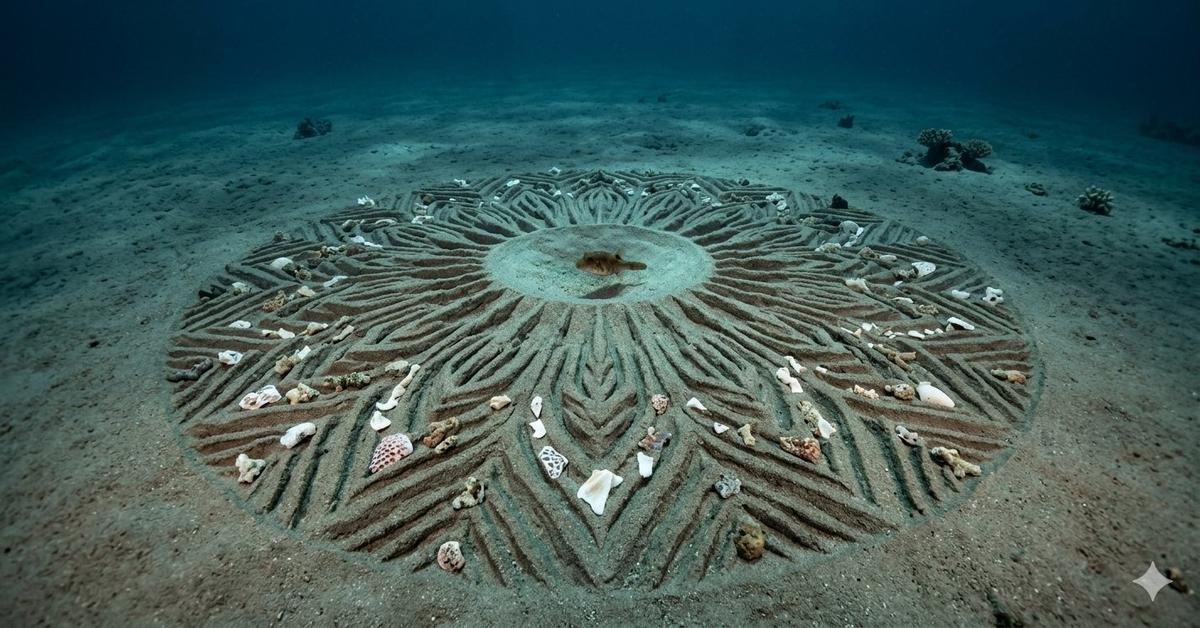
For many years, divers off the coast of southern Japan were haunted by a mystery. On the sandy seafloor, 80 feet below the waves, they found strange, geometric patterns. These were perfect circles, about seven feet wide, decorated with ridges, grooves, and even small shells. They looked like “underwater crop circles.”
People wondered: Was it the movement of the tides? Was it a strange geological event? Or was it something even more mysterious?
In 2012, scientists finally caught the “architect” in action. They expected to find a large, complex creature. Instead, they found a tiny, five-inch-long fish known as the White-spotted Pufferfish. In this blog, we are going to explore the story of the “Architect of the Abyss” and how one small fish uses art and engineering to find love.
A Tiny Artist with a Big Vision
The White-spotted Pufferfish is not very impressive to look at. It is small, brownish, and spends most of its time blending into the sand to avoid bigger fish. But inside this little fish is the mind of a master designer.
When it is time to find a mate, the male pufferfish doesn’t just sing a song or show off bright colors. He builds a monument. He chooses a patch of plain, gray sand and begins to work. For 24 hours a day, for more than a week, the little fish never stops. He knows that if he stops for too long, the ocean currents will wash his hard work away.
The Engineering of the Circle
The way the pufferfish builds the circle is a lesson in physics and persistence. He doesn’t have hands or tools; he only has his fins and his body.
1. Carving the Ridges
The fish swims toward the center of the circle, using his belly and fins to dig a deep groove in the sand. Then he swims back out. He repeats this hundreds of times, moving in a circle, until he has created a pattern of ridges and valleys that look like the spokes of a wheel.
2. Managing the Current
Scientists discovered that these ridges are not just for decoration. The shape of the peaks and valleys actually slows down the water current as it moves toward the center of the circle. This creates a calm “pool” of water in the middle. This is a brilliant piece of engineering—the fish is literally controlling the flow of the ocean to protect his home.
3. Decorating the Gallery
Once the structure is built, the “artist” becomes a “decorator.” The pufferfish searches the seafloor for small pieces of broken shells and coral. He picks them up in his mouth and carefully places them on the ridges of the circle. He isn’t just throwing them down; he places them in a way that makes the circle look even more beautiful.
Why Do They Do It?
You might ask: “Why would a tiny fish spend so much energy making a giant circle in the sand?” The answer is the oldest story in the world: he is trying to impress a female.
In the deep, dark ocean, it can be hard to find a partner. The circle acts like a giant “billboard” that says, “I am a strong, healthy, and hardworking male.”
When a female pufferfish swims by, she inspects the circle. She looks at the symmetry of the ridges and the quality of the decorations. If she is impressed by his work, she will swim to the center of the circle. The calm water in the middle—created by the fish’s clever engineering—provides the perfect, safe place for her to lay her eggs.
The Humility of the Architect
One of the most touching parts of this story is what happens after the eggs are laid. Once the female leaves, the male stays behind to guard the eggs. But he doesn’t try to keep the circle forever.
Because the sand is so soft, the circle slowly starts to disappear as the tide moves. The male doesn’t try to fix it. His work is done. Once the babies hatch and swim away into the big ocean, the male leaves the site, too. If he wants to find a mate again next year, he will start over from scratch, building a brand-new masterpiece in a new location.
What This Teaches Us About Intelligence
For a long time, humans thought that “art” and “complex construction” were things that only humans or maybe birds and chimpanzees could do. We often think of fish as simple creatures that only react to hunger or fear.
The White-spotted Pufferfish proves us wrong. It shows that intelligence comes in all sizes. To build these circles, the fish must have:
- Spatial Awareness: He has to know exactly where he is in the circle without being able to see the whole thing from above.
- Mathematical Precision: The ridges are perfectly spaced and the circle is almost a perfect geometric shape.
- Persistence: He works for 7 to 9 days without rest, showing a level of dedication that is rare in the animal kingdom.
The Fragility of the Abyss
Because these pufferfish live so deep in the ocean, they are safe from many land-based threats. However, they are not invincible.
Trawling—a type of fishing where large nets are dragged across the seafloor—can destroy these delicate sand circles in a single second. Additionally, pollution that settles on the seafloor can make it harder for the fish to find clean sand to build their homes.
The discovery of the pufferfish circles reminds us that there is so much about the ocean we still don’t know. There are likely thousands of other “architects” in the deep sea, creating beautiful things that no human has ever seen. When we protect the ocean, we aren’t just protecting “water and fish”; we are protecting millions of years of hidden culture and art.
Conclusion: A Lesson from the Sand
The story of the White-spotted Pufferfish is a story of how much can be achieved with very little. This tiny fish doesn’t have much—just a few inches of body and a lot of determination—but he creates something that leaves humans in awe.
He reminds us that beauty doesn’t always have to be permanent to be important. He builds his masterpiece, uses it for its purpose, and lets it return to the sea. He doesn’t need a museum or a crowd to clap for him; he does it because it is his “inheritance” and his role in the great cycle of life.
The next time you look at the ocean, think about the “Architects of the Abyss.” Think about the tiny fish working tirelessly in the dark, moving one grain of sand at a time to create a perfect circle. It is a reminder that even in the deepest, quietest parts of our planet, life is busy, creative, and full of wonder.
We should all strive to be a bit more like the pufferfish: working hard to build something beautiful, taking care of those we love, and respecting the natural world that gives us a place to create.