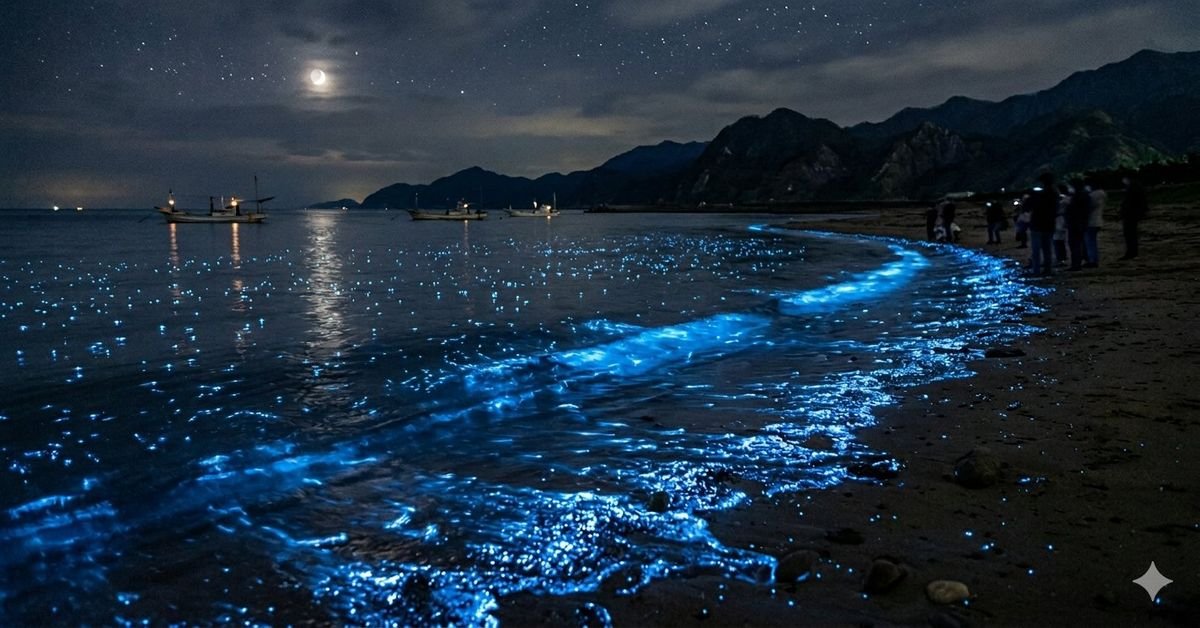
If you stand on the shores of Toyama Bay in Japan during a spring night, you might witness something that looks like a scene from a dream. The dark waves begin to glow with a brilliant, electric blue light. It looks as if the stars from the sky have fallen into the ocean and are dancing in the water.
This magical light show is created by millions of tiny creatures called Firefly Squid. Only about three inches long, these small animals are the “stars of the deep.” While they spend most of their lives in the darkness of the deep ocean, they come to the surface once a year to create one of the most beautiful natural wonders on Earth.
In this blog, we are going to explore the secret life of the Firefly Squid and find out how—and why—they turn the ocean into a glowing masterpiece.
The Science of Living Light
The Firefly Squid is a master of “bioluminescence.” This is a big word that describes the ability of a living creature to produce its own light. While fireflies do this on land, the Firefly Squid does it in the sea using special organs called “photophores.”
These photophores are like tiny lightbulbs spread all over the squid’s body. The largest and brightest ones are at the tips of their two long tentacles and around their eyes. Thousands of smaller lights cover their mantle (the main body).
Inside these photophores, a chemical reaction takes place between a substance called “luciferin” and oxygen. This reaction creates a “cold light,” meaning it produces light without making any heat. This is very important because if the light were hot, the tiny squid would cook itself!
Why Do They Glow?
In the natural world, nothing is done just for decoration. The Firefly Squid uses its blue light for three very important survival reasons:
1. Communication and Finding Love
The primary reason the Firefly Squid comes to the surface of Toyama Bay is to find a mate. Because they live in the deep, dark ocean, they use their flashing lights as a silent language. By pulsing their lights in specific patterns, they can “talk” to other squid and find a partner in the vast, dark water.
2. Counter-Illumination (The Invisible Cloak)
This is one of the smartest tricks in the ocean. Many predators, like large fish, hunt by swimming below the squid and looking up toward the surface. If a squid is silhouetted against the faint light from the moon or stars above, it is easy to see.
The Firefly Squid uses its belly lights to match the brightness of the light coming from the surface. This hides their shadow and makes them almost invisible to anything looking up from below. It is like a high-tech “camouflage” suit made of light.
3. A Flash to Scare
If a predator gets too close, the Firefly Squid can suddenly flash its bright tentacle lights. This unexpected “flash-bang” can startle or blind a predator for a second, giving the tiny squid just enough time to jet away into the darkness and hide.
The Long Journey from the Deep
The Firefly Squid spends most of its life in a place called the “twilight zone” of the ocean, about 600 to 1,200 feet below the surface. In this deep, cold water, there is almost no sunlight.
Every night, they perform a “vertical migration.” They swim up toward the surface to find food, such as small shrimp and fish, and then swim back down to the safety of the depths before the sun comes up.
However, during the months of March to June, millions of these squid leave their deep-sea homes and travel closer to the shore than ever before. This is the only time humans get to see them. In Toyama Bay, the deep underwater canyon brings the deep sea very close to the land, creating the perfect stage for the squid’s light show.
A Short and Bright Life
The life of a Firefly Squid is very short. Most of them live for only one year.
They are born in the deep sea, grow up quickly, and then spend their final months traveling to the surface to lay their eggs. Once the eggs are laid, the adult squid’s life cycle is complete. Many of them die shortly after, having ensured that the next generation will be ready to return to the deep.
This short lifespan means that the squid must be very efficient. They don’t have time to waste. Every glow and every pulse of light is a part of a fast-paced race to keep their species alive.
The Firefly Squid and Human Culture
In Japan, the Firefly Squid (known as Hotaru-ika) is a symbol of spring. For centuries, people have gathered to watch the blue “sea sparkles.”
Because they are so famous, Toyama Bay has the world’s only museum dedicated to the Firefly Squid. Scientists there study how their light works and how the health of the ocean affects their population. This tourism is a great example of how wildlife can support a local economy without being harmed. People take boat tours to see the light show from a distance, leaving the water clean and safe for the squid.
The Importance of the Deep Sea
The Firefly Squid is a reminder that the ocean is not just a flat blue surface; it is a giant, three-dimensional world full of life. These squid are a vital part of the food web. They are a main food source for many larger fish, dolphins, and whales.
By living in the deep sea and moving to the surface, they act like a “conveyor belt” of nutrients. They help move energy through the different layers of the ocean, keeping the entire system healthy.
Protecting the Light
Like many ocean creatures, the Firefly Squid faces challenges.
- Light Pollution: Because they use light to communicate, too much artificial light from cities on the shore can confuse them and lead them in the wrong direction.
- Climate Change: Changes in ocean temperatures can affect the currents and the tiny shrimp they eat. If the water gets too warm, the squid might not be able to complete their journey to the bay.
Protecting the Firefly Squid means keeping our oceans dark and clean. It means respecting the delicate balance of the deep sea.
Conclusion: The Magic of Reality
The Firefly Squid shows us that nature is more creative than any movie. You don’t need a magic wand to see a world that glows; you just need to look at the ocean at the right time.
These tiny “stars of the deep” prove that you don’t have to be big to be brilliant. Even a three-inch squid can light up an entire bay and capture the imagination of the whole world. They remind us that there are still mysteries waiting for us in the deep, and that even in the darkest places, there is light.
The next time you look at the ocean at night, imagine the millions of tiny lights pulsing beneath the waves. The Firefly Squid is a glowing invitation to learn more about our planet and to protect the wonderful, sparkling life that calls it home.