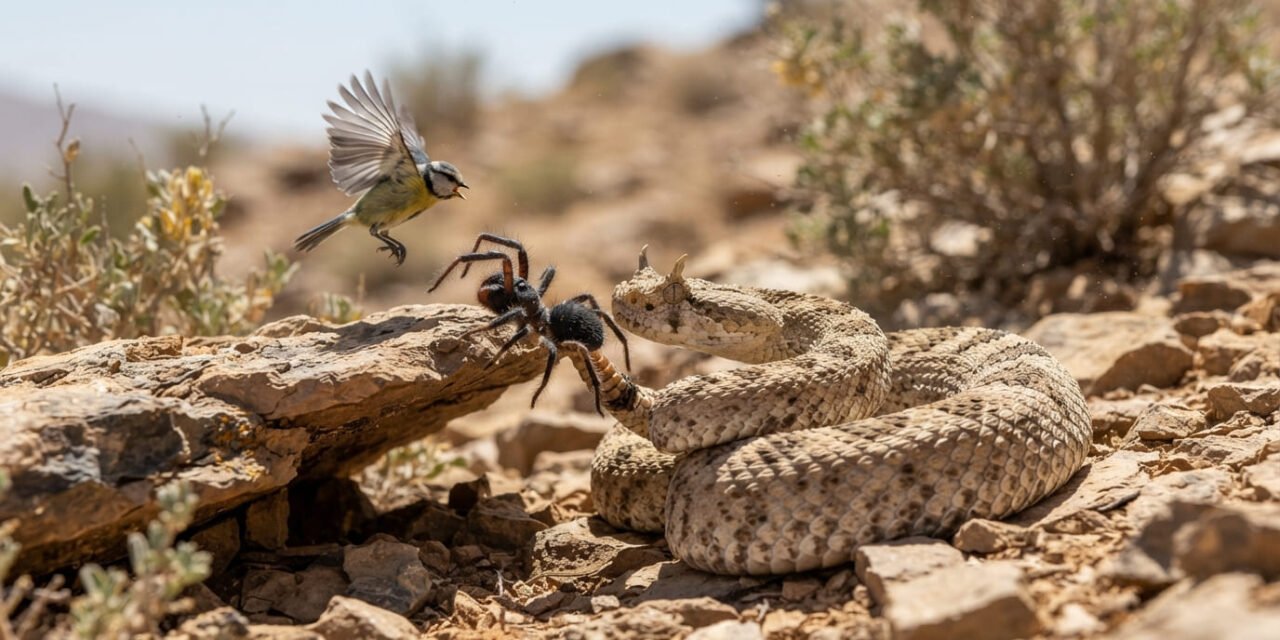
Imagine walking through the hot, barren mountains of western Iran. The ground is a harsh mix of gray gypsum rocks, dry clay, and deep cracks. It is a quiet, desolate place where very little seems to move. As you look down at a rocky ledge, you spot a fat, juicy spider crawling slowly across the stone. Its long, hairy legs twitch as it searches for a place to hide.
From a nearby bush, a migrating warbler spots the arachnid. The bird is exhausted, hungry, and desperate for a quick meal to fuel its long journey across the continent. It watches the spider move, takes a second to aim, and swoops down with its beak open.
But just as the bird is about to snatch its dinner, the gray rock beneath the spider seems to explode. Two massive jaws launch forward, and in a fraction of a second, the bird is caught. The “spider” it was trying to eat was not a spider at all. It was actually the tip of a horned viper’s tail, and the bird just fell for the most convincing puppet show in the animal kingdom.
This is the daily life of the spider-tailed horned viper (Pseudocerastes urachnoides). While many predators use camouflage to hide from their prey, this snake takes things a step further. It does not just hide; it uses a highly realistic, living lure to invite its dinner directly into its mouth. It is a masterclass in deception, and the story of how scientists discovered this creature is almost as strange as the snake itself.
The Fifty-Year Museum Mystery
For a long time, the scientific world did not even believe this snake existed. The story begins in 1968, when a team of scientists went on an expedition through Iran. They collected various reptiles and plants, including a single horned viper that had a bizarre, bulb-like growth at the tip of its tail. Sticking out from this bulb were several long, thin, fringed scales that looked exactly like spider legs.
The scientists were stumped. They had never seen anything like it. But because they only had one specimen, they did not want to declare it a new species. They assumed the snake was just a freak of nature. Perhaps it had a birth defect, a strange tumor, or a terrible parasite that had caused its tail to swell up in a weird way.
The snake was placed in a jar of preserving alcohol and shipped to the Field Museum of Natural History in Chicago. There, it sat on a quiet basement shelf for more than thirty years, forgotten by the world.
The mystery was finally solved in 2001, when Iranian biologists found another one of these strange vipers in the wild. This second snake had the exact same spider-like tail. A few years later, researchers found a third. They realized this was not a sick or deformed animal. It was a completely distinct, highly specialized species that had been living quietly in the Iranian deserts for thousands of years.
To find out how the tail worked, researchers set up video cameras in the rocky hillsides of Iran. When they played back the footage, they were amazed. They were not looking at a random physical quirk. They were looking at one of the most sophisticated hunting tools on the planet.
Anatomy of a Perfect Fake
If you look closely at the tail of this viper, you can see that it is an anatomical masterpiece. The very end of the tail is swollen into a round, fleshy bulb that is the exact color and size of a camel spider’s body. Extending from this bulb are several long, narrow scales. These are not normal snake scales. They are highly modified, long, and feathery, drooping down from the tail tip to look exactly like jointed spider legs.
When the snake is resting, the tail is completely still. It looks like a harmless dead spider sitting on a rock. But the real magic happens when the snake decides to hunt.
The snake itself is a master of camouflage. Its scales are rough, ridged, and colored in shades of dusty gray, brown, and pale yellow. When it coils up against the gypsum rocks of its home, it disappears completely. You could stand three feet away from the snake and never see it.
To start the hunt, the viper places the tip of its tail just a few inches away from its own nose. Then, the performance begins.
Playing the Puppeteer
If the snake simply shook its tail back and forth like a rattlesnake, the illusion would fail. A fast, buzzing tail looks like a blur, not a crawling bug. The viper knows this, so it moves its tail with a highly specific, slow, and jerky rhythm.
It moves the tail in figure-eight patterns, crawling the fleshy bulb over the rocks. To a bird flying high above, it looks exactly like a real spider taking a few steps, pausing to look around, and then scurrying forward again. The snake is a biological puppeteer, using its tail muscles to bring the fake spider to life.
What makes this trick even more impressive is how the snake manages its own body. While the tail is busy dancing, the rest of the snake remains as still as a statue. It does not blink, twitch, or move its head. It tolerates having its tail bumped, moved, and slid across the rough stones, keeping its eyes locked on the sky, waiting for a target to notice the show.
The Migration Trap
You might wonder why birds continue to fall for this trick. If you live in a neighborhood with a lot of spider-tailed vipers, wouldn’t you learn to avoid them?
The answer is yes. Researchers have observed that the local birds that live in the Iranian mountains year-round rarely get fooled by the snake’s tail. They have excellent memory, they know the territory, and they have likely watched other birds get caught. Some local birds will even fly down and harass the snake, chirping loudly to warn others to stay away.
Because the locals are too smart to trick, the viper targets a different crowd: migrating birds.
Every spring and fall, millions of small songbirds fly across the Middle East as they travel between Europe and Africa. These birds are not from the local area. They do not know the geography, and they have never seen a spider-tailed viper in their lives.
By the time these travelers reach the Iranian deserts, they are exhausted. They have flown hundreds of miles, their energy reserves are depleted, and they are desperate for food. When they see a plump spider moving across a rock, they do not pause to double-check if the legs look slightly strange. They see an easy, life-saving meal. The viper sets its trap specifically to exploit these tired, naive travelers. It is a highly seasonal, highly successful business model.
The High-Speed Climax
Once a migrating bird spots the lure and flies down, the trap closes fast. The snake waits with incredible patience. It does not strike when the bird is three feet away, or even one foot away. It waits until the bird is so close that it actually tries to peck at the tail.
The moment the bird’s beak touches or gets within inches of the fake spider, the viper strikes.
A viper strike is one of the fastest movements in the animal kingdom, taking only a fraction of a second. Because the snake’s head is positioned right next to its tail, the bird is already in the absolute center of the strike zone. There is no time to react, no room to dodge, and no way to escape. The hunter becomes the meal in the blink of an eye.
Final Thoughts
The spider-tailed horned viper is a reminder of how creative nature can be when it comes to survival. It did not solve the problem of finding food in a dry, empty desert by becoming the fastest runner or the loudest hunter. Instead, it used its own body to build a prop, learned how to act like a completely different creature, and set a trap for travelers who did not know any better.
The next time you see a spider crawling across a rock, take a second to appreciate the simple things. To you, it is just a bug. But in the rocky deserts of Iran, that same little shape is a legendary illusion, proving that sometimes, the best way to catch a meal is to let your tail do all the talking.Imagine walking through the hot, barren mountains of western Iran. The ground is a harsh mix of gray gypsum rocks, dry clay, and deep cracks. It is a quiet, desolate place where very little seems to move. As you look down at a rocky ledge, you spot a fat, juicy spider crawling slowly across the stone. Its long, hairy legs twitch as it searches for a place to hide.
From a nearby bush, a migrating warbler spots the arachnid. The bird is exhausted, hungry, and desperate for a quick meal to fuel its long journey across the continent. It watches the spider move, takes a second to aim, and swoops down with its beak open.
But just as the bird is about to snatch its dinner, the gray rock beneath the spider seems to explode. Two massive jaws launch forward, and in a fraction of a second, the bird is caught. The “spider” it was trying to eat was not a spider at all. It was actually the tip of a horned viper’s tail, and the bird just fell for the most convincing puppet show in the animal kingdom.
This is the daily life of the spider-tailed horned viper (Pseudocerastes urachnoides). While many predators use camouflage to hide from their prey, this snake takes things a step further. It does not just hide; it uses a highly realistic, living lure to invite its dinner directly into its mouth. It is a masterclass in deception, and the story of how scientists discovered this creature is almost as strange as the snake itself.
The Fifty-Year Museum Mystery
For a long time, the scientific world did not even believe this snake existed. The story begins in 1968, when a team of scientists went on an expedition through Iran. They collected various reptiles and plants, including a single horned viper that had a bizarre, bulb-like growth at the tip of its tail. Sticking out from this bulb were several long, thin, fringed scales that looked exactly like spider legs.
The scientists were stumped. They had never seen anything like it. But because they only had one specimen, they did not want to declare it a new species. They assumed the snake was just a freak of nature. Perhaps it had a birth defect, a strange tumor, or a terrible parasite that had caused its tail to swell up in a weird way.
The snake was placed in a jar of preserving alcohol and shipped to the Field Museum of Natural History in Chicago. There, it sat on a quiet basement shelf for more than thirty years, forgotten by the world.
The mystery was finally solved in 2001, when Iranian biologists found another one of these strange vipers in the wild. This second snake had the exact same spider-like tail. A few years later, researchers found a third. They realized this was not a sick or deformed animal. It was a completely distinct, highly specialized species that had been living quietly in the Iranian deserts for thousands of years.
To find out how the tail worked, researchers set up video cameras in the rocky hillsides of Iran. When they played back the footage, they were amazed. They were not looking at a random physical quirk. They were looking at one of the most sophisticated hunting tools on the planet.
Anatomy of a Perfect Fake
If you look closely at the tail of this viper, you can see that it is an anatomical masterpiece. The very end of the tail is swollen into a round, fleshy bulb that is the exact color and size of a camel spider’s body. Extending from this bulb are several long, narrow scales. These are not normal snake scales. They are highly modified, long, and feathery, drooping down from the tail tip to look exactly like jointed spider legs.
When the snake is resting, the tail is completely still. It looks like a harmless dead spider sitting on a rock. But the real magic happens when the snake decides to hunt.
The snake itself is a master of camouflage. Its scales are rough, ridged, and colored in shades of dusty gray, brown, and pale yellow. When it coils up against the gypsum rocks of its home, it disappears completely. You could stand three feet away from the snake and never see it.
To start the hunt, the viper places the tip of its tail just a few inches away from its own nose. Then, the performance begins.
Playing the Puppeteer
If the snake simply shook its tail back and forth like a rattlesnake, the illusion would fail. A fast, buzzing tail looks like a blur, not a crawling bug. The viper knows this, so it moves its tail with a highly specific, slow, and jerky rhythm.
It moves the tail in figure-eight patterns, crawling the fleshy bulb over the rocks. To a bird flying high above, it looks exactly like a real spider taking a few steps, pausing to look around, and then scurrying forward again. The snake is a biological puppeteer, using its tail muscles to bring the fake spider to life.
What makes this trick even more impressive is how the snake manages its own body. While the tail is busy dancing, the rest of the snake remains as still as a statue. It does not blink, twitch, or move its head. It tolerates having its tail bumped, moved, and slid across the rough stones, keeping its eyes locked on the sky, waiting for a target to notice the show.
The Migration Trap
You might wonder why birds continue to fall for this trick. If you live in a neighborhood with a lot of spider-tailed vipers, wouldn’t you learn to avoid them?
The answer is yes. Researchers have observed that the local birds that live in the Iranian mountains year-round rarely get fooled by the snake’s tail. They have excellent memory, they know the territory, and they have likely watched other birds get caught. Some local birds will even fly down and harass the snake, chirping loudly to warn others to stay away.
Because the locals are too smart to trick, the viper targets a different crowd: migrating birds.
Every spring and fall, millions of small songbirds fly across the Middle East as they travel between Europe and Africa. These birds are not from the local area. They do not know the geography, and they have never seen a spider-tailed viper in their lives.
By the time these travelers reach the Iranian deserts, they are exhausted. They have flown hundreds of miles, their energy reserves are depleted, and they are desperate for food. When they see a plump spider moving across a rock, they do not pause to double-check if the legs look slightly strange. They see an easy, life-saving meal. The viper sets its trap specifically to exploit these tired, naive travelers. It is a highly seasonal, highly successful business model.
The High-Speed Climax
Once a migrating bird spots the lure and flies down, the trap closes fast. The snake waits with incredible patience. It does not strike when the bird is three feet away, or even one foot away. It waits until the bird is so close that it actually tries to peck at the tail.
The moment the bird’s beak touches or gets within inches of the fake spider, the viper strikes.
A viper strike is one of the fastest movements in the animal kingdom, taking only a fraction of a second. Because the snake’s head is positioned right next to its tail, the bird is already in the absolute center of the strike zone. There is no time to react, no room to dodge, and no way to escape. The hunter becomes the meal in the blink of an eye.
Final Thoughts
The spider-tailed horned viper is a reminder of how creative nature can be when it comes to survival. It did not solve the problem of finding food in a dry, empty desert by becoming the fastest runner or the loudest hunter. Instead, it used its own body to build a prop, learned how to act like a completely different creature, and set a trap for travelers who did not know any better.
The next time you see a spider crawling across a rock, take a second to appreciate the simple things. To you, it is just a bug. But in the rocky deserts of Iran, that same little shape is a legendary illusion, proving that sometimes, the best way to catch a meal is to let your tail do all the talking.