For many people, the idea of being in the water with a Great White Shark sounds like a nightmare. For decades, we were told that these animals were monsters to stay away from. But as we enter 2026, something incredible is happening. Thousands of people every year travel to places like South Africa, Australia, and Mexico specifically to meet these giants face-to-face.
This is the world of shark tourism. While it might look like a thrill-seeking adventure for “adrenaline junkies,” it has actually become one of the most powerful tools we have to save sharks. In this blog, we are going to look at the rise of cage diving and how seeing a shark up close is changing the future of ocean conservation.
From Fear to Fascination
In the 1970s and 80s, sharks were mostly seen as “prizes” for fishermen or villains in movies. This fear led to a lot of violence against sharks. People thought that the fewer sharks there were in the ocean, the safer we would be.
But as we learned more about them, our fear turned into curiosity. We began to realize that sharks are not interested in eating humans. We started to want to see them in their natural world. This gave birth to cage diving. Today, instead of bringing back a shark’s jaw as a trophy, people are bringing back photos and stories of a beautiful, peaceful encounter. This shift from “killing” to “watching” is the foundation of modern conservation.
What is Cage Diving?
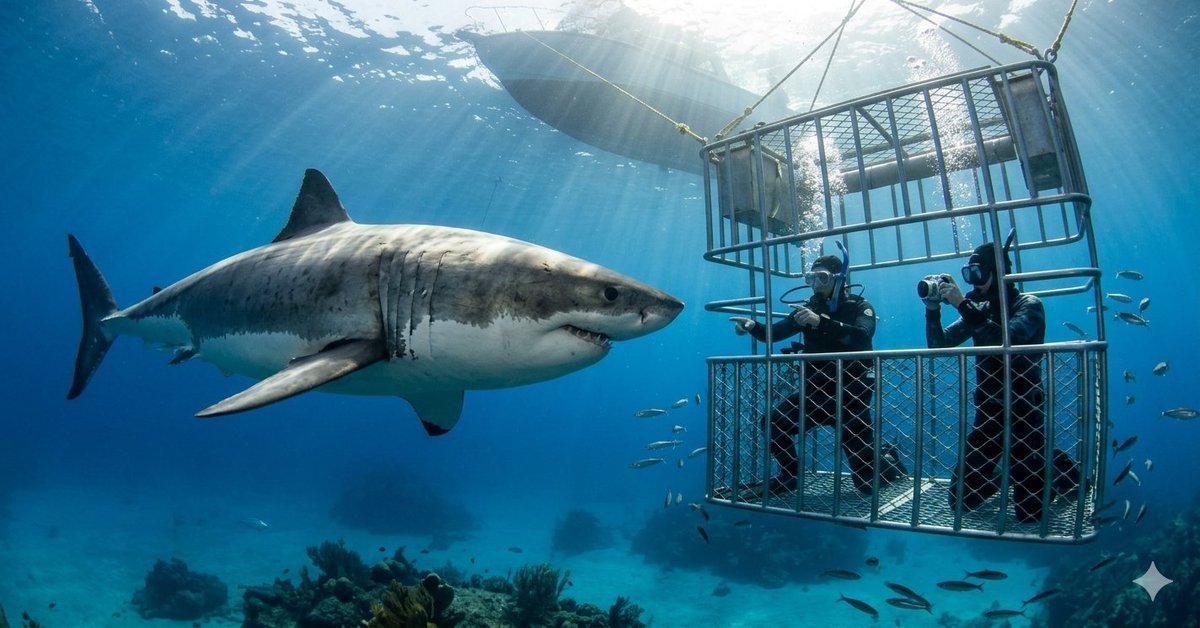
If you have never seen it before, cage diving is exactly what it sounds like. A sturdy metal cage is attached to the side of a boat. You put on a wetsuit and a mask, hop into the cage, and lower yourself into the water.
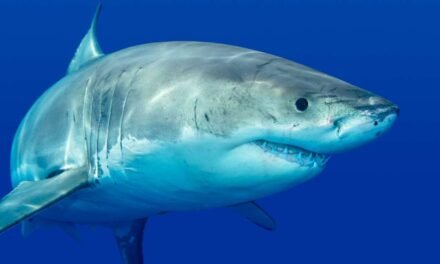
The cage acts as a safe barrier. It allows you to be in the shark’s environment without any risk to you or the animal. When a Great White Shark swims past the cage, it doesn’t try to “attack” the bars. Usually, it swims by with a calm, steady gaze. It might look at you with its large, dark eye, seemingly just as curious about you as you are about it.
The Economics of a Living Shark
One of the strongest arguments for shark tourism is simple math. In the past, a shark was worth a one-time payment to a fisherman for its meat and fins. This might be a few hundred dollars.
However, a living shark that stays in the same area for years can be worth millions of dollars over its lifetime.
- Tourism Jobs: Cage diving boats need captains, guides, photographers, and safety divers.
- Local Businesses: Tourists who come to see sharks stay in local hotels, eat at local restaurants, and buy souvenirs.
- Government Revenue: Many countries charge fees for shark diving permits, and that money goes directly into protecting the oceans.
When a local community realizes that a living shark brings in more money than a dead one, they become the shark’s biggest protectors. In many places, former shark hunters have now become shark guides. They use their skills to find the sharks for tourists instead of for harpoons.
The Ethics: Is It Good for the Sharks?
As cage diving has grown, people have asked important questions: “Does this change the shark’s behavior? Is it bad for them?” In 2026, ethical operators follow strict rules to make sure the answer is “no.”
1. The Question of Baiting (Chumming)
To bring sharks close to the boat, guides often use “chum” (fish parts) or a “decoy” (a wooden seal shape). Ethical companies are very careful not to actually feed the sharks. They want the shark to stay curious, but they don’t want the shark to stop hunting for its own food. The goal is “interaction,” not “feeding.”
2. Respecting the Animal
A good cage diving operator will never allow tourists to touch the sharks or poke cameras through the bars in a way that bothers them. They keep the music low on the boat and limit the number of people in the water. Respecting the shark’s “personal space” is the number one rule of ethical tourism.
3. Science on Board
Many cage diving boats now carry marine biologists. While the tourists are watching the sharks, the scientists are taking notes, identifying individual sharks by the scars on their fins, and tracking their health. Your ticket for a cage dive often helps fund the very research that keeps the species alive.
The “Ambassador” Effect
The most powerful part of shark tourism isn’t the money or the science—it’s the “Ambassador Effect.”
When someone goes cage diving, they usually enter the water feeling a little bit afraid. But when they come out, that fear is gone. They talk about how “majestic” the shark was. They talk about the beautiful colors of its skin and how gracefully it moved.
These people go home and tell their friends and family: “Sharks aren’t monsters.” They become “Shark Ambassadors.” They are more likely to support laws that ban shark finning, they buy sustainable seafood, and they donate to ocean charities. One person seeing a shark can lead to a hundred people wanting to save them.
Where to Experience the Giants
If you are planning a trip in 2026, there are a few world-famous spots where you can meet a Great White Shark ethically:
- Guadalupe Island, Mexico: Known for its crystal-clear blue water, this is one of the best places for photography. You can see for a hundred feet in every direction.
- Gansbaai, South Africa: This is often called the “Great White Capital of the World.” It is a place where you can learn a lot about the history of shark conservation.
- Neptune Islands, Australia: Australia has some of the strictest rules in the world for shark diving, making it a leader in ethical encounters.
Tips for the Ethical Shark Tourist
If you decide to go, here is how you can make sure your trip is helpful for conservation:
- Check the Reviews: Look for companies that mention “conservation,” “education,” or “marine biology” on their websites. Avoid places that promise “guaranteed action” or use aggressive marketing.
- Listen to the Briefing: Pay attention when the guides talk about shark safety and biology. The more you know, the more you will appreciate the animal.
- Share the Truth: After your trip, share your photos and stories. Use your voice to tell people the truth about sharks. Your social media can be a tool for education.
A Vision for the Future
Imagine a world where every coastal town sees sharks as a treasure to be protected rather than a threat to be removed. That is the goal of ethical tourism.
As we move forward, we hope to see even more “observation-only” tours, where we use technology like underwater drones or glass-bottomed boats to see sharks without even entering their space. The future of wildlife tourism is about finding ways to enjoy nature that leave it exactly as we found it.
Conclusion: The Power of the Gaze
There is a famous saying in conservation: “We will only save what we love, and we will only love what we understand.”
For a long time, we didn’t understand sharks, so we didn’t love them. Cage diving has changed that. It has allowed us to look a Great White Shark in the eye and see a living, breathing, thinking being. It has replaced our fear with wonder.
When you dive with a giant, you aren’t just checking something off a “bucket list.” You are participating in a movement to change how humans view the natural world. You are helping to prove that a live shark is worth more than a dead one.
The Great White Shark doesn’t need us to love them, but they do need us to let them live. Through ethical tourism, we are finally learning how to share the ocean with the “Guardians of the Blue.” It is an adventure that saves lives—both ours and theirs.