
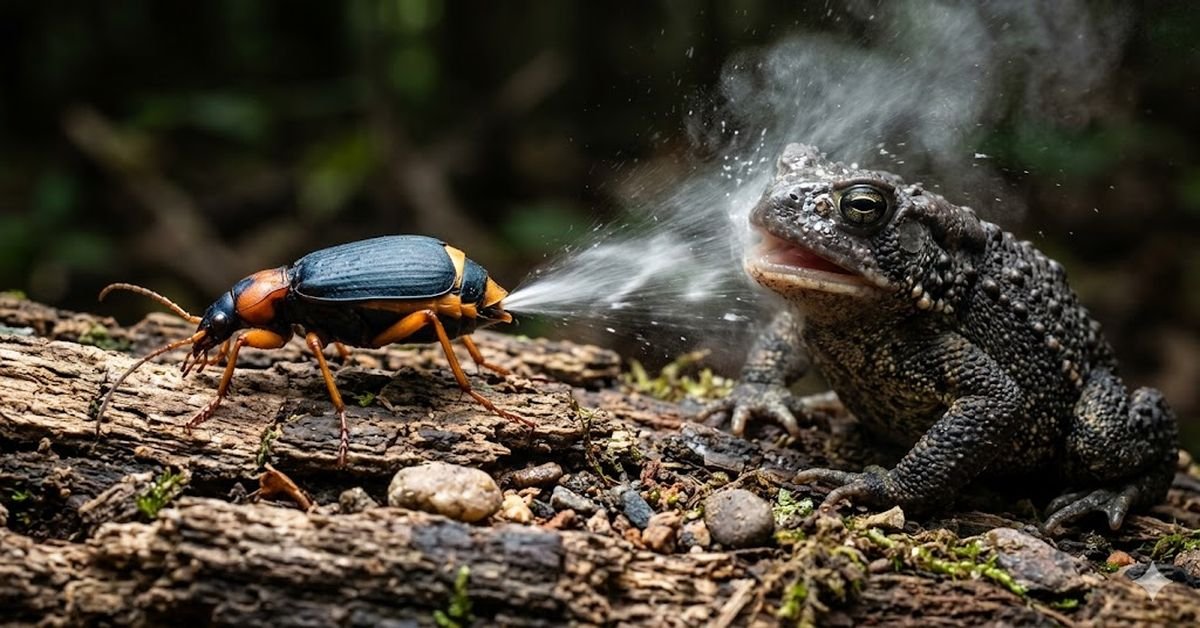
The Bombardier Beetle is an insect that carries a high-pressure chemical lab inside its abdomen. When a toad or a spider tries to eat it, the beetle doesn’t just bite or run away. It turns its rear end toward the predator and fires a jet of boiling, toxic liquid. This liquid hits at 212 degrees Fahrenheit (100 degrees Celsius). That is the exact temperature of boiling water.
This beetle solves a problem that human engineers still struggle with: how to store two explosive chemicals together without blowing yourself up. If you look at the beetle’s anatomy, you see a masterclass in safety valves and heat-resistant plumbing.
The Two-Tank System
The beetle doesn’t just walk around with a pre mixed bomb in its stomach. That would be suicide. Instead, it uses two separate storage tanks.
The first tank contains hydroquinones and hydrogen peroxide. These are the fuel. On their own, they sit quietly. Hydrogen peroxide is the same stuff you might have in your medicine cabinet to clean a cut, though the beetle uses a much more concentrated version. Hydroquinones are organic compounds that serve as the base for the toxic spray.
The second tank is where the magic happens. It is a smaller, reinforced reaction chamber. The walls of this chamber are lined with specialized cells that produce two types of enzymes: catalases and peroxidases.
When the beetle feels a threat, it squeezes the muscles around the first tank. This forces the fuel into the reaction chamber. The enzymes act as a trigger. They cause the hydrogen peroxide to decompose rapidly into water and oxygen. This reaction releases a massive amount of heat. That heat then oxidizes the hydroquinones into p-benzoquinones, which are highly irritating chemicals.
Managing the Explosion
The reaction happens almost instantly. In a fraction of a second, the liquid goes from room temperature to boiling. The oxygen gas produced in the reaction creates immense pressure.
The beetle has a specific valve between the storage tank and the reaction chamber. This is a one-way “check valve.” As the pressure builds in the reaction chamber, it forces the valve shut. This prevents the boiling explosion from backing up into the beetle’s internal organs. If this valve failed, the beetle would cook from the inside out.
Once the pressure reaches a certain point, the only way out is through the exit nozzle at the tip of the abdomen. The liquid is forced out in a series of rapid fire pulses. It isn’t one long stream. It is more like a machine gun. The beetle fires about 500 pulses per second. This pulsing action is crucial because it gives the reaction chamber a microsecond to cool down between shots, preventing the beetle’s own tissues from melting.
A Precision Aim
The Bombardier Beetle is a marksman. It doesn’t just spray blindly behind it. The tip of its abdomen can rotate nearly 270 degrees. It can fire over its back, between its legs, or directly to the side.
Researchers have used high-speed cameras to watch these beetles defend themselves against toads. Even if the toad attacks from the front, the beetle can bend its abdomen underneath its own body and blast the toad right in the face.
The exit nozzle has two small deflectors. These are like the flaps on a jet engine. By moving these flaps, the beetle can change the spread of the spray. It can fire a concentrated “bullet” of acid or a wide mist to ward off multiple small ants. This flexibility makes it one of the most effective defensive units in the insect world.
The Chemistry of Pain
The liquid isn’t just hot; it is chemically aggressive. The p-benzoquinones are known as “allomones.” When they hit the skin or eyes of a predator, they cause an immediate burning sensation and respiratory distress.
For a toad, the experience is traumatic. The heat causes an immediate physical burn, while the chemicals penetrate the mucous membranes. Most predators drop the beetle instantly and spend several minutes trying to clean the toxins off their faces. Some toads have even been observed vomiting up the beetle if they managed to swallow it before the spray hit. Because the beetle is so tough, it often crawls out of the toad’s mouth, completely unharmed.
Why It Doesn’t Blow Up
The reaction chamber is the most resilient part of the beetle’s body. It is made of a thick layer of chitin cross-linked with proteins. This creates a material that is both hard and heat-resistant. It is similar to the ceramic tiles used on the bottom of space shuttles to handle the heat of reentry.
The enzymes themselves are also specialized. Most proteins break down at high temperatures. The catalases and peroxidases in the beetle have a molecular structure that keeps them stable even as the liquid around them reaches the boiling point. This allows the beetle to keep firing multiple times in a row without losing the ability to trigger the reaction.
Evolutionary Engineering
Engineers look at the Bombardier Beetle to solve problems in combustion and aerosol delivery. The “pulse combustion” used by the beetle is much more efficient than a steady burn. It allows for high pressure with less fuel.
Human designs for fire extinguishers and fuel injection systems have been influenced by the beetle’s nozzle. We are trying to replicate that 500-pulse-per-second rhythm to create finer mists for medical inhalers or more powerful sprays for industrial cleaning.
The beetle also teaches us about “compartmentalized safety.” By keeping the reactants separate and using a one-way valve, the beetle manages a high-energy system with a very low failure rate. It is a biological example of a fail-safe mechanism.
Survival Rates
In the wild, the Bombardier Beetle has an incredibly high survival rate against predators of its own size. Ants, which usually overwhelm larger insects through sheer numbers, are often routed by a single beetle. The wide-angle spray can coat dozens of ants in a single blast.
The chemical defense is also a deterrent for birds. Most birds that have tried to eat a Bombardier Beetle learn to recognize the beetle’s distinct shape and colors—usually a combination of dark blues, blacks, and oranges. This is called aposematism, where an animal uses bright colors to warn others that it is dangerous.
The Cost of the Weapon
Maintaining this weaponry is expensive. The beetle has to synthesize these chemicals from its diet. If it fires too many times, it can run out of “ammo.” It takes several days for the storage tanks to refill completely.
Because of this, the beetle is often selective. It might give a small “warning shot” first. If the predator doesn’t back off, it unleashes the full boiling blast. This resource management is a key part of its survival strategy. It doesn’t want to be caught empty-handed when a real threat appears.
Watching the Warrior
You can find these beetles on every continent except Antarctica. They usually hide under rocks or logs during the day and come out at night to hunt other insects. They are ground beetles, meaning they spend most of their time running rather than flying.
If you ever find one, do not pick it up. While the spray won’t kill a human, it will leave a painful, brown stain on your skin that smells like chlorine and burnt rubber. That stain is the result of the quinones reacting with the proteins in your skin. It is a reminder that even the smallest creatures can carry a massive punch.
The Bombardier Beetle is a reminder that nature doesn’t just rely on teeth and claws. Sometimes, the best defense is a well engineered chemical plant and a boiling hot cannon. It survives because it turned its biology into a weapon that is too painful, too hot, and too toxic to ignore.