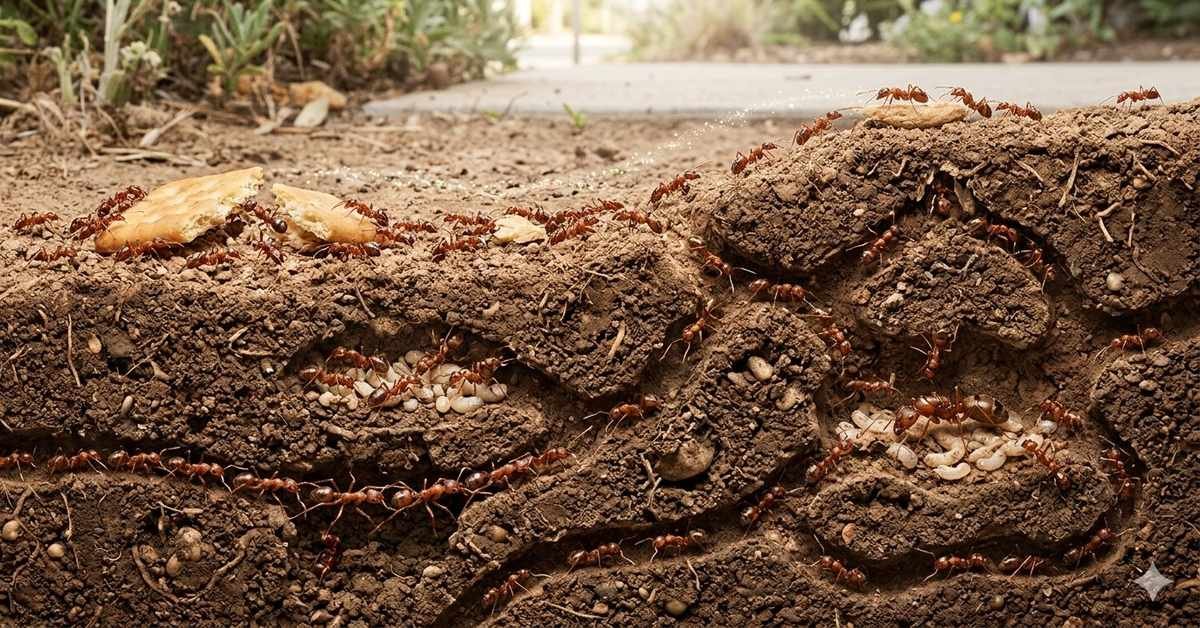
Have you ever stopped on a sidewalk to watch a line of ants carrying a giant cracker crumb? It’s a bit funny if you think about it. Individually, an ant isn’t exactly a genius. It’s got a tiny brain and a very simple set of goals. But when you put ten thousand of them together, something almost magical happens. They stop acting like a bunch of bugs and start acting like a single, massive person.
Scientists have a cool name for this: a “superorganism.” It means the whole colony works like one big body. The individual ants are like cells in your own brain or muscles in your arm. They don’t need a boss, they don’t need a manual, and honestly, they don’t even need the Queen to tell them what to do. They just… know.
No Boss, No Problem
A big misconception people have is that the Queen is the “leader.” We hear the word “Queen” and think of a throne room where she’s barking orders. In reality, the Queen is more like the colony’s heart than its head. Her job is strictly to lay eggs and keep the population steady. She doesn’t manage the construction projects or decide which kitchen cabinet to raid.
If the Queen were to die, the colony would eventually fade away because there would be no more babies, but the day-to-day work wouldn’t stop immediately. They don’t wait for permission to be productive. So, who’s in charge? Nobody. And that’s the secret.
Ants use a system called “decentralized intelligence.” Instead of waiting for a commander to tell them there’s a spill on the counter, they rely on simple interactions with their neighbors. It’s like an “if this, then that” logic. If an ant bumps into a friend who’s carrying food, it might decide to go out and look for food too. If it sees a hole in the nest, it grabs some dirt. There’s no big meeting; they just see a job and do it. It’s a beautiful kind of chaos that somehow creates perfect order.
The Chemistry of Conversation
Since they can’t talk, ants “chat” using smell. They produce chemicals called pheromones, which act like invisible sticky notes. Every ant is basically a walking chemistry set, constantly releasing signals that tell their sisters everything from “I found food” to “Danger is near.”
Imagine an ant finds a piece of dropped chocolate on your patio. It doesn’t run back and shout, “Hey guys, I found the motherlode!” Instead, it takes a small bite and heads back to the nest. As it walks, it presses its abdomen to the ground and leaves a tiny scent trail. It’s like leaving a trail of breadcrumbs, but instead of bread, it’s a chemical perfume that only other ants of the same colony can read.
When another ant crosses that trail, it thinks, “Ooh, that smells like sugar,” and follows it to the chocolate. As that second ant comes back, it adds its own scent to the trail, making it stronger. The more ants that follow the path, the louder the “smell” becomes. But here’s the smart part: once the chocolate is gone, the ants stop leaving the scent. The trail eventually fades away, and the colony stops wasting time going there. It’s a perfect, self-updating map that requires zero batteries and zero satellite connections.
Living Bridges and Tool-Free Engineering
One of the most mind-blowing examples of ant teamwork is the “living bridge.” If a group of army ants needs to cross a gap between two leaves, they don’t turn around and go home. They become the bridge. This isn’t just a metaphor; they literally lock their legs together to form a physical structure that other ants can walk across.
The first ant reaches across the gap and grabs the edge. The next ant crawls over its back and grabs the first ant’s legs. Then another, and another, until they’ve formed a solid chain of bodies. They can even adjust the bridge’s position in real-time. If the gap gets wider or the wind blows, the ants in the bridge can shift their weight or add more bodies to the structure to make it more efficient for the thousands of ants crossing over them.
Think about that for a second. They aren’t just workers; they are the building materials. They feel the weight of their sisters on their backs and know exactly how much tension to hold. No human engineer could build a bridge that fast using only their own friends. Some species, like fire ants, even form “living rafts” during floods. They trap air bubbles between their bodies to stay afloat for weeks, protecting the queen and the larvae in a floating ball of life until they hit dry land.
The Different Jobs in a Tiny City
In a human city, we have plumbers, doctors, and construction workers. Ant colonies have a similar setup, but they don’t go to school to learn their trades. Usually, an ant’s job depends on its age or its size.
When an ant is young, it usually stays deep inside the nest. These are the “nurses.” They spend their time cleaning the eggs and feeding the larvae. As they get older, they move toward the edges of the nest to become “trash collectors” or “diggers.” The oldest and bravest ants are the ones you see on your sidewalk. These are the “foragers.”
Being a forager is the most dangerous job because you might get stepped on or eaten by a bird, so it makes sense to send the older ants who have already contributed most of their lives to the colony. If the colony suddenly needs more food, the nurses will actually “age up” faster and head outside to help. They can sense what the colony needs just by the number of empty-handed foragers they bump into.
Safety in Numbers
The “superorganism” mindset is most visible when the colony is under attack. If you disturb an ant hill, you’ll see a chaotic explosion of activity. But it’s not actually chaos. It’s a highly coordinated defense plan.
Some ants immediately rush to the deepest part of the nest to grab the larvae (the babies) and move them to safety. Others—the soldiers with the big jaws—run straight toward the danger. They don’t hesitate because they aren’t worried about their own individual lives. They are worried about the survival of the “body.” To an ant, losing a few hundred workers is like a human losing a few skin cells after a scrape. It hurts, but the body keeps moving. Their bravery isn’t about being fearless; it’s about being part of something bigger than themselves.
Why Should We Care?
It’s easy to look at ants and think they’re just pests, but we’re actually learning a lot from them. Computer scientists study ant behavior to write better code for delivery trucks or internet traffic. By watching how ants find the shortest path to a crumb, we can figure out how to get your Amazon package to your door faster. We call these “ant colony algorithms,” and they’re used to solve some of the world’s most complicated logistics problems.
But beyond the tech stuff, there’s something deeply humbling about ants. They remind us that big problems don’t always need a “hero” or a genius leader to solve them. Sometimes, you just need a lot of people doing small, simple things correctly. They show us that cooperation is often a better survival strategy than competition.
Environmental Architects
Ants also do a lot of work that we don’t see. They are the world’s greatest tillers of soil. As they dig their tunnels, they move huge amounts of earth, mixing nutrients and allowing air and water to reach the roots of plants. In many parts of the world, ants do more for the soil than earthworms do.
They are also the ocean’s clean-up crew on land. They scavenge dead insects and organic waste, turning it into fertilizer for the forest. Without ants, our world would be a much messier, less fertile place. They are the invisible gardeners of our planet.
Final Thoughts
The next time you see a tiny ant scuttling across your floor, try not to reach for the spray right away. Look at it as a tiny piece of a much larger, invisible mind. It’s a scout, a builder, and a sister, all rolled into one.
An ant colony is proof that we are stronger when we’re connected. They’ve been on this planet for 140 million years, building cities and bridges without a single blueprint or a single boss. They survived the extinction of the dinosaurs and the rise of humans. Maybe they know something we don’t. Maybe the secret to survival isn’t being the smartest person in the room—it’s being the best neighbor.
When we look at the ant, we see a mirror of our own potential. We see what happens when individuals set aside their own egos to work for the good of the community. It’s a small lesson from a small bug, but it’s one that could change the world if we actually listened.
