If you take a long hike through the dense, humid rainforests of the Amazon basin or explore the deep tropical woodlands of Central America, you will quickly realize one universal truth about the jungle. Everything is hiding. The forest is an incredibly crowded and dangerous place. Predators are constantly patrolling the canopy and the undergrowth. Most animals survive by retreating into deep burrows or flying away frantically at the very first sign of danger.
But if you stop walking and look very closely at the trees around you, you might realize that a dead, rotting branch is actually looking right back at you.
This is Nyctibius grandis. People who live near the rainforest commonly call it the great potoo. It is a nocturnal bird that has taken the basic concept of blending in and elevated it to an absolute extreme. To survive in a massive forest filled with hungry eagles, curious monkeys, and climbing snakes, this bizarre creature simply pretends to be a piece of wood. It is a masterclass in optical illusions, and understanding how it pulls off this magic trick requires looking at one of the most uniquely adapted bodies in the avian world.
The Magic of Bark
When you look at a great potoo during the bright daylight hours, it is genuinely difficult to convince your own brain that you are looking at a living, breathing animal. The bird is remarkably large. A fully grown adult can measure nearly two feet long from its beak to the tip of its tail feathers. You would think a bird that large would be incredibly easy to spot.
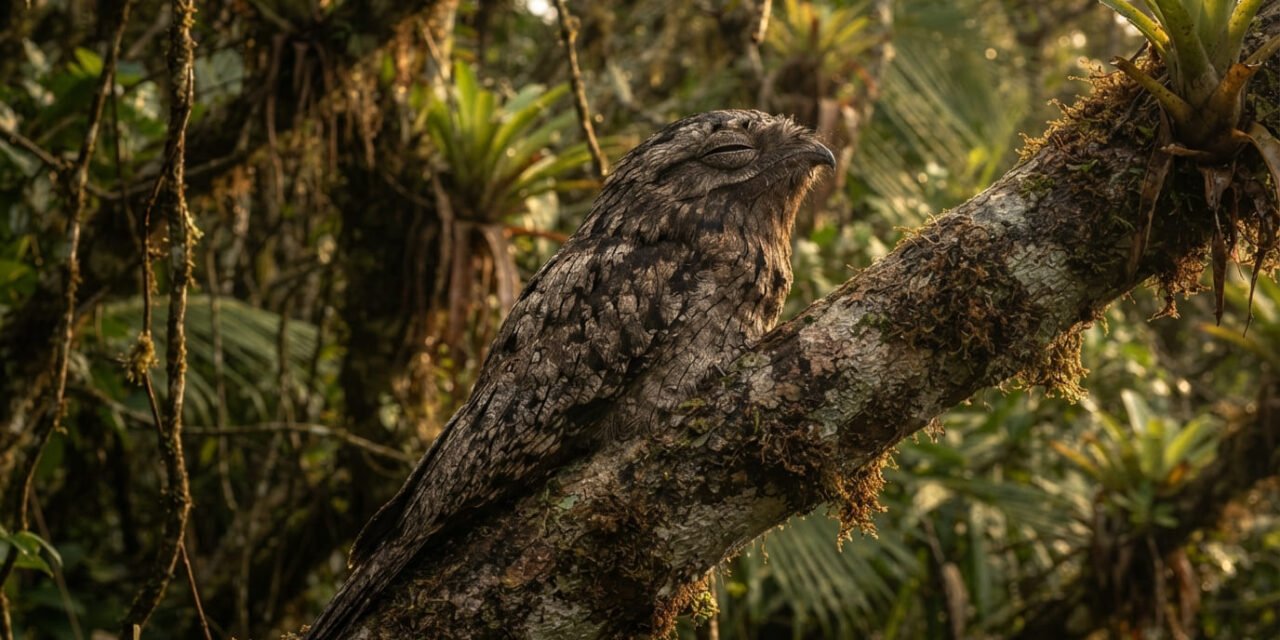
But every single feather on the body of Nyctibius grandis is meticulously patterned and colored to mimic the exact texture of dead tree bark. The feathers are heavily mottled with chaotic splashes of gray, muted brown, rusty red, and pale white. They look exactly like the rough ridges of wood covered in patches of dried lichen.
The camouflage goes far beyond simple coloring. The bird utilizes a highly specific posture to complete the illusion. The great potoo finds the broken end of a thick vertical branch. It perches right on the edge and points its beak straight up toward the sky. By stretching its neck upward and compressing its feathers tightly against its body, the bird seamlessly extends the physical shape of the dead wood. It erases the transition between the tree and its own feet.
The illusion is utterly flawless. But as any predator knows, camouflage only works if you stay completely still. A moving piece of bark is a dead giveaway.
The great potoo is a true master of absolute stillness. It will sit in that exact upright position for hours at a time. It does not twitch. It does not shift its weight. It does not groom its feathers or stretch its wings. It just becomes the stump.
However, animals that freeze in place face a massive problem. The biggest visual giveaway for a hiding animal is the glint of sunlight reflecting off a wet, shiny eye. If a hawk is circling overhead, a sudden flash of light reflecting off a round eyeball will instantly ruin the disguise.
The great potoo solves this problem brilliantly using a unique anatomical quirk. It closes its massive yellow eyes almost entirely, leaving only a microscopic slit open. But the bird does not just squint. The upper eyelids of the great potoo actually feature two tiny natural notches. These tiny folds in the skin allow the bird to keep its eyes firmly shut to hide the reflective surface, while still being able to watch the entire forest through the tiny keyholes in its eyelids. It can literally watch a predator walk right past it while keeping its eyes totally closed.
The Night Awakens
The great potoo spends the entire day locked in this rigid wooden posture, enduring the hot tropical sun and the heavy rains without ever breaking character. But when the sun finally sets, and the jungle goes completely dark, the dead stump suddenly comes to life.
The very first thing you might notice is the sound. The vocalizations of Nyctibius grandis are legendary across its native habitat. They do not sing pleasant little melodies like a robin or a sparrow. Instead, they let out a deep, guttural growl that descends into a loud, haunting moan.
To a person walking through the dark forest alone, the call sounds exactly like a terrified wild animal or a person in deep distress. It is a deeply unsettling, terrifying noise that echoes loudly through the trees. Because of this terrifying midnight call, many local legends and folklore stories heavily feature the potoo as a ghost, a demon, or a restless spirit of the woods.
But the bird is not trying to scare anyone. It is simply claiming its territory and calling out to potential mates under the safety of darkness. Once the vocalizations are finished, the bird gets down to the serious business of finding a meal.
The Massive Mouth
The great potoo is strictly nocturnal. Like the nightjars they are distantly related to, they are dedicated insectivores. But because they are so large and heavy, they do not waste their time or energy chasing tiny mosquitoes or gnats. They require a highly substantial, calorie-dense meal to survive.
If you look at the face of a resting potoo, it looks very strange and almost comical. The beak is incredibly tiny. It looks like a useless little hook glued onto the very front of its face. But that tiny beak is completely deceptive. The actual mouth of the bird extends all the way back past its huge eyes. When a potoo opens its mouth, it looks like the entire front half of its head is splitting wide open. It possesses a cavernous gaping maw that can swallow massive prey entirely whole.
The bird uses its huge yellow eyes to scan the night sky. The large pupils let in maximum ambient starlight and moonlight, giving the bird spectacular night vision. It sits quietly on its favorite branch and watches the air above the canopy for large flying insects.
When a massive katydid or a heavy scarab beetle flies past, the potoo launches itself into the air. It flies completely silently, much like an owl, using soft feathers to muffle the sound of its wingbeats. It swoops out into the open air, opens its massive trap of a mouth, and scoops the giant insect right out of the sky. It swallows the meal instantly and circles right back to the same branch to wait for the next victim. They are incredibly skilled aerial acrobats in the dark, and they are even known to occasionally swallow small bats that happen to fly a bit too close to their perch.
The Nest That Does Not Exist
One of the most fascinating things about Nyctibius grandis is how it handles the delicate process of raising the next generation. Most birds spend weeks tirelessly gathering sticks, mud, and soft grasses to build a warm, secure nest for their eggs.
The great potoo completely ignores this tradition. Building a nest would completely ruin their entire survival strategy. A big messy pile of sticks looks obvious and attracts unwanted attention from hungry capuchin monkeys, toucans, and snakes.
Instead of building anything, the female simply finds a thick branch with a slight natural depression or a small rotten knot in the wood. She lays a single egg directly onto the bare, untreated bark. She does not add a single leaf or piece of moss. She simply sits on top of the egg and assumes her standard wooden posture. Her camouflaged body entirely covers the egg, seamlessly hiding it from the rest of the world. She and her mate take turns incubating the egg, remaining completely motionless so no predator ever suspects a vulnerable meal is hidden underneath them.
When the single chick finally hatches, it faces a very dangerous world. It is incredibly small and completely defenseless. But it already knows exactly how to survive the jungle. The baby potoo is covered in fluffy pale down feathers. As it sits next to its parent on the bare branch, it does not look like a bird at all. It looks exactly like a clump of white tree fungus or a patch of fuzzy lichen growing on the bark.
As the chick grows older, its fluffy white feathers gradually transition into the complex mottled patterns of an adult. It begins to learn how to stretch its neck up to the sky just like its parents. By the time the young bird is finally ready to take its first flight, it has already mastered the incredible art of being completely invisible.
The Brilliance of Doing Nothing
We constantly celebrate the animals in nature that are the fastest, the strongest, or the most venomous. We love to watch cheetahs sprint across the savanna and we marvel at eagles diving from the clouds. We associate survival with intense physical action and overwhelming power.
But the great potoo proves that sometimes the absolute most successful strategy in the natural world is simply doing absolutely nothing.
This bird found a way to conquer the chaotic, dangerous environment of the Amazon rainforest simply by refusing to participate in the chaos. It wears a perfect suit of fake bark. It keeps its eyes closed. It sits completely still and lets the danger walk right past it every single day. Nyctibius grandis is a bizarre awkward looking bird, but it is also a complete masterpiece of evolutionary deception. It reminds us that in a loud, crowded forest, the quietest, invisible creatures are often the ones that survive the longest.