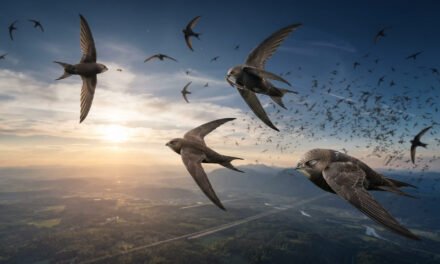
Imagine standing at the entrance of a massive limestone cave on an island in Southeast Asia. Deep inside the towering stone arch, daylight fades into complete, heavy darkness. High above your head, the damp ceilings echo with thousands of sharp, metallic clicking sounds. If you shine a spotlight up into the blackness, you will see tiny, dark birds darting through the air.
They do not land on branches, and they never step on the ground. Instead, they cling directly to the sheer, slippery faces of vertical marble cliffs.
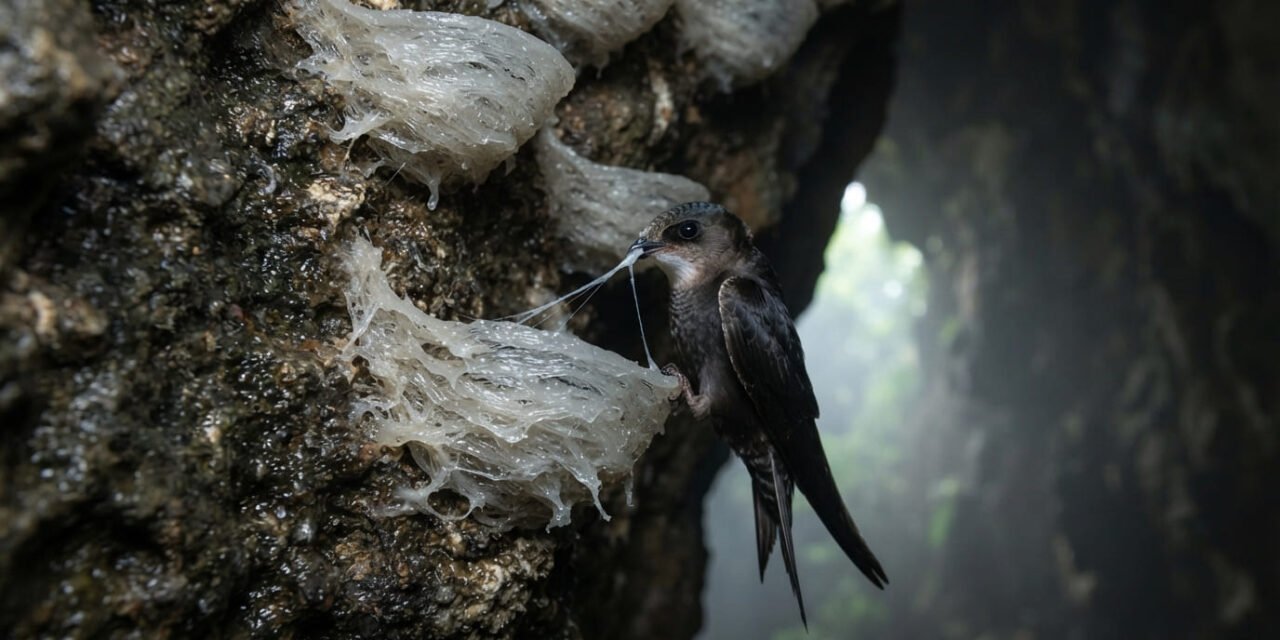
If you look closely at where these birds rest, you will see small, cup-shaped brackets attached directly to the bare stone. They are translucent, white, and look like they were carved out of polished quartz or melted plastic. There are no twigs in these nests. There are no leaves, no feathers, and no mud.
This is the nest of the edible-nest swiftlet (Aerodramus fuciphagus). Found across the coastal caves of Thailand, Indonesia, Malaysia, and Vietnam, this tiny bird solved one of the hardest architectural challenges in nature. Faced with the need to raise a family on vertical stone walls where traditional building materials are useless, the swiftlet turned its own mouth into a biological cement factory. It weaves its home out of pure, hardened saliva.
The Problem of Vertical Real Estate
To understand why the swiftlet builds such a strange nest, you first have to look at where it lives.
Tropical forests are full of hungry predators. Tree snakes, monitor lizards, monkeys, and owls constantly search branches for bird eggs and chicks. An open nest built out of twigs in a tree canopy is highly vulnerable.
The swiftlet decided to eliminate land predators by moving its nursery deep inside subterranean limestone caves. High up on the smooth ceiling of a cave, hundreds of feet above the ground, an egg is completely safe from climbing snakes and prowling mammals.
However, living on a vertical stone cliff creates a major engineering problem. Traditional nest-building materials fail on sheer rock. If a bird tries to stack twigs or dry grass on a vertical wall, the pieces simply drop to the cave floor. Mud, which some birds use to paste twigs together, requires a flat ledge to rest on and slips right off wet limestone in high humidity.
The swiftlet needed a building material that could stick instantly to wet, smooth marble, hold its shape against gravity, and support the weight of two growing chicks. It did not search the forest floor for a solution; it manufactured the answer inside its own throat.
The Seasonal Glue Factory
During most of the year, the edible-nest swiftlet looks like a typical small bird, spending its days flying over the ocean and rainforest catching tiny insects mid-air. But as the breeding season approaches, a dramatic physical change happens inside its body.
Located beneath the bird’s tongue are two specialized organs called sublingual salivary glands. In most birds, these glands are tiny, producing just enough saliva to help swallow dry food.
When the swiftlet prepares to build a nest, its sublingual glands swell to several times their normal size. They become hyperactive chemical factories, packing the bird’s throat with a thick, viscous, and clear mucus.
This specialized saliva is rich in mucin glycoproteins. Glycoproteins are long chains of protein molecules bonded to carbohydrate sugars. This specific molecular structure gives the saliva extraordinary physical properties. It is highly elastic, incredibly sticky, and fast-drying when exposed to air.
While human saliva is mostly water and breaks down quickly, swiftlet saliva acts like a heavy, industrial-grade liquid plastic. It is resistant to humidity and forms strong chemical bonds with calcium carbonate, the primary mineral found in limestone cave walls.
The Master Mason at Work
Building a nest out of saliva is a slow, painstaking process that relies entirely on patience and precise repetition. The male swiftlet does almost all of the construction work, spending up to thirty days completing a single nest.
He starts by choosing a spot on the cave wall. He grips the rough micro-textures of the stone with his small, sharp claws.
Next, he presses his beak against the bare rock and deposits a thick drop of clear saliva. He slowly pulls his head back, drawing the liquid out into a long, continuous thread about as thick as a piece of yarn. He sweeps his head side to side in a tight, horseshoe-shaped arc, pasting the wet thread against the wall.
As the saliva meets the air inside the cave, the water content slowly evaporates. The glycoprotein strands cross-link with one another, hardening from a liquid gel into a solid, rubbery strand within seconds.
The bird repeats this movement thousands of times. He layers thread upon thread, building a crescent-shaped foundation bracket against the stone.
Once the base is securely anchored to the rock, the swiftlet begins weaving the walls of the cup. He deposits concentric loops of saliva, building up a hollow shell. As the layers dry, they turn from a wet, clear gel into a firm, translucent white material that resembles hardened wax or spun glass.
When the nest is finished, it weighs only a fraction of an ounce, yet it is strong enough to support over twenty times its own weight. It remains glued to the damp stone wall for months, holding two eggs and the growing chicks without cracking or slipping.
Acoustic Navigation in the Abyss
Manufacturing a home out of saliva is only half of the swiftlet’s cave survival kit. The other half is its ability to find that home in total darkness.
Many caves inhabited by swiftlets are massive, stretching thousands of feet underground. The nests are often built deep in the interior zones where sunlight never reaches.
While owls and cats rely on giant eyes to see in low light, no eye can see in complete darkness. If there is zero light, vision is impossible.
The edible-nest swiftlet solved this by developing a biological sonar system. It is one of the only bird groups on Earth capable of echolocation.
As the swiftlet flies through the dark cave, it produces a continuous series of sharp, metallic clicking sounds using its syrinx. Unlike bats, which use high-frequency ultrasonic clicks that human ears cannot hear, the swiftlet’s clicks sit at a lower frequency, usually between 1 and 10 kilohertz. To a human standing inside the cave, it sounds like thousands of tiny wooden castanets clicking at once.
The sound waves travel through the dark air, bounce off the limestone pillars, walls, and other birds, and return to the swiftlet’s ears. By processing the subtle timing differences of these echoes, the bird’s brain creates a detailed three-dimensional map of the cave.
It can dodge rocky outcrops, navigate narrow tunnels, and locate its own specific nest on a crowded wall while flying at high speed in total blackness.
The Gold Mine on the Cave Wall
The swiftlet’s unique nest structure has made it famous around the world, but it has also put the bird at the center of a massive human industry.
For over a thousand years, swiftlet nests have been harvested to make bird’s nest soup, a prized delicacy in Chinese culinary tradition. The nests are dissolved in warm water, turning into a gelatinous texture that is served in sweet or savory broths.
Because the nests are made of pure, hardened saliva rich in proteins and amino acids, they have long been believed to boost the immune system, improve skin health, and promote longevity.
Because finding and harvesting these nests is dangerous work, pure white swiftlet nests are among the most expensive animal products on Earth. High-quality nests can sell for over two thousand dollars per kilogram, earning them the nickname “white gold.”
In the past, harvesters had to climb fragile bamboo scaffolding hundreds of feet into dangerous, dark caves to scrape nests off the stone ceiling. Over-harvesting often threatened local bird populations, as nests were sometimes taken before the chicks had a chance to hatch.
Today, the industry has shifted toward sustainable farming. Across Southeast Asia, people build large, multi-story concrete structures known as swiftlet houses or swiftlet hotels.
These buildings are designed to mimic the cool, dark, and humid conditions of a natural limestone cave. Speakers on the roof play recorded swiftlet echolocation clicks to invite wild birds inside.
Once the birds move in, they build their saliva nests on wooden beams inside the building. Farmers wait until the chicks have naturally grown up and flown away before harvesting the empty nests. This sustainable approach protects the bird populations while supplying the market with clean nests.
Lessons for Human Material Science
You should care about the edible-nest swiftlet because its unique saliva is helping human scientists solve complex biomedical problems.
In modern medicine, creating glues that can bond tissues together inside the human body is a major challenge. Most synthetic glues lose their stickiness when exposed to water, blood, or high humidity. They can also be toxic to living cells.
Engineers studying bio-adhesives are looking closely at the swiftlet’s mucin glycoproteins.
By analyzing how the swiftlet’s saliva cross-links and hardens under wet, humid conditions, biochemists are designing synthetic hydrogels and surgical glues. These bird-inspired materials can seal internal wounds, repair damaged cartilage, and bond surgical implants to bone inside the wet environment of the human body without causing irritation or toxic reactions.
A Tiny Architect of the Dark
The edible-nest swiftlet is a wonderful reminder that nature’s best solutions are often hidden in the most unexpected places. It is a tiny, dark bird that spends its life flying through the clouds and resting in pitch-black caves.
It did not need broad wings, heavy jaws, or massive claws to conquer its habitat. Instead, it used its own mouth to build an architectural fortress on sheer stone, turning simple saliva into a home that defies gravity.
The next time you look at a rocky cliff or a dark cavern, think of this tiny cave sculptor. It is a quiet master of natural engineering, proving that with enough time and the right biological glue, even a drop of spit can build a home on a mountain of rock.