Imagine diving down to the bottom of a murky, slow-moving river estuary in Southeast Asia. The water is thick with brown silt, fallen mangroves, and decaying river plants. Sunlight barely penetrates the top few inches of the surface, leaving the riverbed in dim twilight. If you search along the soft mud near the roots, you might spot something lying still in the silt.
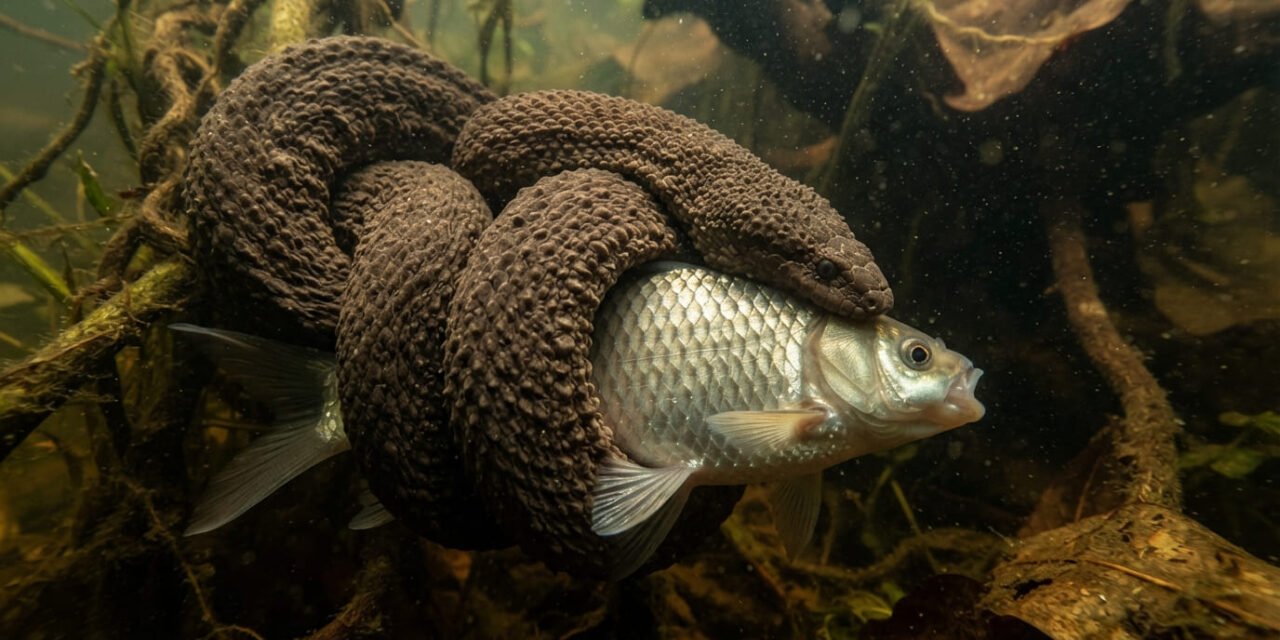
At first glance, it looks like an old piece of waterlogged rubber hose or a discarded automobile tire. It is thick, dark brown, and covered in baggy, wrinkly folds of skin. It moves with a slow, heavy rhythm that makes it look like an unraveled piece of tree root.
This is the elephant trunk snake (Acrochordus javanicus), also known as the Javan file snake. Measuring up to eight feet long and weighing nearly twenty pounds, this strange reptile is one of the most thoroughly adapted aquatic snakes on the planet.
Most snakes can swim when they need to, but they still retain the ability to crawl across dry earth, climb trees, or slither over rocks. The elephant trunk snake took a different path. It abandoned the land entirely millions of years ago, giving up its ability to walk on soil in exchange for complete mastery of the water.
Faced with the challenge of hunting fast, slimy, and smooth fish in dark water without arms, claws, or venom, this unique snake developed a physical solution. It turned its skin into coarse sandpaper and its body into a loose, living net.
The Problem of the Wet Soap Bar
To understand why the elephant trunk snake looks and behaves so strangely, you have to appreciate how difficult it is to catch a fish underwater without hands.
Fish are built for escape. Their bodies are streamlined, flexible, and covered in overlapping scales. To make matters harder, most fish secrete a thick coating of slippery mucus over their skin. This slime layer serves as a protective barrier against parasites and reduces friction as the fish glides through the water.
If you have ever tried to grab a live catfish, eel, or trout with your bare hands, you know how hard it is to maintain a grip. The moment the fish wriggles, it slides out of your fingers like a wet bar of soap.
For a typical land snake hunting on dry ground, holding prey relies on a mix of body weight, ground friction, and backward-pointing teeth. The snake uses the firm ground beneath its belly as leverage to squeeze its target.
Underwater, all of that leverage disappears. Water resistance cushions every movement, making fast lunges difficult. At the same time, there is no solid ground to push against while struggling with a thrashing prey item. If a snake tries to wrap its body around a slimy fish in open water, the fish simply slides straight out of the coils and swims away.
Some marine snakes solved this issue by evolving potent neurotoxic venom, allowing them to paralyze prey with a single quick nip. The elephant trunk snake went in a completely different direction. It remains entirely non-venomous, relying instead on high-friction physics to lock its dinner in place.
The Sandpaper Armor
If you run your hand down the back of a typical garter snake or python, the scales feel smooth, polished, and cool. Smooth, overlapping scales help terrestrial snakes slide over dirt, grass, and leaf litter without catching on obstacles.
If you touch an elephant trunk snake, you receive a shock. Its skin feels rough, raspy, and abrasive, almost identical to coarse sixty-grit sandpaper or a metal wood file.
This unusual texture comes from the snake’s individual scales. Unlike normal snakes, whose scales overlap like shingles on a roof, the elephant trunk snake has small, pyramid-shaped scales that sit side by side without overlapping.
In the center of every single scale sits a raised, sharp, ridge-like keel ending in a microscopic spike. There are tens of thousands of these tiny, spiked pyramids covering the snake’s entire body, from the tip of its snout to the end of its paddle-shaped tail.
Biologists call these structures micro-keels. While they make the snake look dull and rough, they serve a vital mechanical purpose underwater.
When the elephant trunk snake strikes a fish and wraps a loop of its body around the prey, these thousands of tiny spikes bite directly into the fish’s slippery slime coating. The micro-spikes penetrate the thin layer of mucus and hook onto the edges of the fish’s scales.
Instead of sliding along the prey’s slick body, the rough scales create immediate, intense surface friction. The fish’s own thrashing movements actually force the sandpaper skin deeper against its body, locking it in place. The snake does not need to waste energy squeezing with crushing force; the physical texture of its skin does the heavy lifting.
The Baggy Skin Net
The sandpaper texture is only half of the snake’s gripping system. The other half is its loose, oversized skin.
When you look at an elephant trunk snake resting on the riverbed, it looks strangely deflated, as if its skin is three sizes too big for its internal organs. Long, baggy folds of loose tissue hang off its belly and sides.
This extra skin is a deliberate mechanical feature. When a snake with tight, taut skin wraps around a fish, it can only make contact along a narrow line where its round body touches the prey. That leaves plenty of open space for the fish to wiggle out.
Because the elephant trunk snake has loose, flexible skin, its body behaves like a soft beanbag or a wet blanket.
When the snake coils around a fish, the extra skin stretches and folds around every curve, fin, and bump of the prey’s body. The loose skin squishes into the gaps, maximizing the total contact area between the snake and the fish.
By combining maximum surface contact with thousands of sharp sandpaper scales, the elephant trunk snake creates an inescapable friction trap. The fish is held firm by a custom-molded glove of rough spikes, making escape virtually impossible no matter how hard it thrashes.
Built for the River, Ruined on Land
This commitment to an aquatic lifestyle came at a high evolutionary cost. The elephant trunk snake modified its body so thoroughly for underwater hunting that it completely ruined its ability to live on dry land.
Most land snakes have wide, specialized scales running down their bellies called ventral scutes. These broad scutes catch on small bumps on the ground, allowing the snake to push itself forward in a crawl.
The elephant trunk snake has completely lost its ventral scutes. Its belly scales are small, rough, and pyramid-shaped, looking identical to the scales on its back. It also has a faint keel or ridge running along the bottom center of its belly.
If you place an elephant trunk snake on dry land, it becomes almost completely helpless. Without broad belly scales or a firm internal skeleton to support its weight against gravity, its heavy body collapses flat onto the dirt. It can only squirm awkwardly in place, unable to crawl forward or raise its head.
Furthermore, its blood circulation system is tuned specifically for the buoyant environment of water. On land, gravity pulls its blood down toward its tail, making it difficult for the snake’s heart to pump blood back up to its brain.
In the water, however, the snake is in its element. Its body is flattened sideways like an eel, and its short, muscular tail acts like an efficient paddle. It glides through dark, muddy rivers with effortless grace.
Living on a Single Breath
Hunting in murky river bottoms requires immense patience. The elephant trunk snake is an ambush predator that relies on sitting completely still for hours, waiting for a fish to swim within striking distance.
To support this slow-paced lifestyle, the snake evolved an exceptionally low metabolic rate. It burns energy so slowly that it can go weeks or even months between meals without losing significant weight.
It also has remarkable breathing adaptations. Located on the very top of its snout are two small nostrils equipped with internal muscular valves. When the snake dives, these valves seal shut tightly, keeping muddy water out of its air passages.
When the snake needs fresh air, it does not need to swim up and expose its body on the surface. It simply drifts up until the tip of its snout breaks the surface film, opens its nose valves, takes a quiet breath, and sinks back down to the mud.
Even more impressive is its ability to absorb oxygen directly from the water. The snake’s loose skin is packed with thousands of tiny blood vessels sitting right beneath the surface. While resting on the riverbed, the snake can absorb a portion of its required oxygen directly through its skin and mouth membranes, allowing it to stay submerged for over forty minutes at a time without coming up for air.
Raising a Family Beneath the Waves
The elephant trunk snake’s commitment to the water extends to how it reproduces.
Most land reptiles must return to dry ground to lay eggs, because developing embryos inside shelled eggs need to breathe air through the shell and will drown if submerged in water.
The elephant trunk snake bypassed this limitation by giving up egg-laying entirely. It is viviparous, meaning it gives birth to fully formed, live young.
The female carries her developing young inside her body for several months, nourishing them through specialized vascular connections. When the young are ready to be born, the mother simply gives birth to a litter of up to thirty fully functional baby snakes right into the open river.
From the very first second of their lives, the baby snakes possess the same rough, sandpaper scales and loose skin as their parents. They never touch dry land, swimming off into the muddy mangroves to start hunting tiny fish immediately.
Lessons for Human Materials Science
You should care about the elephant trunk snake because its unique skin structure is helping human engineers solve complex material science problems.
In the human world, creating surfaces that maintain a strong grip in wet, oily, or slippery environments is a constant challenge. Standard rubber grips often fail when covered in motor oil, water, or industrial lubricants, causing tools to slip and machinery to fail.
Engineers studying bio-inspired friction surfaces are looking closely at the micro-keels of the elephant trunk snake.
By using 3D printing and advanced molding techniques, researchers are creating synthetic textures that copy the snake’s small, non-overlapping, spiked pyramid scale layout.
These snake-inspired materials are being tested for medical instruments, such as surgical gloves and internal grasping tools that need to hold slippery tissues firmly without causing crushing damage. They are also being used to design better non-slip handles for underwater tools, ocean rescue gear, and industrial equipment that operates in heavy oil environments.
A Forgotten Master of the Mud
The elephant trunk snake is a wonderful reminder that evolution does not always favor high speed, brilliant colors, or sharp teeth. Sometimes, the most successful survival strategy is finding a clever way to manipulate surface friction.
By trading away its ability to walk on land, this quiet Asian water snake turned its body into a specialized tool for underwater life. It turned its skin into sandpaper, its loose folds into a trap, and its entire existence into a quiet success story in the dark rivers of the world.
The next time you see a piece of coarse sandpaper in a workshop, take a moment to appreciate the design. Somewhere in a warm, muddy river in Southeast Asia, a quiet snake is using that same physical texture to catch its dinner, proving that with the right surface design, even the slippiest prey cannot get away.