Imagine standing at the edge of the Namib Desert on a bright summer afternoon. The dunes stretch out as far as your eyes can see, towering hundreds of feet into the blue sky like giant waves of red and gold sand. The wind is quiet, and the midday sun beats down without mercy. If you press a thermometer into the surface of the dune, the temperature reading will shock you. The sand frequently climbs past 140 degrees Fahrenheit. The heat radiating off the ground feels like an open oven door, hot enough to cook an egg and scorch human skin in seconds.
Most animals run for cover during these scorching hours. Lizards seek the shade of scattered rocks, while insects tunnel deep into the cool earth. The open dunes seem totally empty, devoid of life.
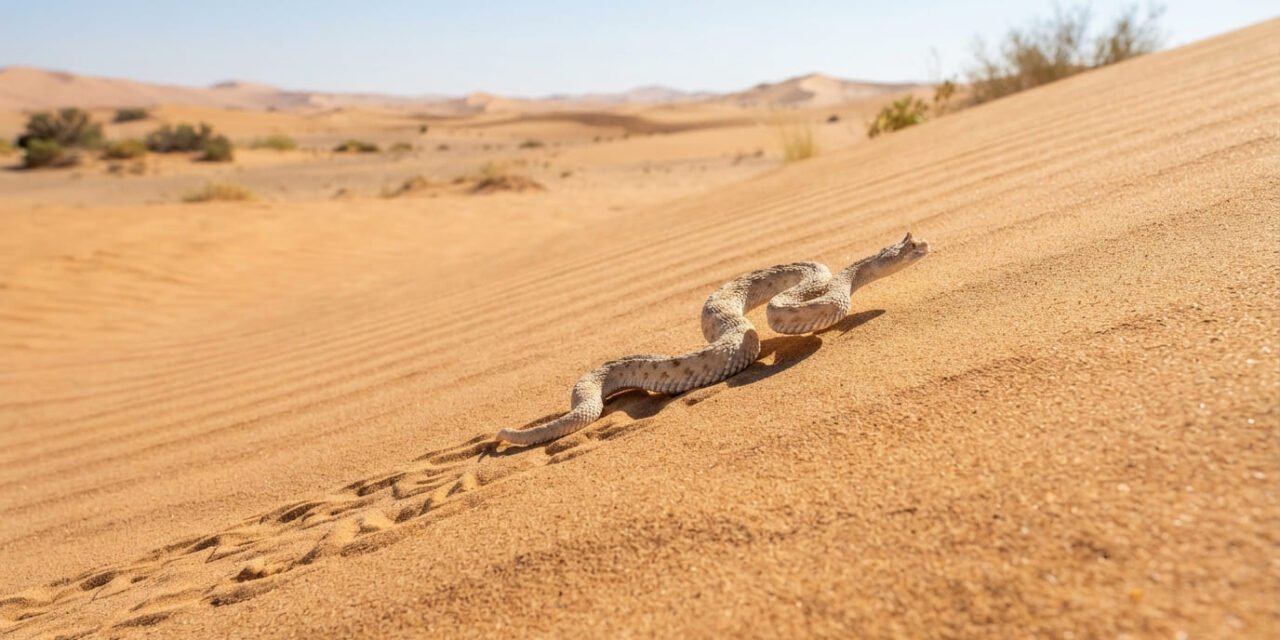
Yet, if you sit quietly near the ridge of a slipface and scan the wind-rippled sand, you might spot a small, subtle shape moving across the crest. It is not running, and it is not slithering straight ahead like a typical snake. Instead, it seems to float across the steep, loose sand in a series of fast, diagonal loops, leaving a neat pattern of parallel S-shaped tracks behind it.
This is Peringuey’s adder (Bitis peringueyi), often called the Namib Desert sidewinding adder. Measuring less than twelve inches in length, this tiny venomous viper holds a unique title in the animal kingdom. It is a true desert specialist that turned the harsh, boiling sand dunes into its personal hunting ground.
Faced with a landscape where the ground is too hot to touch and too loose to push against, this small reptile reinvented how a snake moves, hunts, and breathes.
The Physical Nightmare of Moving on Sand
To appreciate how Peringuey’s adder survives, you first have to look at why normal snake movement fails on a sand dune.
Most snakes rely on a movement called lateral undulation. The snake lays its body flat on the ground and sends S-curves from its head down to its tail. As the body curves, the snake pushes the back edges of its loops against solid objects like rocks, tree roots, or firm soil, propelling itself forward.
This classic technique works wonderfully on a forest floor or a grassy meadow. But on a steep desert dune, lateral undulation becomes a physical nightmare.
First, loose sand offers almost zero traction. When a normal snake tries to push sideways against dry sand grains, the sand simply collapses under the pressure. The snake slips backward, burning a massive amount of energy while barely moving an inch forward. It is the biological equivalent of trying to sprint up a steep hill made of loose ball bearings.
Second, there is the problem of thermal conduction. When a snake slithers in the traditional way, its entire belly skin stays in continuous, scraping contact with the ground. On a 140-degree sand dune, continuous belly contact causes immediate heat transfer. The intense heat from the surface sand would rapidly bake the snake’s internal organs, leading to heat stroke and death within minutes.
Peringuey’s adder needed a way to travel across steep, loose slopes without digging into the sand or burning its skin. Its solution was an aerodynamic and mechanical marvel called sidewinding.
The Mechanics of the Sideway Loop
Sidewinding looks strange when you watch it for the first time. The snake appears to be moving sideways while its head points diagonally toward its destination. It glides across the dunes with a fluid, rolling motion that seems to defy gravity.
For a long time, observers assumed the snake was just wriggling wildly to avoid the heat. But fluid dynamicists and biophysicists who analyzed high-speed video of sidewinding snakes discovered a surprisingly complex physical process.
The snake does not drag its body across the sand at all. Instead, it lifts its body entirely off the ground in sections, using a continuous rolling wave.
Here is how the movement works step by step:
First, the adder lifts its head and front body off the hot sand, throwing them sideways and forward to set down a new firm anchor point.
Second, once the front section touches the sand, the snake transfers its weight onto that single point. It then peels the rest of its body off the ground, lifting its middle section and tail through the air and rolling them forward to match the new position.
Third, while the rear half of the body is rolling forward, the head is already lifting up again to launch the next sideways loop.
Because of this constant lifting and rolling motion, only two small points of the snake’s body ever touch the sand at any given millisecond. The rest of its frame is suspended safely in the cool air above the surface.
This short contact time dramatically reduces heat transfer. The snake touches the boiling sand for such a brief fraction of a second that its skin never has time to absorb dangerous amounts of heat. By rolling over the surface rather than dragging through it, Peringuey’s adder keeps its body temperature manageable while crossing ground that would kill almost any other reptile.
The Secret of Vertical Force
Sidewinding solves the heat problem, but how does it solve the traction problem on loose sand?
When a normal snake pushes against the ground, it exerts horizontal force. On loose sand, horizontal force causes the grains to shear and collapse, creating a slide.
Sidewinding works because the adder shifts its physics. Instead of pushing horizontally against the sand, Peringuey’s adder applies vertical force straight down onto the sand grains.
When you push down vertically on dry sand, the grains pack together beneath your weight, forming a temporary, solid platform. By applying downward pressure on its two contact points, the adder locks the sand grains in place beneath its body, gaining complete traction without causing a mini-landslide.
This allows the tiny snake to climb up steep, fifty-degree dune slopes with ease. While larger animals struggle, slip, and pant as they try to trek up a slipface, Peringuey’s adder glides straight up the ridge without slipping a single inch backward.
Top-Mounted Eyes and the Submarine Ambush
Lifting your body off hot sand gets you across the desert, but it does not get you a meal. Finding food on open sand dunes presents another major challenge.
Because there are no rocks or bushes to hide behind on the open dunes, a small snake sitting on top of the sand would be easily spotted by sharp-eyed hawks, jackals, or crows. At the same time, any small lizard walking past would see the snake from yards away and run to safety.
Peringuey’s adder solved the concealment problem by turning the loose sand into its ultimate camouflage. It buries itself completely beneath the surface film.
If you look closely at the head of a typical viper, its eyes sit on the sides of its face, pointing outward toward the horizon. Peringuey’s adder has a unique skull structure where its eyes are positioned near the very top of its head, pointing straight up toward the sky.
When the adder decides to hunt, it chooses a spot near the crest of a dune where lizards frequently travel. It coils its body into a flat spiral, flattens its ribs, and begins a fast, shimmying motion. Within three seconds, the snake’s entire body sinks beneath the soft sand.
Because its eyes sit high on top of its skull, the adder can submerge ninety-nine percent of its body while leaving only its tiny, pale blue eyes sticking out above the sand line. It looks like a submerged submarine sticking its periscope out of the water.
From two feet away, the buried adder is completely invisible. The sand covers its back, belly, and tail, keeping it cool in the sub-surface shade while hiding its shape from flying predators.
The Wiggling Tail Lure
Sitting buried in the sand with your eyes poking out lets you watch the world, but you still need to pull prey within striking range. Peringuey’s adder has a specialized tool built right into the tip of its tail.
The very end of the adder’s tail is dark brown or black, contrasting sharply with the pale, tan-colored scales on the rest of its body.
When a desert lizard, like a sand-diving lizard or a shovel-snouted lizard, walks past the buried snake, the adder initiates its trap. It keeps its body still under the sand, lifts the dark tip of its tail just above the surface, and begins to wiggle it back and forth in rhythmic twitches.
To a hungry lizard scanning the sand for a snack, the dark, wiggling tail tip looks exactly like a fat beetle larva or an injured insect struggling in the heat.
The lizard falls for the trick. It leaves its safe spot, locks its eyes on the wiggling shape, and trots directly toward the hidden trap. As soon as the unsuspecting lizard steps within three inches of the buried head, the adder launches its attack.
The snake erupts from beneath the sand in a fraction of a second. It clamps its sharp, hollow fangs into the lizard, injecting a fast-acting venom that paralyzes the prey before it can kick or bite back. Within seconds, the struggle is over, and the adder swallows its meal headfirst before burying itself back under the sand to digest in peace.
Harvesting Fog in a Rainless World
Living in the Namib Desert means dealing with another constant threat: the complete absence of fresh drinking water. Parts of the Namib receive less than half an inch of rain per year, and some areas go years without a single rainstorm.
How does a small viper keep from dying of thirst in a waterless wilderness? The answer comes from the ocean.
The Namib Desert sits right along the Atlantic coast of southwestern Africa. Cold ocean currents running along the coast collide with the warm air of the desert, creating thick banks of sea fog that blow across the sand dunes during the night and early morning.
Peringuey’s adder has learned to harvest this floating fog.
During fog mornings, the adder leaves its underground resting spot and coils its body tightly on top of a dune ridge. It flattens its torso out into a wide, shallow dish. As the cool fog rolls over the dunes, tiny water droplets condense on the snake’s smooth, water-repellent scales.
The moisture gathers into larger drops of clear water, pooling along the folds of the snake’s flattened back. The adder simply turns its head inward and licks the fresh water droplets off its own skin. It is a biological rainwater collection system built directly into its body armor, allowing the snake to thrive for months without ever seeing a river or a rain cloud.
Lessons for Human Technology and Engineering
You should care about Peringuey’s adder because its unique way of moving across soft ground is helping human engineers solve complex mechanical problems on Earth and on other planets.
Designing wheeled or legged robots that can navigate soft sand, loose gravel, or deep mud has always been a major challenge for roboticists. Space rovers sent to explore Mars or the Moon frequently get stuck in loose dust, spinning their wheels helplessly until their batteries drain out.
By studying the precise angles, vertical forces, and rolling wave motions of sidewinding snakes, engineers at leading robotics laboratories have built snake-like exploration robots.
These bio-inspired machines do not use wheels or traditional legs. Instead, they replicate the exact sidewinding motion of Peringuey’s adder. By applying vertical pressure to pack the dust beneath their joints, these snake robots can climb steep, sandy inclines that would easily trap a wheeled rover.
These flexible machines are also being tested for earthbound search-and-rescue missions. In the aftermath of an earthquake or a landslide, a sidewinding robot can crawl over unstable piles of rubble, loose dirt, and collapsed walls without triggering further cave-ins, helping first responders locate survivors in tight, hazardous spaces.
A Quiet Master of the High Dunes
Peringuey’s adder is a wonderful reminder that nature does not always require massive size or heavy armor to dominate an environment. It is an animal no longer than a paper pencil, living in one of the hottest, driest, and most unstable habitats on Earth.
It did not try to fight the desert; it adapted to it. It learned to roll across boiling sand without getting burned, hide beneath the surface with top-mounted eyes, harvest its drinking water from the morning mist, and turn its tail into a meal-ticket lure.
The next time you look at a photograph of vast, empty desert dunes stretching out under a scorching sun, remember the tiny sand glider resting just beneath the surface. It is a quiet, beautiful performer living on the edge of the world, proving that with the right physical tricks, even the hottest sand can become a safe place to call home.