Imagine standing beneath the towering canopy of an ancient tropical rainforest in Southeast Asia or Sub-Saharan Africa. The air is thick with humidity, and the sound of buzzing cicadas fills the warm air. High up in the trunk of a massive old-growth tree, fifty feet above the ground, you notice a natural hollow in the wood.
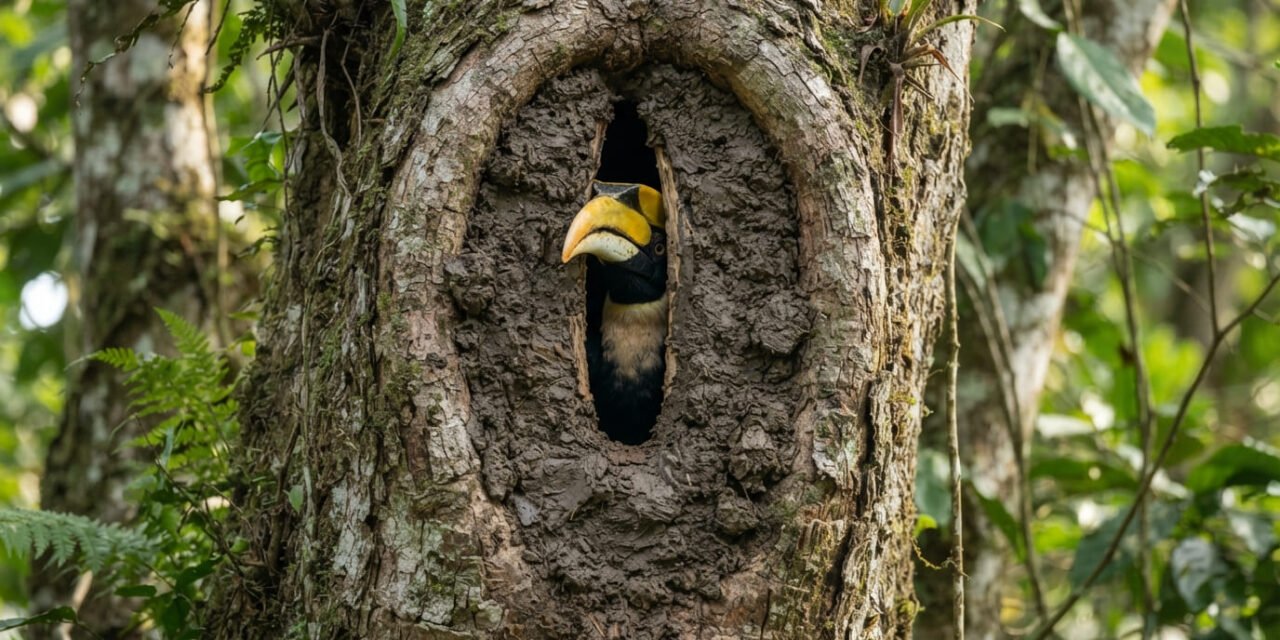
If you watch that hollow carefully through binoculars, you will see something that looks completely backwards to anyone who knows basic bird behavior. A large, colorful female hornbill climbs inside the dark opening. But instead of sitting down on an open nest of leaves and twigs, she turns around, grabs a mixture of mud, fruit pulp, and forest soil, and begins to plaster the entrance shut from the inside.
She does not stop until the hole is completely walled over. She leaves only a tiny, vertical slit less than an inch wide open to the outside world.
For the next two to four months, she will remain locked inside this dark, cramped wooden chamber. She cannot fly. She cannot search for food. She cannot even stretch her wings. She relies entirely on her mate to keep her and her growing chicks alive by passing fruit and small animals through that tiny slot.
This is the breeding strategy of the hornbill (Bucerotidae). It is one of the most extreme, high-stakes nesting behaviors in the entire animal kingdom, turning a simple tree cavity into a living, sealed fortress.
The High Price of Rainforest Parenting
To understand why a female bird would willingly wall herself inside a dark tree trunk, you first have to look at how dangerous the rainforest can be for a mother and her eggs.
Tropical forests are full of hungry predators. Large tree snakes, monitor lizards, civets, monkeys, and birds of prey are constantly searching the branches for nests. A typical open bird nest, built out of twigs on a branch, is extremely vulnerable. A climbing lizard can easily eat an entire clutch of eggs in a few minutes while the parents are away looking for food.
Even natural tree hollows offer limited protection. If the entrance is wide enough for a hornbill to walk through, it is also wide enough for a large monitor lizard or a python to slide inside.
Most birds solve this problem by staying near the nest, aggressively screaming at intruders, or trying to fight off predators with their beaks. But a fight high in a tree canopy is risky, and a large lizard can often overpower a nesting bird.
The hornbill decided to eliminate the physical fight entirely. Instead of fighting off intruders at the front door, the female simply removes the front door. By building a thick, solid wall across the opening, she creates a barrier that almost no predator can break through.
The Materials of the Wall
Building a strong, durable wall inside a damp tree trunk requires the right mix of materials. The female hornbill cannot just grab a pile of dry dirt; the wall needs to set hard, like natural concrete, so it does not collapse under rain or humidity.
The construction process is a cooperative effort between the male and the female, though the female does all the interior masonry.
First, the male flies around the surrounding forest gathering raw materials. He collects wet mud from stream banks, swallows wild fruits, and gathers bits of decaying wood, bark, and dirt. He carries these items back to the nest in his beak or swallows them to bring up later.
He lands on a branch near the tree hollow and passes these building supplies to the female through the open hole.
Inside the dark chamber, the female gets to work. She mixes the mud and wood bits with her own droppings and sticky, regurgitated fruit pulp. This mixture creates a natural, biological mortar. The sticky fruit sugars act like a binder, holding the mud and wood fibers together as the compound dries.
Using the flat side of her large, curved bill like a mason’s trowel, she spatters the wet mud against the edges of the tree hole. She works methodically, building the wall up from the bottom and down from the top.
Over the course of several days, the opening shrinks. As the gap closes, the female stays inside, continuing to plaster the wet mud until only a narrow, vertical slit remains.
Once the mud dries in the warm forest air, it hardens into a tough, stone-like barrier that is nearly impossible for a climbing predator to scratch or pry open.
The Feeding Slit: A Lifeline in the Dark
The finished wall leaves an opening that is barely half an inch to an inch wide and a few inches long. It is just wide enough for the tip of the female’s bill to stick out, but far too narrow for a snake’s head, a monkey’s paw, or a lizard’s snout to enter.
This narrow slot becomes the family’s sole connection to the outside world.
Through this slit, the female receives all of her food, gets fresh air, and disposes of nest waste. She maintains strict cleanliness inside the cramped space by pointing her rear end toward the slit and squirting liquid droppings far out into the forest air, keeping the interior of the box clean and dry.
Because she cannot leave, her survival and the survival of her eggs depend entirely on her mate.
The male hornbill becomes a full-time delivery worker. From dawn until dusk, he flies across miles of rainforest searching for high-energy food. Hornbills are major fruit eaters, especially fond of wild figs, which provide vital moisture and natural sugars. But the growing female and her chicks also need protein. The male hunts for grasshoppers, beetles, scorpions, lizards, tree frogs, and even small birds.
When the male returns to the nest tree, he perches on the outside wall. He regurgitates fruits one by one or passes small prey items through the slit directly into the female’s open beak.
In some larger hornbill species, like the Great Hornbill, the male can carry dozens of wild figs in his throat at a single time, popping them up into his mouth and delivering them to his partner like a feathered vending machine.
The Ultimate Vulnerability: Total Molt
While the protective wall keeps predators out, it also forces the female into a state of absolute, terrifying vulnerability.
Shortly after the entrance is sealed and she lays her eggs, the female undergoes a process called a complete molt. In most birds, feathers fall out and regrow slowly over several weeks, a few at a time, so the bird never loses its ability to fly.
The female hornbill inside the sealed hollow sheds all of her primary wing and tail feathers all at once.
Within a few days, she loses every single feather needed for flight. She becomes completely featherless and flightless, sitting on her eggs in her bare skin.
This total molt makes biological sense inside the narrow space. Large, stiff wing feathers would get bent, tattered, and ruined inside a cramped wooden box. By shedding them all at once while she is trapped anyway, she grows a fresh, perfect set of new feathers just in time for the day she finally emerges.
However, this means there is no plan B. If a storm knocks the tree down, or if the male is killed by an eagle or a hunter while out foraging, the female cannot break out and fly away to save herself. She is entirely dependent on her partner’s loyalty and health. If the male dies, the female and her chicks will starve inside their wooden tomb.
The Double-Lock Strategy
After several weeks of incubation, the eggs hatch into tiny, featherless chicks. The workload for the male doubles instantly. He must now bring enough food to keep himself, his recovering mate, and several rapidly growing chicks alive.
Eventually, the chicks grow so large that the small tree chamber becomes completely overcrowded. There is simply no longer enough room inside the box for the mother, the growing chicks, and the accumulating food.
This is when the family executes a remarkable, two-stage breakout.
Using her bill, the mother bird begins to hammer against the hardened mud wall from the inside. She chips away at the dry mortar until the barrier crumbles. Having fully regrown her flight feathers, she squeezes out of the hole for the first time in months, stretching her wings and taking to the air.
You might think that once the mother exits, the chicks are left exposed to predators. But the hornbill family has a second trick.
As soon as the mother steps out, the older chicks inside the nest immediately go to work. Using the leftover dried mud and their own droppings inside the nest, the chicks rebuild the wall from the inside all over again.
Within hours, the chicks have sealed themselves back into the hollow, leaving the exact same narrow feeding slit. For the remaining few weeks until they are fully grown, both the mother and the father fly around the forest together, bringing food to the re-sealed chicks until they are large enough to break the wall down for good and fly out into the wild.
Architects and Gardeners of the Forest
You should care about the hornbill’s wild nesting behavior because these birds are vital engineers for the health of tropical forests.
Hornbills are often called the “farmers of the forest.” Because they eat massive amounts of wild fruits and travel long distances every day to feed their walled-in families, they disperse the seeds of large rainforest trees over miles of terrain. Many species of large canopy trees rely almost entirely on hornbills to carry their seeds away from the parent tree so new saplings can grow.
If hornbills disappear from a forest, many large tree species fail to reproduce, causing the entire forest structure to break down over time.
Furthermore, their need for large nesting hollows makes them sensitive indicators of forest health. Hornbills cannot dig their own holes in solid wood; they rely on ancient, giant trees that have developed natural hollows over decades or centuries.
When old-growth forests are logged or cleared for agricultural fields, these giant nesting trees disappear. Without large, mature trees to build their sealed fortresses, hornbills cannot breed, causing populations to drop rapidly.
A Legacy of Complete Trust
The nesting behavior of the hornbill is a wonderful reminder of how creative and extreme natural adaptation can be. It is a story of total commitment, physical transformation, and complete trust between two animals.
It took a standard problem—keeping eggs safe from predators—and solved it by turning a tree cavity into a sealed vault. The male works himself to exhaustion flying miles every day to deliver food, while the female surrenders her ability to fly and relies entirely on her mate’s return.
The next time you see a photograph of a colorful hornbill flying over a tropical forest canopy, remember the quiet drama happening inside the old-growth trees below. High above the forest floor, behind a thick wall of dried mud and fruit, a quiet mother is sitting in the dark, proving that with enough trust and a clever wall, even the most dangerous jungle can become a safe place to raise a family.