If you spent your afternoon hiding 30,000 individual pennies across 15 square miles of rugged mountain terrain, you would likely lose most of them by sunset. You might remember a few spots near a distinctive rock or a specific tree. But if your life depended on finding those pennies six months later under three feet of snow, you would be in trouble.
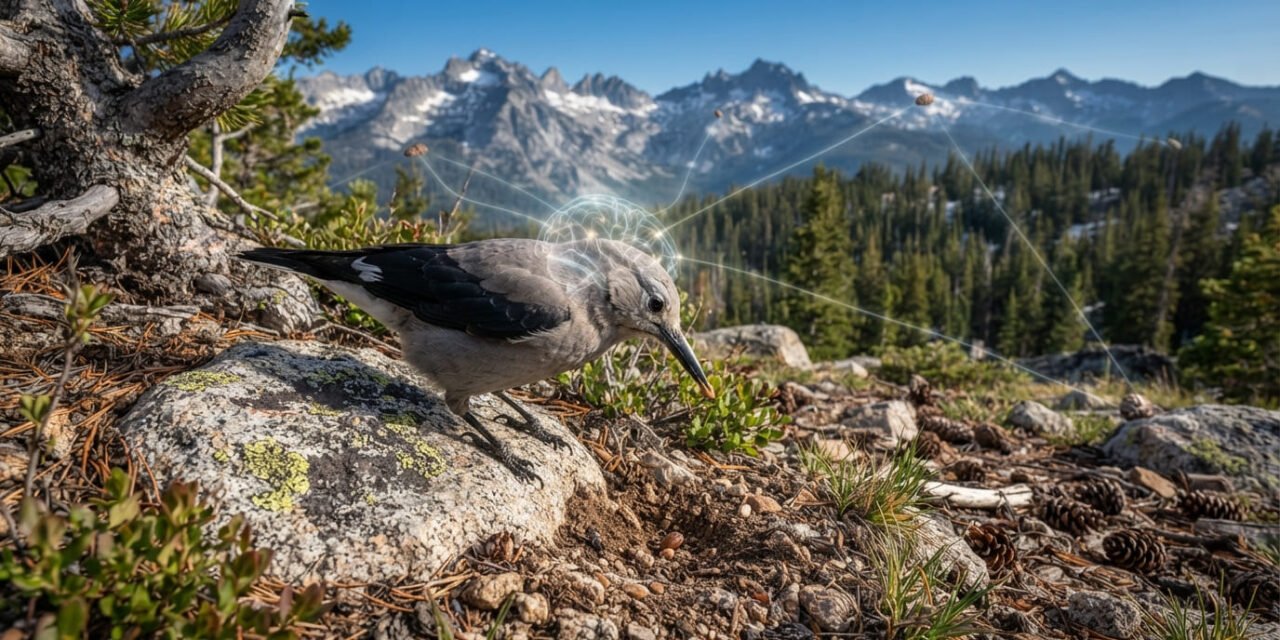
The Clark’s Nutcracker does this every year. This bird lives in the high-elevation forests of the Western United States. It does not migrate to warmer weather when winter hits. Instead, it stays put and relies on a memory that is so precise it makes human recall look amateur.
The Seed Storage Problem
Survival for a bird in the sub-alpine zone is a numbers game. During the late summer and fall, the whitebark pine trees produce a massive amount of high-fat seeds. These seeds are the primary food source for the nutcracker. The bird has a specialized pouch under its tongue that can hold up to 90 seeds at a time.
A single nutcracker spends its entire fall harvesting these seeds. It flies from the trees to various spots across the mountainside. It digs a small hole in the dirt, drops in a cluster of about five seeds, and covers them up. By the time winter arrives, one bird has created thousands of these “caches.” Scientists have tracked individual birds hiding over 30,000 seeds in a single season.
Remembering the Map
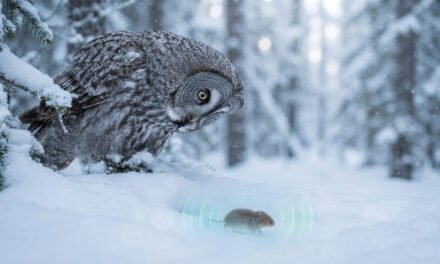
When January hits, and the mountains are buried in snow, the nutcracker has to find those seeds. It does not have a sense of smell that can penetrate deep snow. It cannot see the dirt where it buried the food. It has to remember the exact location relative to distant landmarks.
The bird uses a method called “spatial memory.” It triangulates the position of each cache by looking at large, permanent objects like boulders, fallen logs, or specific cliffs. It remembers the angles and distances from these objects. Even when the landscape changes because of heavy snow, the bird can pinpoint its storage spots within a few centimeters.
This is not a guess. They find about 80% of the seeds they bury. The remaining 20% are not usually forgotten; they are often stolen by rodents or left to grow into new trees. This bird is actually the primary reason whitebark pine forests exist. The trees provide the food, and the birds act as the forest’s mobile planting crew.
A Brain That Actually Grows
The most impressive part of this story is not just the memory itself, but what happens inside the bird’s head. Humans have a part of the brain called the hippocampus, which handles navigation and memory. Birds have a similar structure.
In the fall, when the nutcracker starts caching seeds, its hippocampus actually grows. New neurons are created to handle the massive influx of data. The brain physically expands to make room for the map of 30,000 locations. Once winter is over and the bird no longer needs that specific data, the hippocampus shrinks back down.
This is a biological adaptation that allows the bird to be a specialist. It carries around a high-definition map for six months and then deletes the file when the spring brings new food sources like insects and berries.
Social Intelligence and Theft
The nutcracker is part of the corvid family, which includes crows and jays. These birds are known for being suspicious. Because they all hide seeds in the same general areas, they often watch each other.
If a nutcracker notices another bird watching it while it buries seeds, it will often wait for the observer to leave and then move the seeds to a new spot. They understand the concept of being watched. They know that other birds have the same memory skills they do. This shows a level of “theory of mind”—the ability to understand what another individual is thinking or seeing.
They also recognize individual birds in their social group. They know who the “thieves” are and will be more careful around them. This social awareness helps them manage their resources in a community where everyone is looking for an easy meal.
Why This Matters to You
You might think a bird’s memory is just a neat nature fact. However, researchers study the Clark’s Nutcracker to understand how memory works in humans. The way their brain cells regenerate and store spatial data provides clues for treating memory loss or neurological issues in people.
The nutcracker also shows us how specific an animal must be to survive. There is no room for error. If the bird forgets 50% of its seeds instead of 20%, it dies. It is a high-stakes game of mental gymnastics played out in the cold every day.
The Forest Connection
The relationship between the bird and the tree is a perfect loop. The whitebark pine seeds are heavy and do not have “wings” like maple seeds to catch the wind. They fall straight to the ground. Without the nutcracker, the seeds would just pile up under the parent tree and die.
The nutcracker carries the seeds up to several miles away and often buries them in areas where the soil has been disturbed by fire. This gives the seeds the perfect environment to sprout. The bird is the architect of the high-mountain ecosystem. If the nutcracker disappeared, the forest would eventually stop regenerating.
Dealing with Change
Today, these birds face a new challenge. Whitebark pines are dying due to a fungus called blister rust and attacks from bark beetles. When the trees die, the nutcrackers have to travel further to find food.
If the distance between the food source and the caching site becomes too large, the energy cost of the trip is too high. The bird might decide to abandon the area entirely. We are seeing nutcrackers show up in places they don’t belong because their home forests are failing. When the bird leaves, the chance for the forest to grow back drops to zero.
Observing the Nutcracker
If you go hiking in the mountains of the West, listen for a harsh, grating “kraa-kraa” sound. That is the nutcracker. You will often see them on the very top of a pine tree, scanning the area. They are not just looking for predators; they are constantly updating their mental map.
They are bold birds. They might even fly near your campsite to see if you have anything worth caching. But unlike a seagull that just wants a handout, the nutcracker is a planner. It is always thinking about the next six months.
Final Thoughts
The Clark’s Nutcracker is a specialist in a world that often rewards generalists. It has one job, and it does it better than almost any other creature. It reminds us that memory is a physical tool. It is something the body builds and maintains to meet a specific need.
The next time you lose your car keys or forget a name, remember the nutcracker. It is out there in a blizzard, landing on a patch of white snow that looks like every other patch of snow, and digging exactly where it left five seeds in October. It is a master of its environment because it refuses to forget.
We share the planet with creatures that have abilities we can barely explain. The nutcracker is a small, grey bird that carries a massive, invisible library in its head. As long as it keeps its map, the high-mountain forests have a future. Our job is to make sure those trees stay healthy enough to keep the nutcracker’s memory full.