If you take a walk through a tropical forest in Central or South America during the day, you will likely encounter a massive variety of stinging insects. The sunlight brings out the foragers, the hunters, and the builders. You expect to see wasps darting through the hot, humid air, constantly searching for caterpillars or nectar.
But when the sun finally sets, and the jungle goes completely dark, you assume the danger from stinging insects is mostly over. The vast majority of social wasps are strictly diurnal. They retreat to their nests at dusk, relying on the warmth of the sun to power their flight muscles and their eyesight to navigate the complex canopy.
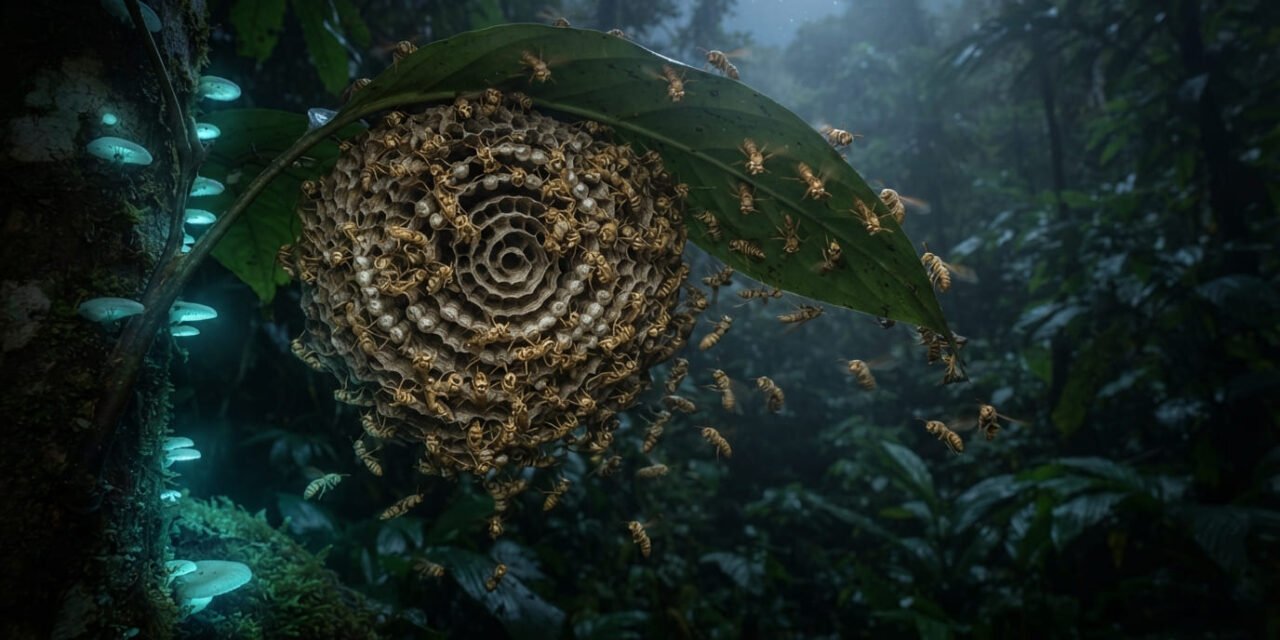
There is, however, one major exception. If you shine a flashlight up into the branches of a tree at midnight in the Amazon basin, you might illuminate something that looks deeply unsettling. You might see a pale, straw-colored paper nest completely covered in hundreds of pale, almost translucent wasps. Their large, unblinking black eyes reflect the beam of your light.
This is Apoica pallens, commonly known as the ghost wasp.
It is a creature that has entirely abandoned the safety and warmth of the daylight to exploit the resources of the night. To understand how they manage to coordinate a complex society in the pitch black of a tropical rainforest, we have to look closely at their bizarre anatomy and their highly aggressive, synchronized defensive tactics.
The Shift to the Night Shift
To appreciate just how unusual Apoica pallens is, you have to understand the basic biology of a typical social wasp.
Most wasps, like the common yellowjackets (Vespula vulgaris) or the European hornet (Vespa crabro), rely heavily on visual cues to hunt and navigate. They need bright sunlight to orient themselves using the polarization of the sky, and they need the sun’s heat to maintain enough energy to fly fast and strike hard. When the temperature drops at night, most wasps become lethargic and basically ground themselves until sunrise.
The ghost wasp completely flipped this script. They belong to a specific subfamily of paper wasps called Polistinae, but they are one of the only genera in that massive group to evolve true nocturnal behavior.
To survive in the dark, they had to undergo some serious physical modifications. Their most striking feature is their eyes. The compound eyes of a ghost wasp are significantly larger relative to their head size than those of a diurnal wasp. These enlarged eyes, called ocelli, are incredibly sensitive to the faintest glimmers of ambient light. They act like biological light amplifiers, capturing the weak moonlight filtering through the canopy and using it to navigate the tangled branches without crashing.
Their coloring is also a distinct product of their lifestyle. Because they do not need to absorb heat from the sun, and because they don’t need bright, contrasting warning colors to ward off daytime predators like birds, their exoskeletons are remarkably pale. They are a dusty, washed-out yellow or a pale cream color. In the harsh beam of a flashlight, they look exactly like small, hovering ghosts.
The Architecture of the Shield
During the day, when the rest of the forest is loud and active, the ghost wasp colony goes entirely dormant. But they do not hide inside a protective, enclosed nest like a hornet.
Apoica pallens builds what is known as an exposed comb nest. They chew up wood fibers and mix them with saliva to create a single, flat, circular disk of hexagonal paper cells. This comb hangs vertically from a branch, usually situated on the underside of a broad leaf or tucked slightly out of the way, but it has no outer paper envelope to protect the larvae inside.
This exposed architecture seems incredibly dangerous. The jungle is packed with ants, predatory beetles, and parasitic flies that would happily devour a comb full of soft, defenseless wasp larvae.
So, how do they protect the babies while they sleep during the day? They use their own bodies.
When the sun comes up, the entire adult population of the colony returns to the nest. Instead of crawling inside, they arrange themselves in a perfectly tight, overlapping formation across the entire surface of the comb. They interlock their legs and their pale bodies, literally building a living, buzzing shield over the exposed cells.
They will sit like this for hours, completely motionless. If a marauding column of army ants, such as Eciton burchellii, happens to cross their branch, the ants won’t find a paper nest. They will just find a solid wall of adult wasps ready to sting. It is a brilliant, highly space-efficient way to protect the next generation without expending the massive amount of energy required to build and maintain a huge, enclosed paper fortress.
The Midnight Hunt
When the sun finally dips below the horizon and the temperature in the forest drops, the living shield begins to break apart. The colony wakes up.
The foraging strategy of Apoica pallens is vastly different from their daytime cousins. A diurnal wasp will usually fly erratically, scanning leaves and flowers for caterpillars or spiders, relying on speed and visual contrast. The ghost wasp, operating in near-total darkness, has to be much more methodical.
They leave the nest in small, coordinated groups. Because their vision, while enhanced, is still limited by the darkness, they rely heavily on chemical trails and scent markers. They fly slowly and deliberately through the understory, using their highly sensitive antennae to pick up the chemical signatures of their prey.
Their primary targets are the soft-bodied insects that also wait for the cover of night to become active. They heavily hunt nocturnal caterpillars, particularly those from the family Noctuidae (the owlet moths). These caterpillars usually hide during the day to avoid birds, emerging at night to aggressively strip the foliage.
When a ghost wasp detects a caterpillar, it doesn’t usually strike with a high-speed dive. It lands softly on the leaf nearby, using the dark to its advantage. It slowly stalks the caterpillar, utilizing its large eyes to track the slow movements of the prey. When it is close enough, it strikes, using its powerful mandibles to immediately sever the head of the caterpillar.
Because a large caterpillar is far too heavy to carry back to the nest whole, the wasp will quickly butcher the prey on the leaf. It chews the soft, protein-rich tissue into a manageable, pulpy ball, tucks it securely under its chin, and flies the meat back to the nest to feed the waiting larvae. They will also hunt nocturnal flies and small spiders, providing a steady stream of protein to the colony while the rest of the wasp world is asleep.
The Swarm Defense
While their hunting tactics are stealthy and deliberate, their defensive tactics are anything but quiet.
Because they are active at night, their primary predators are not birds or diurnal lizards. They have to worry about nocturnal mammals like kinkajous, opossums, and bats. These are large, powerful animals that could easily destroy a fragile paper comb in seconds.
If a large predator bumps the branch where an Apoica pallens nest is hanging, the colony does not send out one or two warning guards like a yellowjacket nest might. They don’t waste time trying to assess the threat. They respond with immediate, overwhelming, synchronized violence.
When the nest is vibrated, the adult wasps instantly break their resting formation. They launch themselves into the dark air by the hundreds. But they don’t just fly randomly. The ghost wasp has evolved a highly specific swarming behavior designed to confuse and repel large mammals.
They immediately target the face and the eyes of the intruder. Because they can see better in the dark than most mammals, they can track the movement of the predator’s head. They swarm in a tight, concentrated cloud, deliberately flying directly into the eyes, nose, and ears of the animal, stinging repeatedly.
The sheer volume of the swarm, combined with the sudden, sharp pain of the venom, is usually enough to send even a hungry opossum tumbling out of the tree in a panic. The wasps will pursue the threat for a short distance before quickly returning to the comb, reforming their living shield before any opportunistic ants can take advantage of the chaos.
The Chemistry of the Night
There is one final, deeply strange aspect to the ghost wasp’s nocturnal existence.
Researchers studying Apoica pallens have noted that the wasps seem to be highly sensitive to the phases of the moon. Their foraging activity spikes dramatically during a full moon, when the ambient light in the forest is highest. During a new moon, when the canopy is pitch black, they often choose to stay on the nest, relying on stored food rather than risking a blind flight through the trees.
Furthermore, they seem to possess a unique chemical communication system. When the colony decides to abandon an old nest and move to a new location, a common occurrence in the tropics, they do not swarm randomly. A few scout wasps will find a new branch, and then they will physically drag their abdomens along the leaves and twigs, leaving a highly specific pheromone trail through the dark forest.
The rest of the colony, which might consist of hundreds of individuals, will then follow this invisible chemical highway through the night, flying in a neat, organized line until they reach the new site and immediately begin constructing a new comb.
When you look at the ghost wasp, you see an animal that looked at the crowded, highly competitive world of daytime predators and simply decided to opt out. They traded the warmth of the sun for enlarged eyes, pale armor, and the ability to hunt by moonlight. In the dense, chaotic environment of the Amazon rainforest, Apoica pallens proves that sometimes the best way to survive the competition is simply to wait until everyone else has gone to sleep.