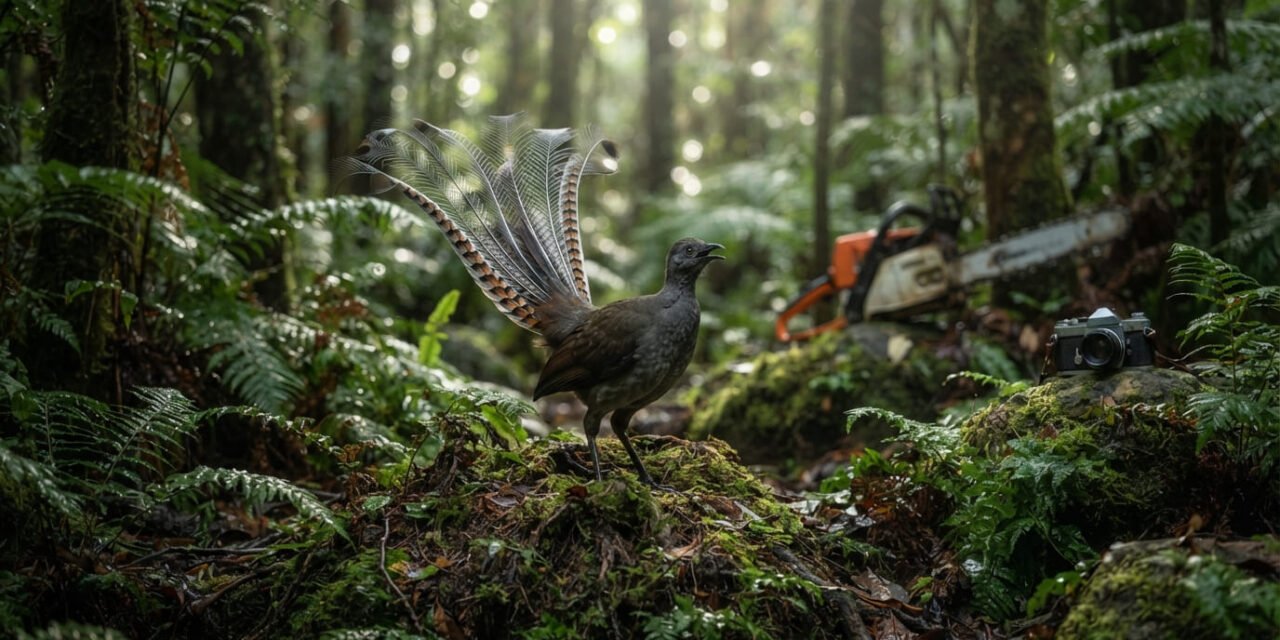
If you go into the deep temperate rainforests of southeastern Australia, you might hear the sound of a construction crew at work. You will hear the mechanical grind of a chainsaw, the sharp click of a camera shutter, or the high-pitched whine of a car alarm. But when you look for the source, you won’t find any humans.
You will find a ground-dwelling bird about the size of a pheasant with a long, ornate tail. The Superb Lyrebird is the world’s most sophisticated acoustic thief. It doesn’t just copy sounds; it clones them with such high fidelity that it can trick other birds and high-end recording equipment.
Most songbirds have a limited repertoire. They learn the songs of their parents and stick to those patterns. The lyrebird has a different strategy. It spends its life absorbing every sound in its environment and incorporating those sounds into a complex, theatrical performance.
This isn’t a random hobby. It is a biological necessity driven by the intense competition for mates. To understand why this bird can mimic a power tool as easily as a forest owl, you have to look at the unique engineering of its throat.
The Most Complex Vocal Organ in the World
The vocal organ of a bird is called the syrinx. In humans, the larynx sits at the top of the windpipe. In birds, the syrinx sits at the bottom, where the windpipe splits into two tubes leading to the lungs. Most songbirds have four pairs of muscles controlling this organ. The Superb Lyrebird has only three pairs, but they are more powerful and flexible than those of any other avian species.
This reduction in muscle count is actually an evolutionary advantage. It allows the bird to control the membranes of the syrinx with extreme precision. The lyrebird can vibrate the left and right sides of its syrinx independently.
It can produce two different pitches at the same time or use one side to create a steady rhythm while the other side sings a melody. This is how it replicates complex, layered sounds like the “chug-chug” of an engine, followed by the metallic screech of a blade hitting wood.
The bird’s brain is also specialized for this task. Large portions of its forebrain are dedicated to acoustic learning and memory. It doesn’t just hear a sound; it analyzes the frequency, the timbre, and the rhythm. It then practices these sounds for hours, fine-tuning its performance until the imitation is perfect. This requires a level of neural plasticity that is rare in the animal kingdom.
The Biological Purpose of Mimicry
Male lyrebirds are the primary mimics. During the breeding season, a male will clear a patch of forest floor to create a “mound.” He stands on this mound and performs for up to four hours a day. He spreads his tail feathers over his head like a silver umbrella and begins his concert. The goal is to impress females.
A female lyrebird chooses a mate based on the complexity and accuracy of his song. A male that can mimic twenty different bird species, along with the sound of a falling tree and a kookaburra’s laugh, demonstrates that he is old enough to have learned these sounds and healthy enough to spend hours singing instead of foraging. The song is a proxy for his fitness. If he can survive in the forest while making a loud, constant noise that attracts predators, he must have superior genes.
The mimicry also serves a defensive purpose. When a predator like a hawk or a fox approaches a lyrebird’s nest, the bird can mimic the alarm calls of multiple other species. This creates the illusion that a large group of angry birds is nearby, which often confuses the predator and causes it to retreat. In some cases, lyrebirds have been observed mimicking the sound of a dingo or a large bird of prey to scare away smaller competitors from a food source.
Chainsaws and Camera Shutters: The Human Influence
The most famous trait of the lyrebird is its ability to copy human-made sounds. In the 1930s, a lyrebird named “James” became a celebrity in Australia for his perfect imitation of a local sawmill. In more recent years, David Attenborough’s film crews recorded lyrebirds in the wild imitating the sounds of their own cameras.
This happens because the lyrebird is a generalist. It doesn’t know the difference between a natural sound and a mechanical one. It only cares about the complexity of the frequency. Chainsaws and camera shutters have sharp, distinct acoustic signatures that are easy for the lyrebird’s syrinx to replicate. As humans encroach further into the Australian bush, the “soundscape” of the forest changes. The birds simply adapt. They are living recorders of the history of their environment. If a forest were logged twenty years ago, the local lyrebirds might still be singing the sounds of the machinery that was used, passing those sounds down to the next generation.
Social Learning and Cultural Evolution
Lyrebirds don’t just learn from their environment; they learn from each other. Young males will often hang around the mounds of older, more experienced males to “eavesdrop” on their repertoire. They pick up the most successful sounds and add them to their own songs. This leads to regional dialects. A group of lyrebirds in one valley might specialize in mimicking black cockatoos, while a group five miles away might focus on the sound of local hikers’ whistles.
This is a form of cultural evolution. The “hit songs” of the lyrebird world change over time. If a specific sound becomes popular with females, more males will learn it, and it will spread through the population. If a sound stops being effective, it is eventually dropped from the playlist. This makes the lyrebird one of the few non-human animals that demonstrates a clear, evolving culture based on vocal communication.
The Physical Toll of Performance
Singing for four hours a day is physically exhausting. It requires a massive amount of oxygen and constant muscle contraction. The lyrebird has a high metabolic rate to support this activity. While it is singing, it is not eating or watching for predators. It is completely focused on performance.
The tail feathers also add to the physical burden. The “lyre” feathers can be nearly thirty inches long. Moving these feathers in sync with the song is a feat of coordination. The bird must maintain a perfect balance between its vocal output and its physical display. If the feathers aren’t moving correctly, the female will lose interest, regardless of how good the song sounds. This multi-sensory performance is why the lyrebird is considered one of the most advanced “performers” in nature.
Why You Should Care
The Superb Lyrebird is more than just a talented mimic. It is a sentinel for the health of the forest. Because it relies on a diverse range of sounds for its survival, a quiet forest is a sign of an ecosystem in trouble. If the birds that the lyrebird mimics disappear due to habitat loss, the lyrebird’s song becomes simpler and less effective.
By studying the lyrebird, we learn about the limits of vocal anatomy and the way animals perceive sound. We also see a clear example of how human activity changes animal behavior. The fact that a bird in the middle of a remote forest is singing the sound of a camera shutter is a direct reflection of our presence in their world. The lyrebird is holding up a mirror to the environment, and sometimes the sounds it reflects to us are our own.
Protecting the Soundscape
The Superb Lyrebird is currently protected, but its habitat is at risk from bushfires and land clearing. In the 2019-2020 Australian fires, large portions of their range were burned. When the forest burns, the “acoustic library” of that area is destroyed. The birds that survive have to find new sounds and new mates in a devastated landscape.
Conservation efforts focus on preserving large, connected tracts of old-growth forest. These areas provide the quiet, stable environment the birds need to develop their complex songs. Without these spaces, the lyrebird’s song will fade, and we will lose one of the most remarkable biological gadgets ever evolved.
Final Thoughts
The Superb Lyrebird is an engineer of sound. It uses a simplified syrinx to create the most complex noises on the planet. It turns the forest into a theater where math, physics, and biology meet. It proves that you don’t need a large brain to be a genius; you just need the right hardware and a reason to sing. The next time you are in the woods and hear something that doesn’t belong, look for the bird with the silver tail. It is likely just playing back a recording of the world it lives in.