If you stand on the forest floor in the dense, humid rainforests of Southeast Asia, perhaps in the ancient jungles of Borneo, Sumatra, or the Philippines, you might feel completely cut off from the sky. The massive Dipterocarp trees tower over a hundred feet high, their broad leaves overlapping to create a thick, green roof that blocks out most of the sunlight.
Down in the shadows, the air is still and heavy. But hundreds of feet above your head, the forest canopy is a completely different world. It is a three-dimensional highway of tangled branches, lianas, and leaves. It is bright, breezy, and packed with life.
Navigating this high-altitude maze is incredibly dangerous. If an animal misses a jump or loses its grip, the resulting fall to the forest floor is almost certainly fatal. Birds and bats solve this problem with powered flight. Monkeys solve it with long limbs and prehensile tails, swinging calculatedly from branch to branch.
But what if you are a lizard? You don’t have feathers, and you certainly don’t have the upper body strength of a gibbon. For the common flying dragon, scientifically known as Draco volans, the solution is as elegant as it is extreme. You simply grow a pair of collapsible wings out of your own ribcage.
The Architecture of a Glider
To understand how a reptile manages to fly, you have to look closely at its skeletal structure. When a Draco volans is just sitting quietly on the trunk of a tree, it doesn’t look like an aerial acrobat at all. It just looks like a very standard, somewhat skinny lizard, usually measuring no more than eight to ten inches long from its nose to the tip of its long, whip-like tail.
Its primary defense is camouflage. The scales of the flying dragon are mottled in dull shades of brown, grey, and olive green. When it presses itself flat against the bark of a mahogany or teak tree, it becomes practically invisible, looking exactly like a patch of rough lichen or a slightly raised knot in the wood.
But hidden beneath that unassuming exterior is a radical evolutionary modification.
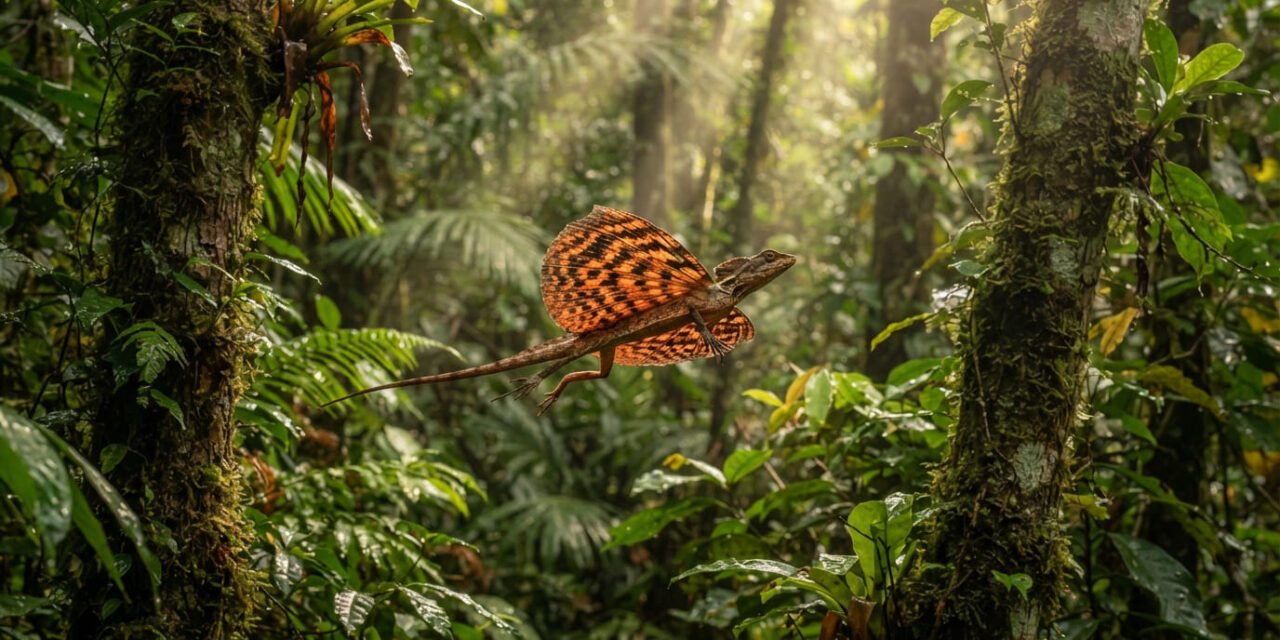
In a human, or a dog, or even a typical iguana, the ribs curve around the chest cavity to protect the heart and lungs. Draco volans took a different path. Several of its ribs are highly elongated. Instead of curving inward to close the chest cavity, these ribs extend straight outward from the sides of its body. Connecting these extended ribs is a thin, highly flexible fold of skin called a patagium.
When the lizard is resting, specialized muscles pull these ribs back against the sides of its body, folding the patagium up tightly, much like a closed umbrella. This allows the lizard to crawl, climb, and squeeze into tight spaces without a pair of delicate wings getting snagged on the rough bark. But when the lizard needs to move quickly, that biological umbrella snaps open.
The Physics of the Leap
Draco volans does not possess powered flight. It cannot stand on a branch and flap its way up into the clouds like a sparrow. It is strictly a glider. But calling it a “glider” almost undersells the incredible aerodynamics involved in its movement.
Imagine a predator, perhaps a highly agile arboreal snake like the twin-barred tree snake (Chrysopelea pelias), spots the lizard and strikes. The lizard doesn’t try to outrun the snake up the trunk. Instead, it throws itself backward into thin air.
For a fraction of a second, the lizard is simply in freefall. But instantly, the muscles in its chest contract. The elongated ribs snap forward and outward, pulling the patagium taut. The lizard instantly transforms from a falling rock into a perfectly tensioned kite.
As the air catches the membrane, the lizard’s descent slows dramatically. It flattens its body out to maximize the surface area. The brightly colored underside of the patagium, often splashed with brilliant yellows, oranges, or vivid blues, suddenly flashes into view.
It doesn’t just drift aimlessly to the ground, either. Draco volans is a highly controlled pilot. By subtly adjusting the angle of its ribs and tilting its long, slender tail, the lizard can steer itself through the air. It can bank sharply to avoid a hanging vine, correct its course if a sudden gust of wind hits the canopy, and accurately target the trunk of a tree up to thirty or even forty meters away.
As it approaches its landing site, the lizard pulls its head and torso up, stalling its forward momentum just like an airplane flaring out before touching down on a runway. It hits the bark feet-first with a soft thud, instantly retracts its ribs, folds away its brightly colored wings, and disappears back into the camouflage of the tree trunk. The entire flight takes only a few seconds, leaving the frustrated snake stuck in the neighboring tree.
Ambush in the Branches
You might assume that an animal capable of leaping between trees would use that mobility to constantly hunt down fast-moving prey. But flying costs energy, and Draco volans prefers to conserve its calories. Instead of chasing food, it lets the food come to it.
The flying dragon is a strict insectivore, and its diet is incredibly specialized. It feeds almost exclusively on canopy-dwelling ants and termites.
A frequent target is the Asian weaver ant, Oecophylla smaragdina. These ants are notoriously aggressive and build massive, complex nests out of living leaves high in the canopy. They travel up and down the tree trunks in long, busy columns.
When a Draco volans is hungry, it simply finds a spot along one of these heavily trafficked ant highways. It positions itself vertically on the bark, usually facing head-down. And then, it waits. It relies entirely on its mottled grey and brown camouflage to hide from the marching insects.
When a weaver ant walks just a little too close, the lizard’s head snaps forward. It grabs the ant with a sticky tongue and swallows it whole. It does this over and over again, casually picking off the passing workers without ever having to move its body. If a column of termites, such as those from the Macrotermes genus, creates a mud tunnel up the side of the tree, the lizard will happily set up camp and break into the tunnel for a soft-bodied, protein-rich meal.
By relying on ambush tactics rather than active pursuit, the flying dragon ensures that the calories it gains from eating tiny insects far outweigh the energy it spends catching them.
Colorful Conversations
Living high in the rainforest canopy presents a serious communication problem. The jungle is incredibly loud. Cicadas scream, monkeys howl, and the wind constantly rustles the broad leaves. Trying to attract a mate or defend a territory using sound is mostly a waste of effort. Furthermore, making noise is a great way to attract the attention of hungry birds of prey.
So, Draco volans relies entirely on a visual language.
Underneath the lizard’s chin is a specialized, fleshy appendage called a gular flag, or a dewlap. In males, this flag is usually quite long and painted in a bright, neon yellow. In females, it is shorter and often a cool, mottled blue.
When a male wants to claim a specific tree as his territory, or if he spots a female he wants to impress, he doesn’t make a sound. Instead, he extends his ribs slightly to show off the bright colors of his patagium, and he rapidly flicks his yellow gular flag in and out.
It looks exactly like a sailor using semaphore flags to send a message across a crowded harbor. The bright yellow flashes vividly against the dark bark of the tree, easily catching the eye of other lizards in the area. If a rival male sees the display, he might flash his own flag in response, leading to a tense, slow-motion standoff where the two lizards circle each other on the bark, fiercely flicking their chins until one decides to fold his wings and glide away in defeat.
The Ground is Lava
For Draco volans, the canopy is a haven. It is where they hunt, sleep, fight, and mate. They are so perfectly adapted to life in the trees that going to the ground is essentially a death sentence. Down in the leaf litter, they are slow, clumsy, and incredibly vulnerable to ground-dwelling predators like monitor lizards or centipedes.
In fact, there is only one reason a flying dragon will ever willingly descend to the forest floor.
When a female Draco volans is ready to lay her eggs, she cannot do it in the canopy. The eggs need the stable temperature and moisture provided by the dirt. She takes a massive risk, diving out of her safe tree and gliding all the way down to the base of the trunk.
She works quickly, using her snout to gouge out a small, shallow hole in the soil. She deposits a clutch of anywhere from two to five small, leathery eggs into the dirt, covers them back up with soil, and immediately scrambles back up the trunk toward the safety of the canopy. She will never see her offspring. When the tiny babies hatch a few weeks later, their instincts immediately drive them upward, climbing straight into the trees before they are eaten.
It is easy to think of flight as a trait reserved strictly for birds, bats, and insects. But Draco volans is a perfect example of nature’s stubborn creativity. Faced with a vertical world where a single slip means death, this tiny reptile simply refused to be grounded. It turned its own ribs into a parachute, learned to steer with its tail, and claimed the open air of the jungle as its own personal highway.