If you are trekking through the dense, humid rainforests of Central Africa, perhaps navigating the thick vegetation of the Democratic Republic of the Congo or the western edges of Uganda, you have to watch where you put your hands. The rainforest canopy is a chaotic tangle of lianas, broad leaves, and moss-covered branches. It is an environment where almost everything is fighting for a sliver of sunlight, and everything seems to be colored in endless, repeating shades of green and brown.
In this chaotic environment, camouflage is everything. But one resident of these forests takes the concept of blending in to an entirely different, almost mythical level.
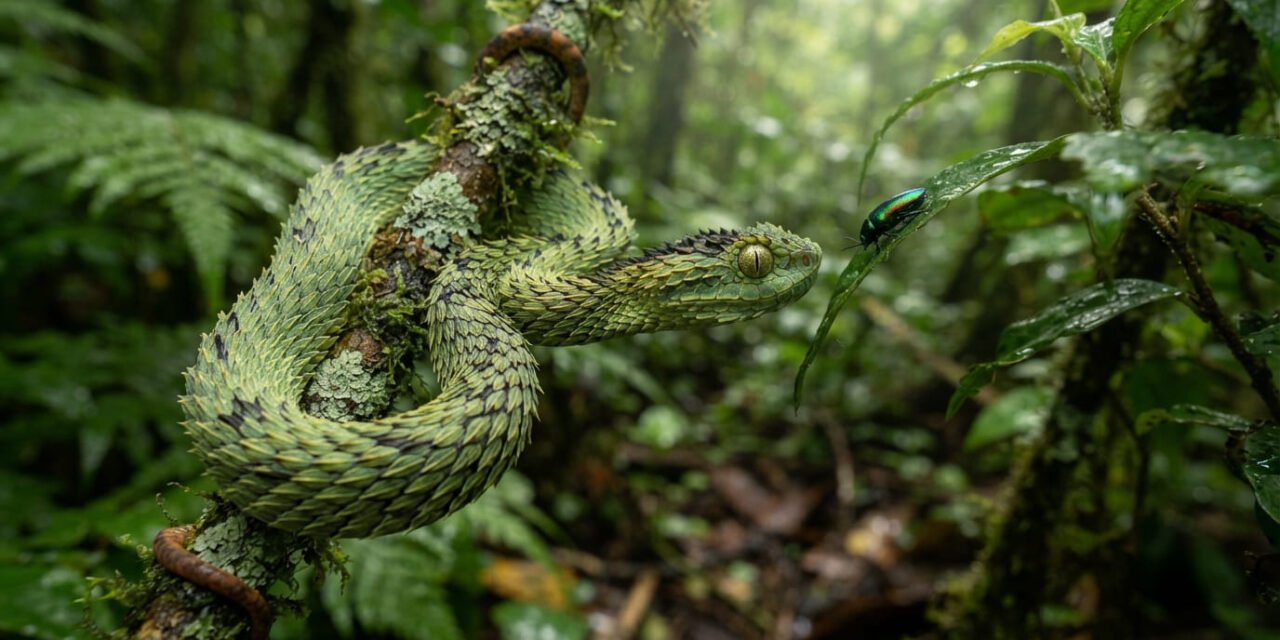
If you were to stare directly at a branch where an Atheris hispida was resting, there is a very good chance you wouldn’t see a snake at all. You would just see a cluster of dried, bristly leaves, or maybe a patch of aggressively spiky moss. Commonly known as the spiny bush viper, or sometimes the rough-scaled bush viper, this snake looks less like a reptile and more like a small, angry dragon that has been intricately carved out of forest debris.
It is a stunning, bizarre animal. But those heavily textured, spiky scales aren’t just for show. They are the core component of a highly specialized, remarkably patient ambush strategy designed to catch prey in a forest where every meal is constantly on the move.
A Suit of Bristling Armor
To understand how the spiny bush viper hunts, you first have to look closely at its ridiculous, bristling skin.
Most snakes, especially those that spend their lives climbing in trees, have scales that are smooth and flat. If you think about a typical tree boa or a green mamba, their scales overlap perfectly, creating a sleek, streamlined surface that allows them to glide effortlessly over bark and leaves without snagging.
Atheris hispida went in the exact opposite evolutionary direction. Its scales are heavily keeled. A “keel” is a raised ridge running down the center of a scale, but on this particular viper, the keels are elongated and exaggerated to an extreme degree. They project outward and upward from the snake’s body, giving it a bristly, rough, and almost furry appearance. Even the scales on its head stand up like tiny, stiff horns.
This bristling armor provides two distinct advantages in the rainforest.
First, it completely shatters the snake’s outline. Predators and prey alike are hardwired to look for specific shapes. When a bird or a small mammal scans the trees, its brain is looking for the long, smooth, cylindrical shape of a snake. The spiny scales of Atheris hispida break up that recognizable cylinder. The rough texture creates irregular shadows, making the snake look exactly like a broken, mossy twig or a cluster of dead ferns. Even their coloring, which ranges from bright yellowish-green to deep olive or rusty brown, perfectly mimics the shifting, dappled light of the canopy.
Second, the rough scales might provide a tactile advantage. While the rainforest is humid, the bark of the trees and the tough vines can be slick with frequent rain. The spiky, heavily textured belly and side scales of the viper give it an incredible amount of grip. It doesn’t glide quickly like a mamba; it anchors itself firmly, moving with deliberate, slow precision.
The Patient Sniper
Because the spiny bush viper has traded smooth aerodynamics for spiky camouflage, it is not a fast-moving snake. It cannot chase down a fleeing lizard, and it certainly isn’t going to win a footrace against a panicked rodent.
Instead, it relies entirely on extreme patience. It is an ambush predator, a biological sniper that finds a good vantage point and simply waits for dinner to deliver itself.
When the sun begins to set, and the nocturnal activity of the forest picks up, the viper climbs into the lower shrubs and small trees. It rarely goes higher than ten feet off the ground, preferring the thick, tangled understory where smaller animals frequently travel. It finds a thin branch, often choosing a spot near a heavily trafficked rodent run or a flowering plant that attracts tree frogs.
The viper then uses its prehensile tail. It wraps the tip of its tail tightly around the branch, anchoring itself securely. It then coils the rest of its body into a tight, spring-loaded S-shape, resting its bristling, triangular head on top of its coils.
And then, it just stops moving. It can sit perfectly still in this striking position for hours, sometimes even days, completely blending into the foliage. It relies on its highly sensitive eyes and the heat-sensing pits located near its snout to detect the microscopic shifts in temperature and movement caused by approaching prey.
The Lightning Strike
While the viper’s overall movement is slow and deliberate, its strike is anything but.
When a meal finally wanders too close, the ambush is triggered. A common target for the spiny bush viper is the African woodland mouse, from the genus Grammomys, which frequently climbs through the lower branches at night searching for seeds and fruits. They also heavily target various species of African reed frogs from the genus Hyperolius, which are active in the damp understory.
When a Grammy’s mouse pauses on a branch just a few inches away, the viper doesn’t hesitate. The tight, S-shaped coil of its body acts exactly like a compressed metal spring. In a fraction of a second, it launches its upper body forward.
Because it is a viper, it possesses long, hollow fangs located at the front of its mouth. When its mouth is closed, these fangs are hinged and fold flat against the roof of its mouth. But the moment the snake opens its jaws to strike, the fangs snap forward, locking into a vertical, stabbing position.
The strike is so fast that it is almost a blur. The fangs puncture the mouse, injecting a highly potent, hemotoxic venom directly into the prey’s bloodstream, and then the snake immediately pulls back.
This quick release is a crucial survival tactic for an arboreal snake. If the viper were to hold onto a struggling, panicked mouse, the rodent’s thrashing could easily knock the snake off the branch, sending them both tumbling to the forest floor, where larger predators might be waiting. By biting and releasing instantly, the viper stays anchored and safe.
The Chemistry of Hemotoxin
Once the bite is delivered, the viper simply resets its coils and waits again. It doesn’t need to chase the mouse, because the venom does all the work.
The venom of Atheris hispida is primarily hemotoxic, meaning it attacks the blood and tissues of the victim. When the venom enters the mouse’s system, it causes massive internal hemorrhaging and destroys the red blood cells. It also contains enzymes that immediately begin to break down the cellular walls of the muscle tissue, essentially starting the digestion process before the snake even swallows its meal.
For a small rodent or a Hyperolius frog, the venom is overwhelmingly fast. The animal usually only makes it a few feet down the branch before it succumbs to the toxins and dies.
Once the prey is dead, the viper uses its flicking, forked tongue to pick up the specific chemical scent trail left by the dying animal. It slowly, deliberately uncoils and follows the scent directly to the carcass. Because the venom has already started breaking down the tissues from the inside out, the viper can easily swallow the meal whole, using the flexible ligaments in its jaws to wrap its mouth over the animal.
A Beautiful, Dangerous Mystery
Despite their incredible appearance and fascinating hunting strategies, we actually know surprisingly little about the day-to-day lives of the spiny bush viper in the wild.
Because they live in some of the most remote, dense, and politically unstable regions of Central Africa, studying them in their natural habitat is incredibly difficult. They are solitary, secretive creatures that spend their entire lives trying not to be seen.
Furthermore, while we know their venom is highly effective against small rodents and frogs, its specific effects on humans are still somewhat of a mystery. Because they live far away from major human settlements and rarely leave the trees, bites are exceptionally rare. However, there is currently no specific antivenom manufactured for Atheris hispida. The few recorded bites on humans have resulted in severe pain, swelling, and blood-clotting issues, proving that this tiny, bristly dragon commands serious respect.
When you look at a photograph of a spiny bush viper, it is easy to assume it is a creature out of a fantasy movie. But out in the humid, chaotic undergrowth of the Congo, there is no magic involved. It is simply a masterclass in highly specific evolution. It is an animal that abandoned speed and sleekness, choosing instead to grow a suit of spiky camouflage, anchor itself to a branch, and wait in the shadows with a pair of hypodermic fangs. It is a brilliant reminder that sometimes, the deadliest hunters in the forest are the ones that look exactly like a pile of dead leaves.