Imagine hiking along the jagged, wind-whipped ridges of the Pyrenees or the high Himalayas. The air is dangerously thin. The temperature hovers near freezing, and the wind constantly threatens to push you off balance. Suddenly, a massive shadow glides silently over the granite path ahead of you. You look up, expecting to see a golden eagle riding the thermal drafts.
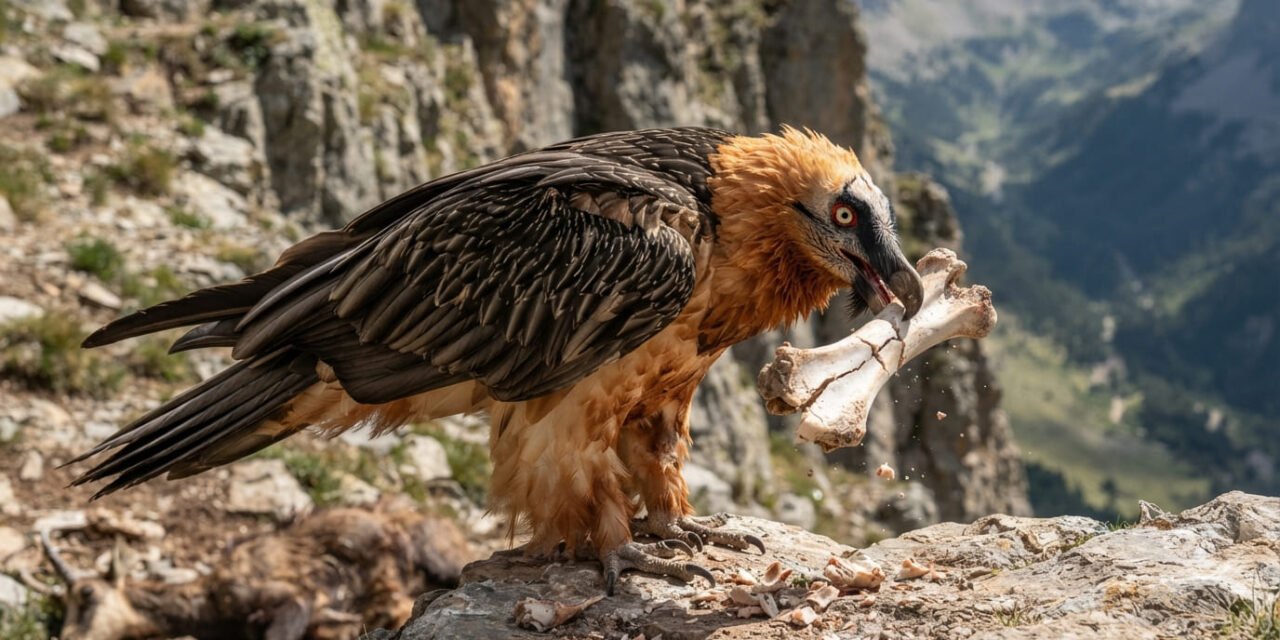
Instead, you see something that looks like it belongs in a high-fantasy novel. It is a bird with a nearly ten-foot wingspan. It has piercing yellow eyes surrounded by striking, blood-red rings. A tuft of stiff, bristly black feathers hangs sharply from its chin like a goatee. Its chest and underbelly are a vibrant, rusty orange.
This is Gypaetus barbatus, commonly known as the bearded vulture.
If you know anything about vultures, you probably picture a bald bird huddled over a rotting carcass, covered in gore. The bearded vulture shatters that stereotype entirely. It doesn’t have a bald head because it doesn’t need to plunge its neck into the messy, bloody viscera of a dead animal. In fact, by the time the bearded vulture arrives at a carcass, there is usually no meat left at all.
This bird is the absolute final cleanup crew of the high mountains. It survives on a diet that would fatally puncture the digestive tract of almost any other animal on Earth. It eats solid bone.
The Scavenger’s Dilemma
To understand why a bird would choose to eat skeletons, you have to look at the fierce competition of the mountain ecosystem.
When a large mountain herbivore, like an Alpine chamois (Rupicapra rupicapra) or a heavy Alpine ibex (Capra ibex), dies in the harsh winter or falls from a cliff, a frantic race begins. Wolves, foxes, eagles, and other scavenger birds like the Griffon vulture descend on the carcass immediately. They fight violently over the soft tissues, the internal organs, and the muscle meat. It is a chaotic, noisy, and dangerous feeding frenzy.
The bearded vulture simply opts out of the fight. It sits high on a cliff edge and waits patiently. It knows that the other scavengers are going to leave the most calorie-dense, nutritious part of the animal behind.
While muscle meat rots quickly in the sun and is highly sought after, bones are durable. More importantly, inside those heavy leg bones and ribs is marrow. Bone marrow is incredibly rich in fats, proteins, and essential minerals. By specializing its diet to consist of 70 to 90 percent bone, the bearded vulture essentially eliminates all of its competition. Once the other predators have picked a Capra ibex skeleton completely clean and wandered off, the bearded vulture glides down to a private, uncontested feast.
The Physics of the Bone Drop
Deciding to eat a bone is one thing. Actually getting it down your throat is another problem entirely.
Small bones, like the ribs of a young Alpine marmot (Marmota marmota), can be swallowed whole. But the heavy, thick femur of an adult ibex is far too large for even a massive bird to ingest.
To solve this, the bearded vulture uses gravity and highly calculated aerodynamics. The bird picks up the massive bone in its talons, a rare trait, as most vultures cannot carry things with their feet, and takes off into the sky. It rides the thermal updrafts, circling higher and higher until it is several hundred feet in the air.
It isn’t just flying randomly. The bird is looking for a very specific type of terrain called an ossuary. These are flat, sloping rock faces that the vulture uses specifically as an anvil. When the bird is perfectly positioned over the rock slab, it releases the bone.
But it doesn’t just drop it and hope for the best. The vulture immediately goes into a steep dive, following the bone as it falls. As the heavy femur smashes into the granite and shatters into dozens of jagged pieces, the bird lands right next to it, ready to eat.
This is not an instinctual, thoughtless behavior. It takes years of practice to master. Young bearded vultures frequently miss their targets, dropping bones into soft snow or heavy brush where they don’t break. They have to learn how to account for wind speed, the weight of the bone, and the angle of the rock. They will sometimes drop a single stubborn bone twenty or thirty times before it finally shatters to their liking.
Swallowing Jagged Glass
Once the bone is shattered, you have to witness the most uncomfortable-looking meal in the animal kingdom. The bearded vulture walks over to a jagged, sharp splinter of bone that might be eight to ten inches long. It picks it up in its beak, tilts its head back, and swallows it.
If a dog or a human swallowed a sharp shard of a cooked bone, it would likely puncture their esophagus, stomach, or intestines, leading to a massive internal hemorrhage and a painful death.
The bearded vulture survives this because its throat and esophagus are incredibly elastic and lined with tough, thickened tissue. The bird uses its tongue to position the bone shard perfectly straight, allowing it to slide down the throat vertically without catching the sides. You can actually watch the visible bulge of the sharp bone sliding slowly down the bird’s neck.
The Chemical Furnace
Getting the bone into the stomach is impressive, but digesting it requires an entirely different level of biological extreme.
Most vertebrate stomachs utilize gastric acid to break down food. In a healthy human, stomach acid has a pH level resting somewhere between 1.5 and 3.5. That is strong enough to break down a tough steak over a few hours.
The bearded vulture has a stomach pH hovering around 1.0.
To put that into perspective, battery acid has a pH of about 0.8. The inside of a bearded vulture’s stomach is a highly concentrated, furiously acidic chemical bath. When that ten-inch shard of ibex bone hits the bird’s stomach, the intense acid goes to work immediately. It aggressively dissolves the calcium phosphate matrix of the bone, melting it away until all the rich, fatty marrow and proteins are fully exposed and absorbed.
Within 24 hours, an entire jagged bone is completely liquefied and digested. Because their diet is so incredibly high in fat from the marrow, the vulture’s liver and digestive enzymes are also uniquely hyper-adapted to process massive amounts of lipids without causing health issues. It is a biological furnace designed specifically to turn the unyielding architecture of a skeleton into pure flight energy.
The Mystery of the Rust-Red Makeup
Beyond its incredible digestive system, the bearded vulture has one more deeply strange quirk.
When you see a mature Gypaetus barbatus flying overhead, its chest and neck are a brilliant, fiery orange-red. It looks fierce and majestic. But here is the catch: that isn’t the bird’s actual color. Underneath that vibrant hue, the bird’s feathers are naturally a stark, snowy white.
The bearded vulture actively paints itself.
In the wild, these birds actively seek out hidden mountain springs and muddy puddles that are heavily concentrated with iron oxide, essentially, wet rust. When they find a good iron-rich mud bath, they completely immerse themselves. They splash around, rubbing their chests, necks, and heads vigorously in the red mud. They will then sit in the sun, letting the iron-rich soil dry and permanently dye their white feathers a deep, rusty orange.
For decades, biologists were completely baffled by this behavior. Why would a scavenger spend precious energy seeking out specific mud to dye its feathers?
While there are still debates, researchers believe it serves a dual purpose. First, it is a status symbol. Finding an iron-rich spring in the vastness of the Himalayas takes time, territorial knowledge, and experience. A brightly colored vulture signals to other birds that it is old, wise, and commands a large territory. Second, iron oxide is known to limit the growth of certain bacteria and feather-degrading parasites. By painting itself with rust, the bird might literally be applying a primitive form of antibacterial armor to keep its feathers healthy.
The Ultimate Recycler
It is incredibly easy to overlook scavengers, or to view them as gross, opportunistic creatures lurking in the shadows of the “real” hunters. But the ecosystem of a high mountain range is unforgiving. Every single calorie matters. Nothing can be wasted.
The bearded vulture is the ultimate realization of that biological efficiency. It waits for the wolves to finish. It waits for the eagles and the foxes to take their share. It waits until nothing is left but the bleached white skeleton of a Rupicapra rupicapra lying on a frozen rock. And then, it uses gravity, patience, and a stomach full of battery acid to extract life from the absolute last remnants of death.
Gypaetus barbatus doesn’t fight for scraps. It built a unique, untouchable niche at the top of the world, proving that sometimes, the most dominant survival strategy is learning to digest the things everyone else threw away.