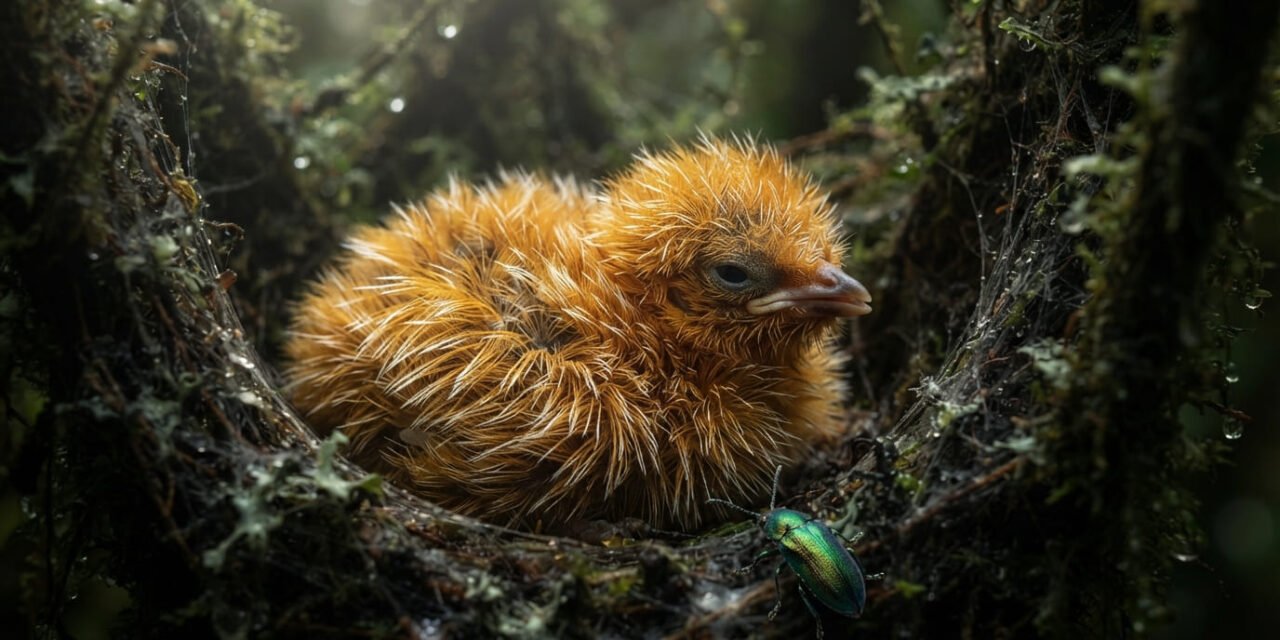
If you walk through the lowland rainforests of the Amazon, you will see things that do not make sense. You might spot a bright orange, fuzzy shape sitting in a nest made of dead leaves. It looks like a giant, toxic caterpillar. It moves with a slow, rhythmic sway. You would likely avoid touching it. Most predators do the same.
If you looked closer, you would find that this creature is not a bug. It is the chick of the Cinereous Mourner. This bird has developed one of the most specialized survival tricks in the world. It survives its first few weeks of life by pretending to be a venomous insect.
The Cinereous Mourner (Laniisoma elegans) is a medium sized bird found in South America. The adults are plain. They have grey and yellow feathers. They blend into the shadows of the forest. They stay quiet and hidden. Their chicks face a different problem. They sit in open, cup shaped nests in the understory of the forest.
These nests are easy to find. In the Amazon, predators like monkeys, snakes, and larger birds are everywhere. Research shows that about 80 percent of nests in this region fail because predators eat the eggs or the chicks. The Cinereous Mourner solved this problem through a strategy called Batesian mimicry.
The Appearance of a Killer
When a Cinereous Mourner chick hatches, it does not look like a bird. Most bird chicks have thin, grey or white down. This chick has long, bright orange feathers. These feathers are called neossoptiles. They are tipped with white spots. They grow to be much longer than typical bird down. Some are four times the length of the chick’s actual body. These feathers do not look like plumage. They look like the long, toxic hairs of a flannel moth caterpillar.
The flannel moth caterpillar belongs to the Megalopygidae family. It is often called the puss caterpillar. It is famous for its thick, fuzzy coat. Underneath that soft hair, the caterpillar hides venomous spines. If a monkey or a human touches these spines, they receive a painful sting.
The venom causes swelling, nausea, and intense burning. Predators in the Amazon know this color. Bright orange is a warning sign. It tells hunters that a meal will result in pain or death. This is called aposematism. The Cinereous Mourner chick uses this warning even though it has no venom of its own.
The white tips on the orange feathers are a vital detail. They mimic the specific texture of the flannel moth caterpillar’s hair. In the dim light of the forest floor, the white spots create the illusion of depth. They make the chick look like a solid, hairy mass rather than a bird with wings and a beak. This visual lie is the chick’s primary defense.
The Art of the Crawl
A costume is not enough to survive in the Amazon. Predators are smart. They watch for movement. If a bright orange caterpillar starts acting like a hungry bird chick, the disguise fails. The Cinereous Mourner chick knows this. It does not beg for food when it hears a noise. It does not open its mouth wide or chirp.
When the chick senses a potential threat, it begins to move its head. It weaves slowly from side to side. It moves in a steady, rhythmic pattern. This movement perfectly matches the way a large caterpillar crawls across a branch. The bird keeps its head down and hides its beak. It tucks its legs under its body. It becomes a moving, orange oval.
Scientists observed this behavior in 2012 and 2015. They found that the chicks perform this “dance” even when the parents are not around. It is a hardwired instinct. If a predator like a capuchin monkey approaches, it sees a toxic insect moving toward it. The monkey does not want to get stung. It moves to a different tree. The chick remains safe because it stayed in character.
Parental Stealth and Silence
The parents of the Cinereous Mourner are part of the act. In most bird species, parents fly to the nest many times an hour. They bring food and make noise. This attracts attention. The Cinereous Mourner parents operate differently. They arrive at the nest very rarely. Sometimes they only visit once every hour or two.
When a parent arrives, it does not fly directly to the nest. It lands far away. It moves through the branches with extreme caution. It stays silent. This reduces the number of visual and acoustic cues for predators. The chicks grow slowly because they receive less food. This slow growth is a calculated risk. It keeps the chick in the “caterpillar phase” for about 20 days.
During these 20 days, the chick is completely dependent on its disguise. It does not have the strength to fly. It does not have the talons to fight. It only has its orange fuzz and its rhythmic swaying. By limiting their visits, the parents ensure that the only thing a predator sees is a dangerous caterpillar that has been sitting in the same spot for hours.
The Science of Discovery
For a long time, the Cinereous Mourner was a mystery. Ornithologists knew the adults, but they rarely found the nests. It was not until researchers like Gustavo Londoño found a nest in the Madre de Dios region of Peru that the truth came out. They were shocked by the appearance of the chick. At first, they thought they had found a new species of insect.
The researchers tracked the nest for several weeks. They recorded the chick’s movements. They compared the chick to local species of flannel moth caterpillars. The match was almost perfect. The researchers realized they were looking at the first known case of a bird mimicking an invertebrate for protection.
The study found that the mimicry is most effective during the first three weeks. After 20 days, the chick starts to grow its adult feathers. The orange fuzz begins to fall off. The bird loses its “costume” just as it gains the ability to fly. This transition is perfectly timed. As soon as the bird is too large to look like a caterpillar, it gains the mobility to escape predators through flight.
Evolutionary Logic
You should care about this bird because it challenges how you think about nature. Evolution usually produces traits that help an animal hide or fight. The Cinereous Mourner did something different. It decided to stand out. It uses a bright color to attract attention, but only to send a false message.
This is a high stakes game of bluffing. If a predator ever decided to ignore the warning and bite the chick, the trick would be over. The bird is completely edible. It has no chemical defense. It survives entirely on the reputation of the flannel moth caterpillar. This shows that the memory of a predator is a powerful force in the wild. A monkey that was stung by a caterpillar once will remember that pain for years. The Cinereous Mourner lives in the space created by that memory.
Physical Measurements of Survival
The nests are usually found about one to two meters above the ground. This is the exact height where you find flannel moth caterpillars. The chicks themselves are about 10 to 12 centimeters long during the peak of their mimicry. This matches the size of a large, mature caterpillar.
The feathers that make up the orange coat are unique. They lack the structural hooks found in flight feathers. This makes them soft and air filled. This structure helps with insulation, but its main job is to create volume. It makes the chick look larger and “fuzzier” than it actually is. Every millimeter of the chick’s body is designed to reinforce the lie.
Final Observations
The Cinereous Mourner is a specialist in deception. It has transformed the most vulnerable time of its life into a performance. It uses the color orange as a shield. It uses a slow sway as a weapon. While other birds rely on speed or camouflage, this bird relies on theater.
The Amazon is a place where you cannot always trust your eyes. A poisonous bug might be a harmless bird. A pile of dead leaves might be a nursery. The Cinereous Mourner chick is a reminder that in a world of predators, the best way to survive is to become something that nobody wants to touch. It is a master of the costume, and it has used that costume to escape death for millions of years.