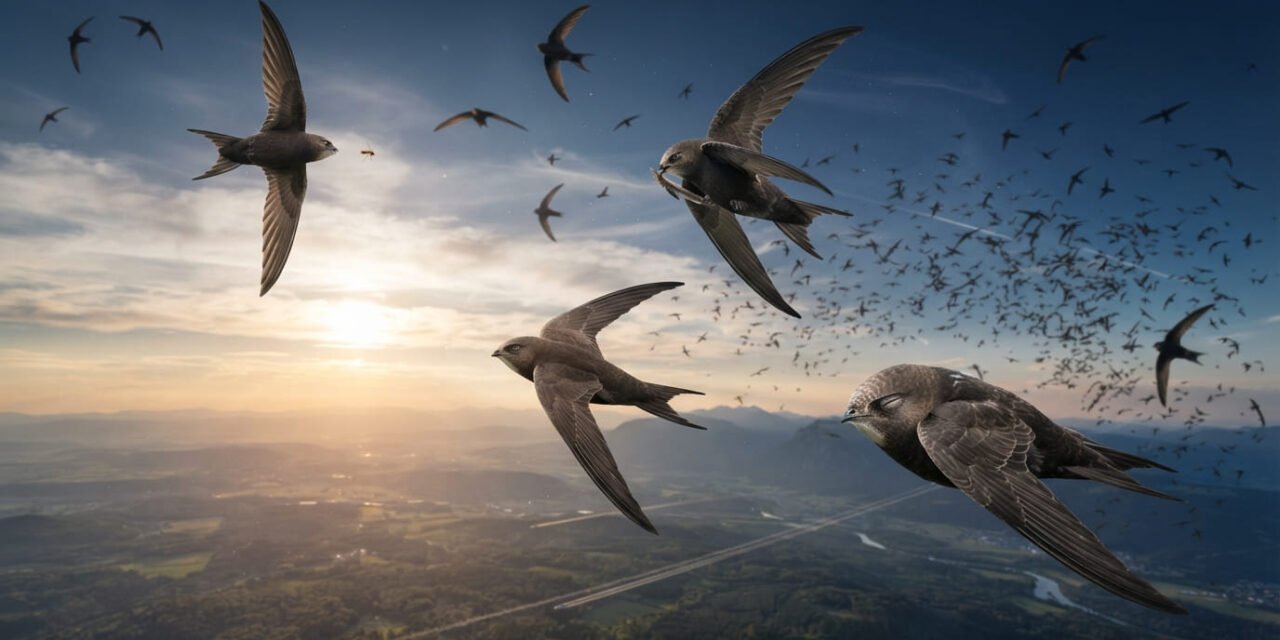
You are looking at a bird that forgets the earth exists. For most animals, the ground is home, a place to rest, eat, and sleep. For the Common Swift, the ground is a dangerous place that it avoids at all costs. This bird is a biological anomaly that spends nearly its entire life in the sky. It eats in the air. It mates in the air. It even sleeps while gliding thousands of feet above the clouds. Researchers have tracked these birds and found that some individuals stay airborne for ten months straight without ever touching a branch or a chimney.
The Common Swift is a medium sized bird with a soot brown body and long, scythe shaped wings. If you see one on the ground, it is likely in trouble. Its legs are so short, and its wings are so long that it struggles to take off from a flat surface. This physical limitation is why the species evolved to be the ultimate aerial specialist. Evolution traded the ability to walk for the ability to live in a world of constant motion.
The Physics of Constant Lift
The wings of a swift are masterpieces of natural engineering. They have a high aspect ratio, which means they are long and thin compared to their width. This design reduces drag and allows the bird to glide for long distances with very little effort. While a pigeon or a crow must flap its wings constantly to stay up, a swift uses the air like a sailor uses the wind.
The wing shape is a crescent. This allows the bird to execute sharp turns at high speeds without losing altitude. Swifts typically fly at 25 to 35 miles per hour during their daily routines, but they can reach speeds of 70 miles per hour when they need to move fast. They use a technique called flap gliding. They give a few quick, powerful flaps to gain speed and then lock their wings to glide on the resulting momentum.
These birds are experts at finding thermals. Thermals are columns of rising warm air. You might see a swift circling higher and higher without moving its wings at all. It is hitching a ride on rising heat. By staying inside these columns, the swift gains thousands of feet of altitude for free. It saves its muscle energy for the long migration from Europe to sub Saharan Africa.
Eating on the Wing
A swift does not land to eat. It survives on what biologists call aerial plankton. This consists of millions of small insects and spiders that are carried up into the sky by wind currents. You will find flies, aphids, beetles, and even tiny spiders on silk threads floating at altitudes where most birds never go.
The swift has a wide, gaping mouth that acts like a scoop. It flies through clouds of insects with its mouth open, collecting hundreds of bugs in a short time. When it catches an insect, it uses its tongue to push it into a pouch in its throat. It binds the insects together with sticky saliva into a ball called a bolus. A single bolus can contain over 1,000 individual insects.
During the nesting season, the parents collect these balls to feed their chicks. However, during the ten month non breeding period, the adult simply swallows the insects as it catches them. This constant supply of protein allows the bird to maintain its high metabolism without ever needing to stop at a bird feeder or a berry bush.
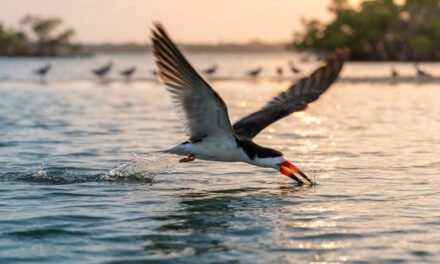
Water collection is just as efficient. To drink, a swift flies low over a pond or a lake. it skims the surface of the water with its lower beak, scooping up liquid without slowing down. It happens so fast that you might miss it if you blink. This keeps the bird hydrated during the heat of the day without making it vulnerable to predators like cats or foxes that wait at the water’s edge.
The Mystery of Aerial Sleep
The most frequent question people ask about a bird that never lands is how it sleeps. If you stop moving in the sky, you fall. The swift solves this with a trick called unihemispheric slow wave sleep. This means it shuts down half of its brain at a time.
When it is time to rest, the swift performs a behavior called a vesper flight. Just as the sun begins to set, the birds climb to extreme altitudes, often reaching 8,000 to 10,000 feet. At this height, they are safe from most predators and the air is calm. Once they reach the top, they begin a long, slow glide.
One half of the brain stays awake to control the wing muscles and monitor the environment. The other half goes into a deep sleep. The eye connected to the awake half stays open to watch for obstacles or changes in wind direction. After a period of time, the bird switches sides, allowing the other half of the brain to rest. This allows the swift to get the recovery it needs while remaining fully operational. It is a form of autopilot that keeps the bird stable and on course throughout the night.
Mating in the Sky
Mating is another activity that usually happens on a branch or in a nest. For the swift, it happens in the open air. This is a feat of extreme coordination. The male and female must align their bodies and fly at the same speed while moving at high velocity.
They perform aerial displays that involve chasing each other through the sky at top speeds. When they are ready, they fly in a synchronized glide, making contact for only a few seconds before breaking away. This behavior ensures that the birds do not have to land and risk being caught on the ground. It also reinforces the bond between the pair, as only highly skilled fliers can complete the maneuver.
Molting and Maintenance in Flight
Feathers take a lot of damage during a ten month flight. They get hit by rain, dust, and wind. Most birds molt their feathers while they are resting in a safe place. The swift molts while it is flying.
It replaces its feathers one or two at a time. This ensures that it always has enough wing surface area to stay in the air. If it lost too many feathers at once, it would lose lift and fall. The process is slow and calculated. It takes months for a swift to replace its entire set of flight feathers. While the new feathers are growing in, the bird continues its migration across continents, never once stopping to wait for the process to finish.
The Only Exception: The Nest
The only time a swift touches the earth is to raise its young. They choose high, inaccessible spots like the crevices of cliffs or the eaves of old buildings. Even then, they avoid landing on the ground. They fly directly into the hole or onto the ledge.
Their nests are made of materials they find in the air. They catch feathers, blades of grass, and scraps of paper that the wind has blown into the sky. They glue these materials together using their own thick, sticky saliva. The result is a small cup that is cemented to a vertical wall.
Once the chicks hatch, the parents are on a constant rotation. They bring back thousands of insects every day. As soon as the chicks are old enough to fly, they drop out of the nest and begin their own ten month journey. They will not land again until they are mature enough to start their own nests years later.
Tracking the Journey
Until recently, the ten month flight was just a theory. In 2016, researchers in Sweden used tiny electronic data loggers to track the movements of Common Swifts. The results were clear. Some birds stayed in the air for over 300 days without a single second of recorded stationary time.
These birds traveled from Northern Europe to Central Africa and back. They flew through storms and over deserts. They crossed the Mediterranean Sea without stopping for a break on any of the islands. A swift can travel over 120,000 miles in a single year. Over a lifetime of 20 years, a swift flies a total distance that would take it to the moon and back several times.
Why You Should Care
The Common Swift is a reminder that animals can adapt to almost any environment if the pressure is high enough. It shows you that the sky is not just a highway to get from one place to another. For some creatures, the sky is the only place they truly belong.
You should care about these birds because they are vital for controlling insect populations in your cities. A single colony of swifts can eat millions of mosquitoes and flies in a single summer. They do this for free, and they do it without using chemicals or pesticides. They are the ultimate urban cleaners.
Protecting these birds means protecting the buildings they nest in. As we renovate old buildings and seal up cracks, we take away the only places these birds can land to reproduce. Using swift bricks or leaving small gaps in masonry can ensure that this aerial athlete continues to fill the summer sky. The swift is a masterpiece of endurance, but it still needs a small piece of the earth for its children.