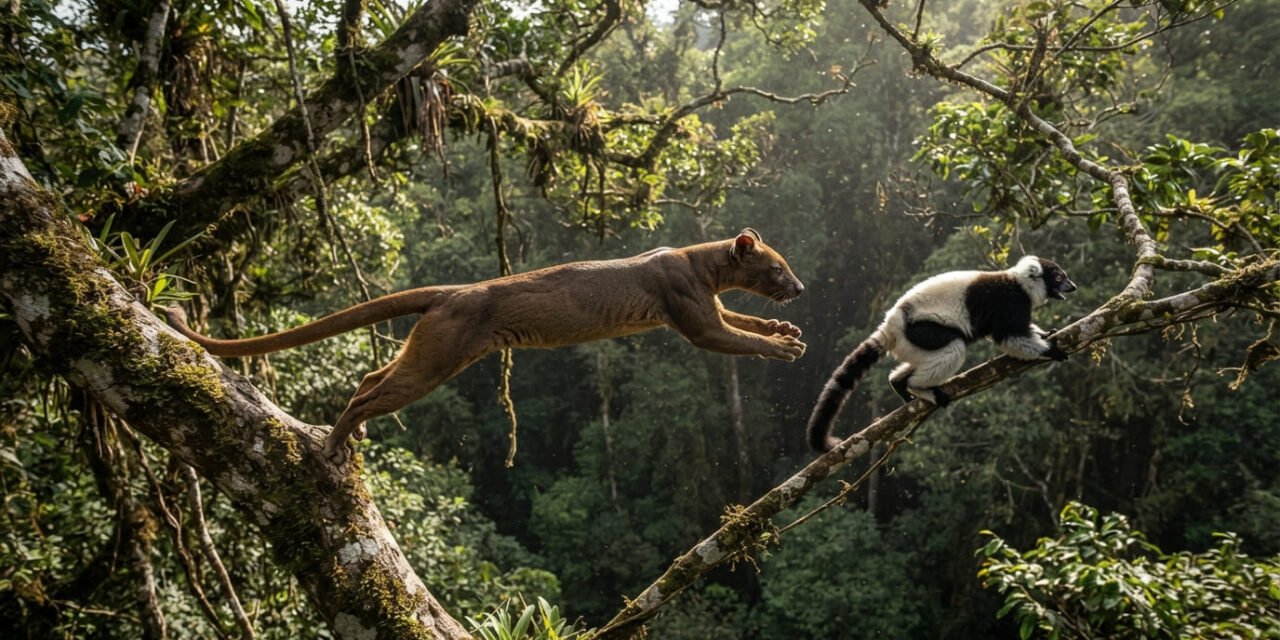
You might think you are looking at a small mountain lion when you first see a Fossa in the forests of Madagascar. It has a slender body, short reddish brown fur, and a muzzle that looks like a cat. But the Fossa is not a feline. It belongs to the family Eupleridae. It is a unique mongoose that evolved to be the top predator on its island. You should care about this animal because it represents a masterclass in specialized anatomy. It survives by doing things other predators cannot do. It moves through the canopy as easily as it moves on the ground.
The Fossa (Cryptoprocta ferox) weighs between 12 and 19 pounds. It measures about 5 to 6 feet from its nose to the tip of its tail. Half of that length is the tail. This tail is a vital tool for balance. The Fossa is an apex predator. It has no natural enemies on Madagascar except for humans. Its survival depends on its ability to catch lemurs. Lemurs make up more than half of their diet. To catch a lemur, you must be able to climb better than almost any other mammal. The Fossa achieves this through a specific set of physical traits.
The Secret of the One Hundred Eighty Degree Ankle
The most important part of the Fossa’s body is its ankles. Most predators have ankles that only move in a few directions. A domestic cat can climb up a tree quickly, but it must go down backward or jump. The Fossa does not have this problem. Its ankle joints are incredibly flexible. They can rotate one hundred eighty degrees.
This rotation allows the Fossa to descend a tree trunk headfirst. You can observe this in the wild. The Fossa grips the bark with its back feet while its head points toward the ground. This gives the predator a massive advantage. It can see exactly where it is going while it moves down. It can track a lemur that is trying to escape to the lower branches. If you are a lemur and you jump down to avoid a Fossa, the Fossa follows you instantly. It does not have to turn around or hesitate.
The bone structure in the ankle allows the foot to turn inward or outward with ease. This flexibility comes from the subtalar joint. This joint is much more mobile in the Fossa than in other carnivores. You can compare this to the way a squirrel moves. The Fossa is essentially a 20 pound squirrel with the teeth and claws of a leopard. This combination of size and agility makes it the most dangerous animal in the Madagascar canopy.
Retractable Claws and Flat Feet
The Fossa uses its paws to maintain a grip on slick or vertical surfaces. It has semi retractable claws. This means it can pull its claws back into its paws when it walks on the ground. This prevents the claws from getting dull. When the Fossa climbs, it extends the claws to dig into the wood. The claws are sharp and curved. They act like climbing spikes.
You will also notice that the Fossa is plantigrade. This means it walks with its entire foot flat on the ground. Most cats walk on their toes. Walking flat footed gives the Fossa more surface area. It provides a better balance on narrow branches. You can think of it like a human wearing climbing shoes with a lot of grip. The flat feet help the Fossa stay stable when it stands on its hind legs to reach for a lemur.
The pads of the paws are thick and leathery. They provide friction. This friction is necessary when the forest is wet from rain. The Fossa does not slip. It moves with total confidence on branches that are only a few inches wide. This physical stability allows the Fossa to hunt in the middle of a storm when its prey is most vulnerable.
The Logic of the Long Tail
The tail of a Fossa is almost three feet long. It is thick and muscular. It is not just for show. The Fossa uses its tail as a counterweight. When the Fossa runs along a branch, its tail moves in the opposite direction from its body. If the Fossa tilts to the left, the tail moves to the right. This keeps the animal’s center of gravity centered over the branch.
You can see the tail in action when the Fossa leaps. It can jump over 15 feet between trees. During the jump, the tail acts like a rudder. It helps the Fossa adjust its position in mid air. This allows the predator to land precisely on a moving target. The tail also helps the Fossa stay balanced when it is eating. A Fossa often catches its prey in a tree and must balance on a branch while it consumes the meal. The tail wraps around the branch to provide a third point of contact.
Hunting Tactics in the Canopy
The Fossa is a patient hunter. It uses stealth to get close to a lemur colony. It can hunt during the day or at night. Its eyes have a reflective layer called the tapetum lucidum. This layer amplifies light. It gives the Fossa excellent night vision. Most lemurs are diurnal and sleep at night. The Fossa uses the darkness to ambush sleeping lemurs.
When a Fossa attacks, it uses its powerful forelimbs to pin the prey. It delivers a quick bite to the back of the neck or the throat. Its jaw muscles are large. Its teeth are designed for shearing through flesh and bone. A Fossa can eat an entire lemur in a single sitting. If it catches a large lemur like an Indri, it might carry the carcass to a safe spot on the ground to finish its meal.
The Fossa also hunts other animals. It eats tenrecs, birds, and lizards. It is a generalist. This means it can survive even if the lemur population drops. However, the Fossa is most efficient when it is in the trees. Its entire skeleton is built for vertical movement.
Solitary Life and Scent Marking
You will rarely see two adult Fossas together. They are solitary animals. They only meet to mate. Each Fossa has a large territory. A male may have a territory of up to 10 square miles. They defend these areas aggressively. The Fossa uses scent to communicate with other Fossas. It has scent glands on its chest and under its tail.
The Fossa rubs its body against trees to leave a chemical message. These messages tell other Fossas about the health, sex, and identity of the individual. You can smell a Fossa before you see it. The scent is strong and musky. This scent marking prevents physical fights. A Fossa can tell if a territory is occupied just by smelling a tree trunk. This saves energy and reduces the risk of injury.
The Unique Mating Ritual
The mating behavior of the Fossa is one of the strangest in the animal kingdom. It takes place in a “mating tree.” A female will climb to a high branch in a specific tree. She will stay there for several days. Males will gather at the bottom of the tree. They will compete for the chance to climb up and mate with her.
The female chooses which males she will mate with. She may mate with several different males over a week. This behavior is rare among carnivores. It ensures genetic diversity in the offspring. Once the mating period is over, the female leaves the tree. She will raise the cubs alone. The cubs stay with their mother for about a year. During this time, they learn how to use their ankles and tails to hunt.
Conservation and the Future of Madagascar
You should care about the Fossa because it is in danger. There are fewer than 2,500 adult Fossas left in the wild. The biggest threat is habitat loss. People are clearing the forests of Madagascar for agriculture and charcoal production. When the trees disappear, the Fossa loses its hunting ground.
The Fossa also faces competition from invasive species. Dogs and cats introduced by humans compete for food. Some people kill Fossas because they believe the animals hunt livestock. This is a problem because the Fossa is essential for a balanced forest. Without the Fossa, lemur populations would grow too large. This would lead to overgrazing and damage to the forest.
Protecting the Fossa requires protecting the forest. You can support organizations that work on reforestation in Madagascar. You can also support local communities to reduce their reliance on charcoal. The Fossa is a biological treasure. It is a mongoose that learned how to be a lion in the trees. It is a reminder of how life adapts to its environment.
Final Thoughts on the Fossa
The Fossa is a masterpiece of evolution. Its one hundred eighty degree rotating ankles allow it to move in ways that defy gravity. Its long tail provides the balance needed for high altitude sprints. Its retractable claws give it the grip of a professional climber.
When you think of a predator, you might think of a wolf or a tiger. But the Fossa is just as impressive. It is a quiet, solitary hunter that has mastered the three dimensional world of the rainforest. It is an animal that refuses to be categorized. It is a mongoose, it looks like a cat, and it climbs like a squirrel. The Fossa is the true king of Madagascar.


