
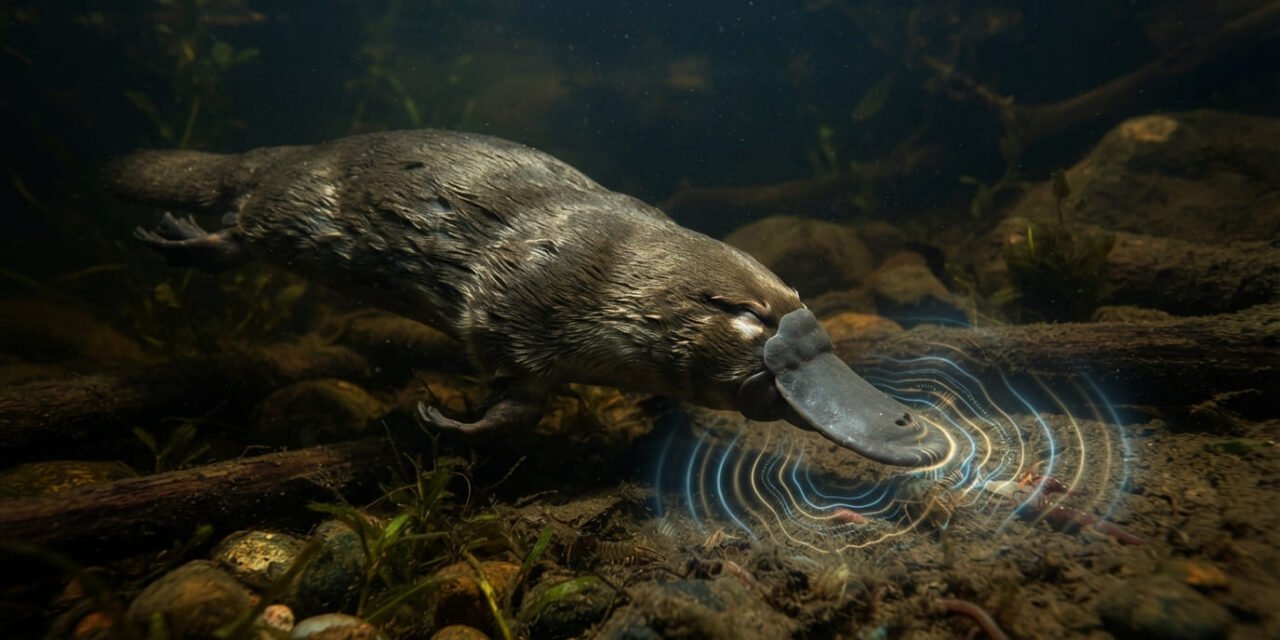
Imagine swimming in a pitch-black, freezing river at three in the morning. The water is so muddy and filled with sediment that it looks like thick pea soup. You cannot see your own hand if you hold it an inch from your face. If you were looking for a tiny, buried shrimp to eat, you would probably starve. But a platypus does this every single night.
To make things even more difficult, the platypus does not even try to use its normal senses. When it dives beneath the surface, it closes its eyes. It plugs its ears. It pinches its nostrils shut. It becomes functionally blind, deaf, and unable to smell. Yet, it moves with absolute confidence, sweeping its head side to side and snapping up fast-moving prey with perfect precision.
The platypus did not solve the problem of underwater hunting by improving its eyes or ears. It solved it by evolving a completely new sensory system. Its soft, leathery bill is not just a mouth; it is a highly advanced biological sensor array that reads the invisible electrical currents of the riverbed.
The Great Evolutionary Puzzle
When European naturalists first saw a preserved platypus specimen in 1799, they thought it was a joke. They suspected a clever taxidermist had sewn the bill of a duck onto the body of a beaver-like mammal. Even after they realized the animal was real, they struggled to understand how it fit into the natural world. It was a mammal, yet it laid eggs, had venomous spurs on its hind legs, and possessed a broad, flat tail.
For a long time, early scientists assumed the platypus was a primitive, poorly evolved creature, a clunky evolutionary stepping stone. They looked at its bill and assumed it was a simple, rigid structure used to shovel mud, much like the bill of a duck.
They could not have been more wrong. The platypus is a masterclass in sensory specialization. It has survived for millions of years because it found a way to exploit a habitat that other mammals could not navigate. By turning its bill into a combined electric and pressure receiver, the platypus can map its underwater world in three dimensions without needing a single photon of light.
Closing Out the World
To understand why the platypus needs its bill sense, you have to look at what happens when it dives. The moment a platypus submerges, a specialized fold of skin called the operculum seals over its eyes and ears. At the same time, its nostrils close up tight.
This sensory shutdown is a brilliant evolutionary trade-off. In the murky, turbulent creeks of eastern Australia, sight is practically useless. Light scatters off floating silt, and the darkness of night makes vision impossible. Hearing is equally unreliable, as the sound of rushing water, bubbling currents, and scraping pebbles creates a wall of acoustic noise.
Instead of wasting brainpower trying to filter out this useless data, the platypus turns these senses completely off. It redirects its entire mental processing capacity to its trigeminal nerve, the massive neural highway that connects its bill directly to its brain.
Inside the Suéde-Like Sensor Array
The bill of a platypus is nothing like the hard, horn-like beak of a bird. If you were to touch a living platypus, you would find that its bill is soft, fleshy, and flexible, with a texture like damp suede. It is incredibly pliable, especially around the edges.
This soft skin is packed with roughly 100,000 individual sensory receptors. These receptors are divided into two distinct groups, working together like a team of specialized detectives:
First, there are the push-rods. The platypus has about 60,000 of these tiny, rod-like pillars of skin distributed across its bill. The push-rods are mechanoreceptors, which means they are sensitive to physical touch and water pressure. They are incredibly delicate; a push of just 20 microns, a fraction of the width of a human hair, is enough to trigger a signal. When a tiny bug swims through the water, it creates microscopic pressure waves. The push-rods detect these ripples, telling the platypus that something is moving nearby.
Second, there are the electroreceptors. The platypus has about 40,000 of these sensors, which are actually modified mucous glands. They are arranged in neat, parallel rows running down the length of the bill. These glands act as biological voltmeters. They are sensitive enough to detect electrical fields as weak as 20 microvolts per centimeter.
Every time an animal moves a muscle, a tiny pulse of electricity is generated. When a freshwater shrimp flicks its tail, or a small fish beats its fins, the muscle contractions release a microscopic burst of bioelectricity into the water. The platypus’s bill reads these electrical whispers, turning the invisible energy of the river into a clear map.
The Thunder and Lightning Calculation
Having these two senses is impressive, but the real genius of the platypus lies in how its brain combines them. The platypus is able to calculate both the exact direction and the distance of its prey using a method that mirrors how we track thunderstorms.
When a lightning bolt strikes, you see the flash almost instantly because light travels incredibly fast. The sound of the thunder, however, travels much more slowly. If you count the seconds between the flash of light and the rumble of thunder, you can calculate exactly how far away the storm is.
The platypus does the same thing underwater. When a buried shrimp flicks its tail, it creates two separate signals: an electrical pulse and a physical pressure wave.
Because electricity travels almost instantly through water, the platypus’s electroreceptors register the muscle contraction immediately. This is the biological “lightning.”
The physical ripple, or pressure wave, travels much more slowly through the water, moving at the speed of sound. A fraction of a millisecond later, this mechanical ripple hits the bill and bends the push-rods. This is the biological “thunder.”
By measuring the microscopic delay between the instant electrical signal and the slower mechanical wave, the platypus’s brain calculates the distance to the prey. The larger the delay, the farther away the shrimp is. If both signals arrive at the same instant, the prey is directly on the bill, and the platypus snaps its jaws shut.
The Saccadic Sweep
To find these signals in the first place, the platypus uses a very specific swimming style. As it glides along the bottom of a creek, it constantly sweeps its head from left to right in rapid, circular arcs.
These sweeps are called saccades, and they serve the same purpose as the rapid eye movements humans use to scan a room. By sweeping its bill back and forth, the platypus compares the strength of the electrical signals hitting different parts of its bill.
If the electrical field is stronger on the left side, the platypus immediately steers to the left. By continuously adjusting its path to follow the strongest electrical gradient, it homes in on the target like a heat-seeking missile. It can detect a shrimp buried deep beneath several inches of mud and gravel, digging it out with its powerful claws before swallowing it whole.
Lessons for the Future of Robotics
The platypus’s elegant solution to underwater navigation is highly relevant to human technology. Modern engineers struggle to build robots that can operate in dark, murky, or deep-sea environments.
Traditional underwater drones rely heavily on cameras, which become useless when mud and silt are kicked up. They can also use sonar, but sonar systems require a lot of power, are bulky, and can disrupt marine life with loud acoustic pulses.
By studying the platypus, roboticists are developing a new field of technology called active electrosense. Researchers have built autonomous underwater vehicles equipped with flexible, bionic fingers and sensor pods that mimic the platypus’s dual-sensing bill.
These drones do not use cameras. Instead, they emit a weak, oscillating electric field and use sensors to measure how objects in the water disrupt that field. This allows them to navigate through muddy harbors, inspect underwater pipelines, and map deep-sea trenches with minimal power and zero reliance on light. The platypus proved that you do not need a camera to see in the dark; you just need to know how to read the energy around you.
Final Thoughts
The platypus is a reminder that evolution does not produce imperfect animals. It produces specialists. When we look at this strange, egg-laying mammal with its beaver tail and duck-like bill, we are not looking at a primitive relic of the past. We are looking at one of the most sophisticated sensory engineers on the planet.
It took the absolute darkness of the muddy riverbed and conquered it using the physics of electricity and pressure. It proved that sometimes, the best way to understand your environment is to close your eyes, plug your ears, and let the quiet currents of the world tell you exactly where to go.