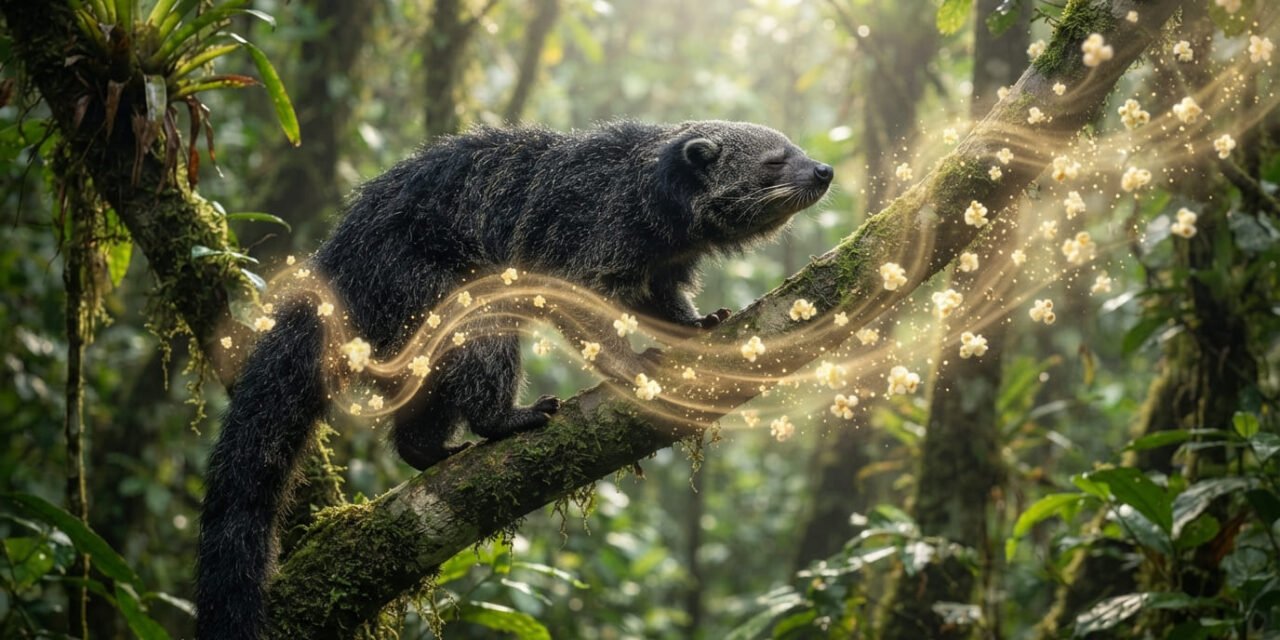
If you were to walk through the deep, humid rainforests of Southeast Asia at twilight, you might experience a strange sensation. Among the smells of damp earth, rotting leaves, and tropical flowers, a sudden gust of wind might bring a highly familiar scent. It is the rich, warm aroma of freshly popped, hot buttered popcorn. For a second, you might think you are standing outside a movie theater rather than in the middle of a dense jungle. But there are no concession stands here. You are smelling the calling card of one of the strangest mammals on Earth: the binturong.
The binturong (Arctictis binturong) is often called the bearcat. This name is highly misleading because it is not related to bears, and it is not a cat. It actually belongs to the Viverridae family, which makes it a close relative of civets and genets. It is a medium-sized mammal with shaggy black fur, long white whiskers, and a face that looks like a curious mix of an otter and a small bear. But its most famous trait is its scent. It smells so much like movie theater popcorn that zookeepers and field researchers often use the smell to track the animal down in the dark.
The Chemistry of the Theater Scent
For a long time, people did not understand how a wild mammal could smell like a processed snack. The secret was finally unlocked by researchers who studied the chemical compounds in the animal’s secretions. They found that the binturong produces a volatile chemical compound called 2-acetyl-1-pyrroline, or 2-AP for short.
If that chemical name sounds complicated, the reaction that creates it is actually very simple. It is the same chemical that gives popcorn its unmistakable smell. When you heat corn kernels, the sugars and amino acids inside undergo a chemical change called the Maillard reaction. This reaction produces 2-AP, which wafts into the air and makes your mouth water.
In the binturong, this chemical is not produced by high heat. Instead, it is generated in the animal’s urine and specialized scent glands located near the tail. When the binturong urinates, the liquid contacts these glands, and the chemical compound is released into the surrounding air. Because the compound is highly volatile, it evaporates quickly, carrying the warm, buttery scent far through the forest canopy.
The Tail as a Paint Roller
The binturong does not just leave its scent in one place. It uses a highly active system to spread its popcorn perfume across its territory. This is where its massive, muscular tail becomes a tool for communication.
When a binturong climbs through the trees, it drags its tail and hindquarters along the branches. It presses its scent glands against the rough bark and leaves a sticky trail of urine behind. The long, coarse hair on its tail acts like a paint roller. As the tail drags, it distributes the scent evenly across the wood.
This scent trail serves as a bulletin board for other binturongs. By sniffing a branch, a passing binturong can learn a great deal of information. It can tell the sex of the animal that left the scent, how long ago they passed by, and whether they are healthy or ready to mate. Because binturongs are solitary animals that rarely interact face-to-face, this popcorn-scented highway is their primary way of maintaining a social structure without getting into physical fights.
A Fifth Hand in the Canopy
The prehensile tail is a marvel of evolutionary design. The binturong is the only mammal in Asia, Europe, or Africa to have a fully prehensile tail. It is also one of only two carnivores in the entire world with this trait; the other is the kinkajou of Central and South America.
The tail is nearly as long as the binturong’s body, often measuring up to 90 centimeters. It is incredibly thick and muscular at the base. The last third of the tail is highly flexible and can wrap tightly around tree limbs. On the underside of the tail tip, the binturong has a leathery, ribbed patch of bare skin. This patch acts like the palm of a hand, providing extra friction and grip when the bark is wet or slippery.
Young binturongs can hang completely upside down, supported only by their tails. As they grow into heavy adults, sometimes weighing up to 20 kilograms, they become too heavy for this trick. However, they still use the tail as a safety line. When a binturong sleeps high in the canopy, it wraps its tail tightly around a thick branch. If a sudden gust of wind blows or the branch shakes, the tail locks in place, preventing the animal from falling. It is a constant, built-in safety belt.
Anatomical Oddities for Vertical Living
Living in the high canopy requires more than just a strong tail. The binturong’s entire body is designed for slow, deliberate climbing. It is flat-footed, or plantigrade, meaning it walks on the soles of its feet just like humans and bears. This is unusual for a carnivore, as most cats and dogs walk on their toes. Walking flat-footed gives the binturong a broad, stable base of support when balancing on round branches.
The binturong also has the ability to rotate its hind ankles 180 degrees. This is a rare adaptation that is shared by only a few other tree-dwellers, like squirrels and the fossa. When the binturong climbs down a tree trunk head-first, it turns its back feet completely around. This allows its sharp claws to point upward, digging into the bark and acting as brakes. It can walk straight down a vertical trunk with complete control, rather than having to slide or climb down backward.
Its coat is another specialized shield. The fur is long, coarse, and shaggy. It is oily and sheds water easily. In the tropical rainforest, heavy downpours are a daily occurrence. The binturong’s coat acts like a high-quality raincoat, keeping the skin dry and preventing the animal’s body temperature from dropping during cold mountain storms.
The Carnivore That Eats Figs
If you looked at the binturong’s teeth, you would see the sharp canines of a predator. Because of its skeleton and skull structure, scientists classify the binturong in the order Carnivora. But if you watched one eat in the wild, you would see a very different story. The binturong is primarily a frugivore. Up to 80 percent of its diet consists of fruit, and its absolute favorite food is the strangler fig.
The binturong plays a critical role in the health of the rainforest. It is one of the few animals large enough to eat massive quantities of figs and spread the seeds across long distances. When a binturong eats a fig, it swallows the seeds whole. As the seeds pass through the animal’s highly acidic digestive tract, the stomach acid strips away the tough outer coating of the seeds.
When the binturong defecates, it deposits these processed seeds high in the branches of other trees. Because the outer coat has been weakened by digestion, the seeds germinate much faster than they would if they had simply fallen to the ground. In fact, many fig trees rely almost entirely on the binturong to reproduce. The animal is a key gardener of the forest, helping to replant the very trees it relies on for food.
Survival in a Changing Forest
The binturong is currently listed as Vulnerable by the International Union for Conservation of Nature. Their populations are declining across their entire range. The biggest threat they face is habitat destruction. Large areas of Southeast Asia’s rainforests are being cleared for agriculture, particularly for oil palm plantations. When the old-growth trees are cut down, the binturong loses its food, its canopy highway, and its safety.
They are also captured for the pet trade and hunted for their fur and meat. In some areas, their scent glands are harvested for use in traditional medicines, even though the chemical compound inside is completely harmless and has no medicinal value. Protecting these animals requires preserving the dense, continuous forests they need to travel.
Final Thoughts
The binturong is a reminder that nature has an incredible sense of humor and design. It is a creature that purrs like a cat when it is happy, climbs like a monkey with its tail, walks flat-footed like a bear, and smells like a fresh batch of movie theater popcorn. It is a composite animal that occupies its own unique space in the forest.
The next time you smell popcorn in an unexpected place, think of the binturong. Think of a shaggy black beast sitting high in a fig tree in Borneo, dragging its tail across a branch to paint the canopy with its signature scent. It is a quiet, slow-moving architect of the forest that has spent millions of years keeping the jungle alive, one seed and one buttery trail at a time.