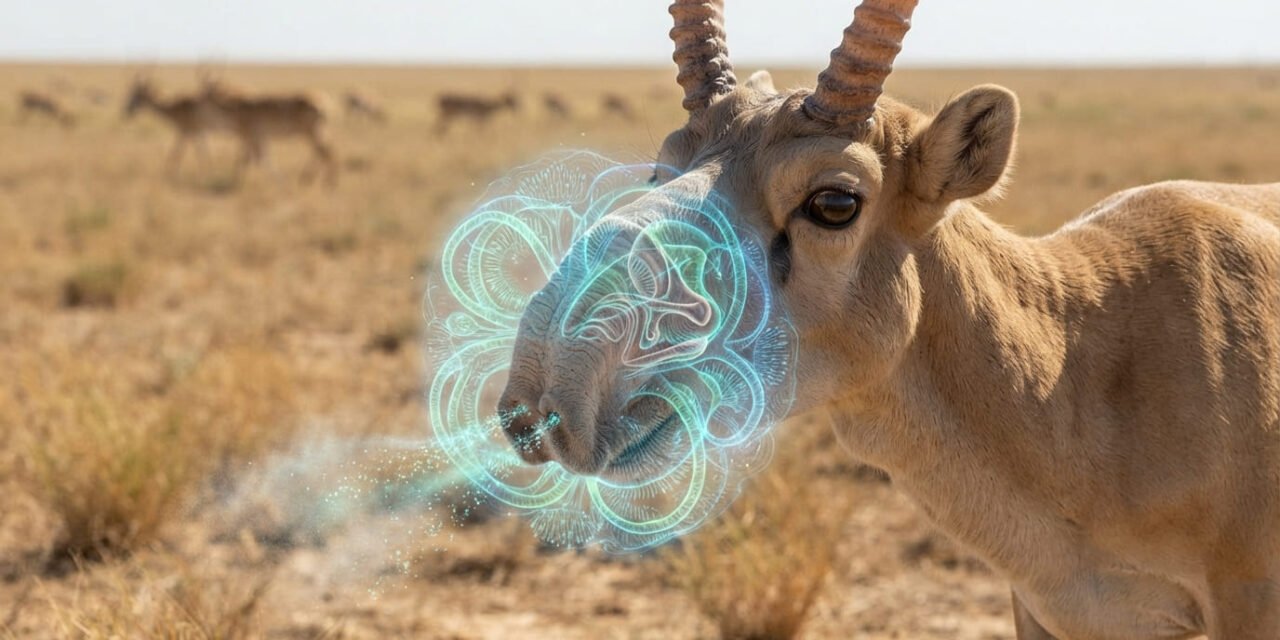
If you saw a Saiga antelope for the first time, you would probably think it was a prop from a low-budget sci-fi movie. It has the body of a standard, smallish deer, but its face ends in a bulbous, drooping nose that looks like a miniature elephant trunk. This isn’t an evolutionary accident. That nose is a highly specialized piece of biological equipment that allows the Saiga to survive in one of the most punishing environments on the planet: the Eurasian steppe.
The steppe is a place of extremes. In the summer, it is a dust bowl where the wind kicks up thick clouds of grit. In the winter, the temperature drops to below zero. Most animals would choke on the dust or freeze their lungs on the air. The Saiga handles both because of that strange snout.
The Engineering of the Snout
The Saiga’s nose is essentially a two-stage climate control system. It is filled with a complex network of mucous membranes and blood vessels. When the antelope inhales during the hot, dry summer, the nose acts as a filter. The internal structure is so intricate that it traps the fine dust particles before they can reach the lungs. This is vital because these animals move in massive herds of thousands. When a herd runs, they kick up a wall of dirt that would suffocate a normal mammal.
In the winter, the nose switches roles. When the air is cold enough to freeze tissue on contact, the Saiga’s snout acts as a heat exchanger. As the air passes through the large internal chambers of the nose, the concentrated blood vessels warm it up. By the time the breath hits the lungs, it is at a safe temperature. This prevents the animal’s core temperature from dropping and protects its respiratory system from cold-induced damage.
The High-Speed Life of the Steppe
Saiga antelopes are built for movement. They are nomadic by necessity. The vegetation on the steppe is sparse and patchy, so the herds have to keep moving to find enough grass to eat. They can cover 50 to 70 miles in a single day.
Their running style is as unique as their nose. Most antelopes have a bounding, leaping gait. Saigas run with their heads held low to the ground. This looks awkward, but it is incredibly efficient for long-distance travel. They can maintain a steady pace of 40 miles per hour for long stretches. This speed is their primary defense against wolves. On the flat, open plains, there is nowhere to hide, so you have to be able to outrun anything that wants to eat you.
A History of Near-Extinction
The story of the Saiga isn’t just about cool biology; it’s about a species that has repeatedly stared down extinction. In the early 20th century, they were hunted so heavily for their horns and meat that only a few thousand remained. They made a massive comeback in the mid-1900s, with populations reaching nearly two million.
However, the collapse of the Soviet Union in the 1990s led to a surge in illegal poaching. In traditional Chinese medicine, Saiga horns are used as a substitute for rhino horn. This demand caused the population to crash again, dropping by 95% in just a decade. At one point, they were one of the most endangered mammals on Earth.
The Mystery of the Mass Die-Offs
Even when they aren’t being hunted, the Saiga faces bizarre biological threats. In 2015, the world watched in horror as 200,000 Saigas, roughly 60% of the entire global population, died in the span of three weeks. It wasn’t a predator or a lack of food. It was a bacterium called Pasteurella multocida.
This bacterium normally lives harmlessly in the Saiga’s respiratory tract. But researchers found that an unusual spike in heat and humidity triggered the bacteria to migrate into the bloodstream, causing hemorrhagic septicemia. The herds died so fast that mothers and calves were found dead side-by-side, still in their grazing positions. It was a stark reminder of how vulnerable specialized species are to even slight changes in their climate.
The Recovery Effort
The good news is that Saigas are incredibly resilient. Females often give birth to twins, and they start breeding when they are only a year old. This high reproductive rate means that if you give them space and protection, they can rebuild their numbers quickly.
Conservationists in Kazakhstan and Mongolia have worked hard to establish protected corridors for the herds. By 2023, the population in Kazakhstan alone had rebounded to over 1.3 million. This is one of the greatest success stories in modern conservation. It shows that even a species on the absolute brink can recover if the poaching stops and the habitat is preserved.
Why You Should Care About the Saiga
You might wonder why a weird-looking antelope in Central Asia matters. The Saiga is a “keystone species.” They are the lawnmowers of the steppe. By grazing on the tough grasses, they keep the vegetation from becoming overgrown and dry, which reduces the risk of massive wildfires. Their waste provides essential nutrients for the soil, and they are the primary food source for the steppe’s top predators.
If the Saiga disappears, the entire steppe ecosystem begins to unravel. The grass grows tall and dies, creating tinder for fires. The soil loses its fertility. The wolves and eagles lose their food. The Saiga isn’t just an animal; it’s the heartbeat of one of the largest grassland systems on the planet.
Biological Specificity and Rhythm
The most interesting thing about the Saiga is the sheer specificity of its design. Every part of it is a response to a problem. The nose handles the air. The wide, flat hooves handle the mud and snow. The golden coat provides camouflage against the dry grass.
When you look at a Saiga, you are looking at the result of thousands of years of trial and error in one of the toughest environments ever known. It isn’t a “pretty” animal by human standards, but it is a perfect animal for the steppe. It doesn’t need to be elegant; it needs to be functional.
The Future of the Herd
As the climate changes, the Saiga will face new versions of old problems. The heat spikes that caused the 2015 die-off are becoming more common. The migration routes are being cut off by new roads and fences.
But if the last hundred years have shown us anything, it’s that you should never count the Saiga out. They have survived ice ages, mass hunting, and bacterial plagues. As long as they have the freedom to roam and that strange, trunk-like nose to filter the dust, they will continue to be the weird, wonderful ghosts of the Eurasian plains.
Lessons from the Steppe
We often try to solve problems with more energy and more technology. The Saiga solves the problem of swings with a bit of extra skin and some clever plumbing in its face. It’s a reminder that sometimes the most effective way to handle a harsh environment isn’t to fight it, but to build the right equipment to live within it.
The Saiga doesn’t ask the steppe to be less dusty or less cold. It just keeps walking, breathing through its trunk, and doing the work it was designed to do. There is a kind of quiet, stubborn brilliance in that. In a world that is constantly changing, the Saiga’s specialized survival is a masterclass in adaptation.