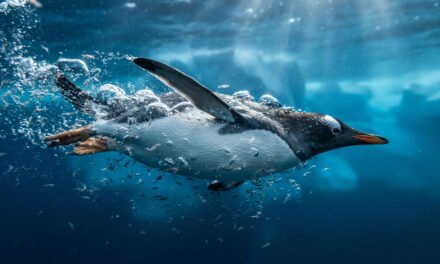
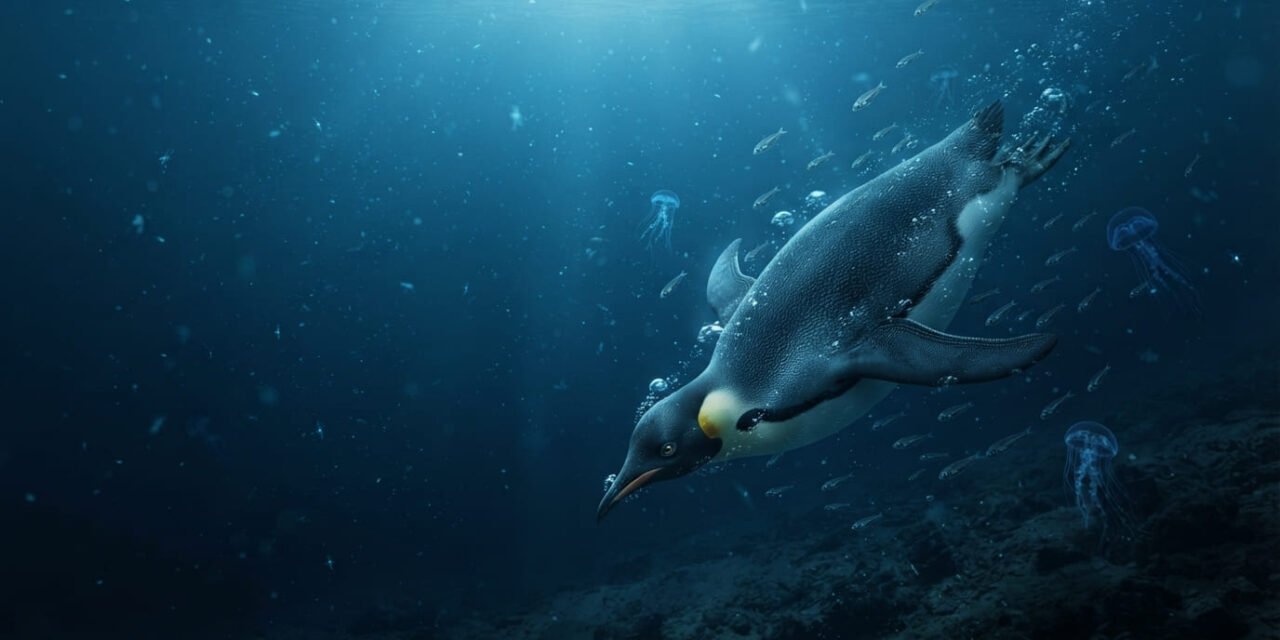
If you jumped into the Southern Ocean and tried to swim down to 1,800 feet, your lungs would collapse. The pressure at that depth is roughly 800 pounds per square inch. Most birds have hollow, light bones designed for flight, which would shatter under that kind of weight. But the Emperor Penguin is not built for the sky. It is built for the abyss.
This bird is a professional athlete of the deep. It can hold its breath for 20 minutes and swim to depths that few submarines reach. It does this in water that is literally at the freezing point. Every part of its body is designed to handle a world that is fundamentally hostile to warm-blooded life.
Solving the Pressure Problem
Most birds have bones filled with air. This makes them light enough to fly, but it also makes them fragile. If you take an air-filled container deep underwater, the pressure will eventually crush it. Emperor Penguins have evolved a different solution. Their bones are solid and heavy. They act like a diver’s weight belt, helping the bird sink quickly without burning too much energy.
Because their bones are solid, there is no air space inside them to be compressed. This allows them to handle the massive weight of the ocean without injury. They also have a flexible ribcage. As they dive deeper, their ribs can actually fold down to allow the lungs to collapse safely. This prevents the tissue damage that would happen if the lungs tried to stay inflated against the pressure.
The Five-Beat Heartbeat
When a human exercises, their heart rate goes up to move more oxygen to the muscles. The Emperor Penguin does the exact opposite. To stay underwater for 20 minutes, they have to conserve every single molecule of oxygen.
As soon as the penguin hits the water, its heart rate begins to drop. On land, its heart beats about 70 to 100 times per minute. During a deep dive, that rate can drop as low as five beats per minute. This is called the “dive reflex.” By slowing the heart, the bird ensures that oxygen is only sent to the organs that absolutely need it, like the brain and the heart. The muscles essentially shut down their oxygen use and run on a different kind of fuel.
Blood That Functions Like a Scuba Tank
Emperor Penguins have much more hemoglobin in their blood than humans do. Hemoglobin is the protein that carries oxygen. They also have high levels of myoglobin in their muscles, which stores oxygen locally.
When a penguin dives, its blood is saturated with oxygen. It uses its muscles as a secondary storage tank. This allows them to keep swimming even when their lungs have collapsed and are no longer providing fresh air. By the time the penguin returns to the surface, it has used up almost every bit of oxygen in its system. They can tolerate levels of carbon dioxide in their blood that would be toxic to a human.
Staying Warm in a Frozen Sea
The water in the Antarctic is about 28 degrees Fahrenheit. Salt water stays liquid at temperatures below the freezing point of fresh water. If your body temperature is 100 degrees, that water will suck the heat out of you almost instantly.
Emperor Penguins have the highest feather density of any bird. They have about 100 feathers per square inch. These feathers are stiff and scale-like, and they overlap like shingles on a roof. Underneath these feathers is a thick layer of downy fluff that traps a layer of air. This air acts as an insulating suit.
Before they dive, penguins preen their feathers with a special oil from a gland near their tail. This makes the feathers completely waterproof. If the water never touches their skin, they don’t lose heat as fast. They also have a thick layer of blubber under their skin that acts as a final barrier against the cold.
The Mystery of the Ascent
When human divers come up from the deep too fast, they get “the bends.” Nitrogen bubbles form in the blood and can cause paralysis or death. For a long time, scientists wondered why penguins don’t get the same thing.
The secret is in how they manage their air. Because their lungs collapse early in the dive, they aren’t absorbing much nitrogen from the air into their blood while they are at depth. They also climb back to the surface at a specific angle and speed that allows any gas in their system to be managed safely. They don’t just bolt for the surface; they manage their ascent with the precision of a computer.
The Energy Cost of Fishing
Diving to 1,800 feet is not just a physical challenge; it is an energy challenge. The penguin is looking for fish, squid, and krill. If they spend more energy diving than they get from the food they catch, they will starve.
They use a technique called “porpoising” when they need to move fast near the surface. They leap out of the water to reduce friction and take quick breaths. When they are deep, they use their wings like powerful oars. They don’t “swim” like a fish; they “fly” through the water. Their wings are stiff and flat, working like hydrofoils to move them forward with minimal effort.
Why This Matters
The Emperor Penguin lives in the most extreme environment on Earth. By studying how they survive these dives, we learn about the limits of vertebrate biology. Their ability to shut down blood flow to certain organs and survive on almost no oxygen is being studied to help humans who suffer from strokes or heart attacks.
Their survival depends entirely on the sea ice. They need the ice to breed, but they need the open water to hunt. As the ice patterns change, these birds have to travel further and dive deeper to find food. If the energy cost of the dive becomes too high, the colony cannot survive.
Final Thoughts
The Emperor Penguin is a reminder that nature find ways to break the rules. We think of birds as creatures of the air, but this bird has traded the sky for the deep ocean. It has traded light bones for solid ones and a fast heart for a slow one.
The next time you look at the ocean, remember that there is a bird down there, nearly half a mile below the surface, in total darkness and crushing pressure. It is hunting in a world where it shouldn’t be able to exist. It survives not through luck, but through a series of biological modifications that make it the most specialized diver on the planet. Our job is to make sure the environment stays stable enough for them to keep making those dives. They are the guardians of the Antarctic deep, and as long as they are diving, we know the Southern Ocean is still alive.