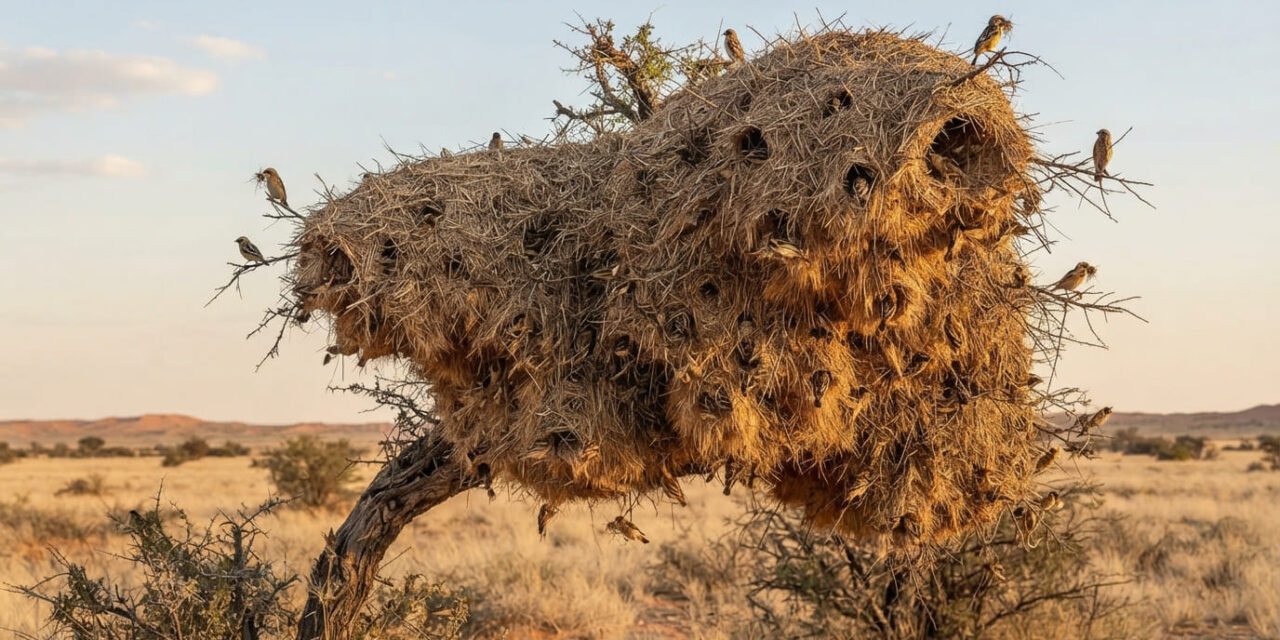
If you travel through the Kalahari Desert in Southern Africa, you will eventually see something that looks like a giant haystack stuck in a tree. These structures are so large that they sometimes snap thick branches or pull down telephone poles. These are the homes of the Sociable Weaver, a small bird that has figured out how to build the most permanent and complex apartment complex in the animal kingdom.
A single nest can weigh over 2,000 pounds. It can house up to 500 birds at once. While most birds build a new nest every year, the Sociable Weaver builds a home that lasts for a century. They are the only birds that live in a truly communal structure where generations of the same family stay under one roof for decades.
Built from the Ground Up
The construction starts with a simple framework of sticks. The birds don’t use mud or glue. They rely on the way different types of grass interlock. They harvest long, stiff grass stems and weave them into the existing structure. They use sharp, thorny sticks on the outer layer to keep snakes and hawks away from the entrances.
Each pair of birds has its own private “room” inside the giant haystack. These rooms are about four inches wide and have their own entrance tunnels facing downward. This downward-facing design is a security feature. It makes it very difficult for a predator to climb inside without being seen by the hundreds of birds living above.
Natural Air Conditioning
The Kalahari Desert is a place of extremes. In the summer, the sun can bake the ground at 110 degrees Fahrenheit. In the winter, the temperature drops below freezing at night. Small birds usually struggle to survive these shifts because their bodies lose heat quickly.
The Sociable Weaver solves this with thermal mass. The thick layers of grass and sticks act as heavy insulation. During the day, the heat from the sun stays on the outer layers of the nest. The inner rooms stay cool and shaded. At night, the birds huddle together in the center of the nest. Their combined body heat is trapped by the grass, keeping the temperature inside the rooms up to 40 degrees warmer than the outside air.
This temperature control is a lifesaver. By staying in a climate-controlled room, the birds save energy. They don’t have to eat as much food to stay warm or pant to stay cool. They use the nest to bypass the harshest parts of the desert environment.
The Cooperative Society
The word “Sociable” in their name isn’t a suggestion. It is a survival requirement. A single pair of birds could never build or maintain a 2,000-pound structure. They work together. Young birds often stay with their parents for several years to help raise the next brood of chicks and help with “home repairs.”
No leader or boss is telling them what to do. If a bird sees a hole in the roof or a loose stick, it fixes it. They are constantly adding new layers of grass to the top as the bottom layers rot away. This continuous maintenance is why some nests have been in use for over 100 years. It is a permanent monument to their teamwork.
Dealing with Unwanted Guests
A 2,000-pound nest is a target. Pythons and Cape Cobras often try to crawl into the tunnels to eat eggs or chicks. When a snake is spotted, the weavers don’t always fly away. They gather together and “mob” the predator. They fly close to the snake and make loud alarm calls to distract it. While they can’t kill a cobra, they can make it so uncomfortable that it leaves the area.
They also have to deal with “roommates.” Other birds, like the Pygmy Falcon, often move into the weaver nest. The weavers allow this because the falcons provide extra protection. A falcon will hunt larger birds that might try to destroy the nest. It is a trade-off. The weaver loses a few rooms to the falcon, but it gains a high-level security guard in return.
The Problem with Success
Sometimes the Sociable Weaver is too good at its job. Because the nests are so heavy, they can become a liability. If the birds keep adding grass to one side of the nest, the weight can become lopsided. After a heavy rain, the grass absorbs water and the weight doubles.
It is common to find large trees in the Kalahari that have split in half under the weight of a weaver nest. When a tree falls, the birds don’t give up. They immediately start building a new nest in a nearby tree or on a man-made structure like a power line tower. They are incredibly resilient. They have adapted to human technology faster than many other species, often preferring telephone poles because they are harder for snakes to climb.
Managing the Waste
Living with 500 people in one house creates a mess. The weavers manage this by having a strict “no bathroom” policy inside the nest. The birds always exit their tunnels to relieve themselves. This keeps the interior dry and reduces the spread of parasites.
The downward-facing tunnels also help with ventilation. Air flows up into the tunnels and circulates through the grass, preventing the nest from becoming damp or moldy. This cleanliness is another reason the structures can last for such a long time without collapsing from rot.
Why You Should Care
The Sociable Weaver is an example of how cooperation can overcome physical limitations. A bird that weighs less than an ounce can build a fortress that survives a century of desert storms.
Scientists study these nests to learn about “emergent behavior”—how a large group of individuals can create a complex system without a central plan. It is a living example of how small, consistent actions lead to massive results. For the people living in the Kalahari, the nests are a vital part of the landscape. They provide shade for other animals and help distribute nutrients into the soil as the grass eventually breaks down.
Final Thoughts
The Sociable Weaver is a master of communal living. They have figured out how to build a home that is safer, warmer, and more durable than anything they could build alone. They have turned grass and sticks into a high-performance thermal machine.
The next time you see a small, brown bird, don’t assume its life is simple. It might be a member of an engineering team that is maintaining a century-old skyscraper. They remind us that survival is often about finding the right people—or birds—to live with. As long as they keep weaving, the Kalahari will be dotted with these giant haystacks, proving that even the smallest creatures can build something that lasts longer than a human lifetime.