If you take a small boat down the slow-moving, muddy tributaries of the Amazon or Orinoco river basins in South America, you expect to see bright, elegant birds. You might look for the brilliant flash of a macaw or the sleek, high-speed dive of a kingfisher. But if you drift too close to the dense, tangled swamps bordering the water, you might encounter a bird that looks, and smells, like an absolute evolutionary mistake.
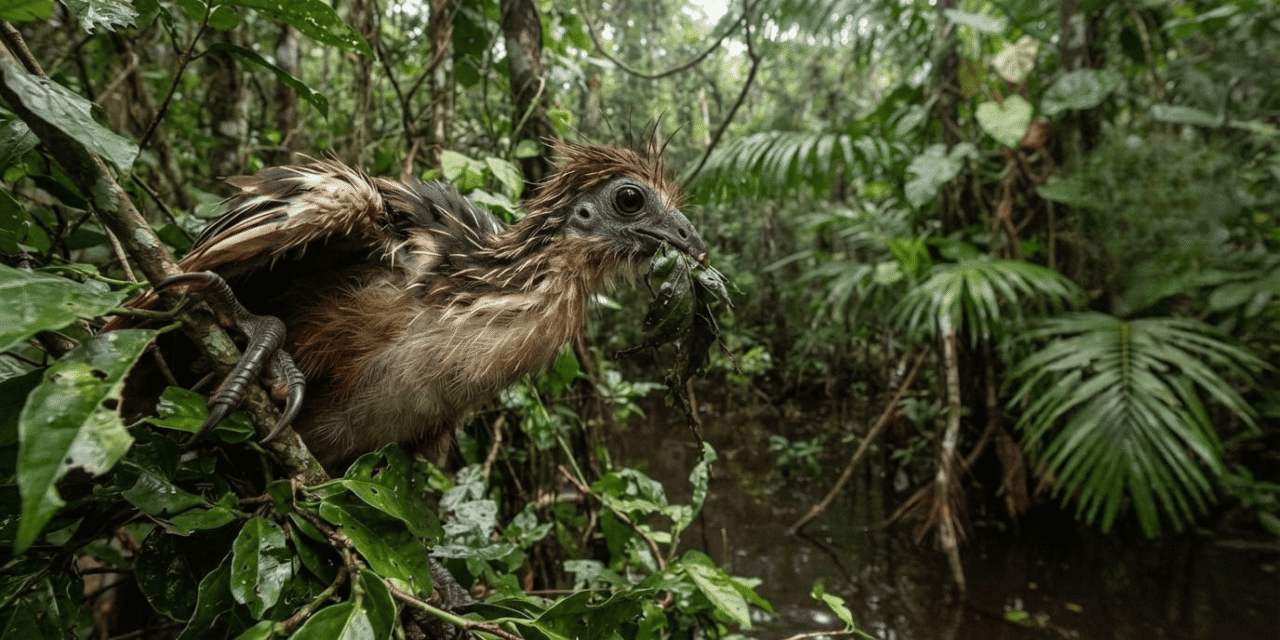
It is roughly the size of a pheasant, but it moves with none of a pheasant’s grace. It has a chestnut brown body, a striking, featherless patch of bright blue skin around its eyes, and a messy, spiked crest of feathers on its head that makes it look perpetually startled. It clambers awkwardly through the branches, flapping its oversized wings clumsily to keep its balance.
This is Opisthocomus hoazin, commonly known as the hoatzin.
Locals also know it by a much less flattering name: the stinkbird. While it might look like a messy, uncoordinated chicken, the hoatzin is actually one of the most biologically bizarre creatures on the planet. To understand how it survives in the fierce, predator-heavy environment of the Amazon, you have to look at a digestive system borrowed from a cow and a survival trick left over from the dinosaurs.
The Flying Cow
Almost all birds share a relatively similar diet based on high-energy foods. They eat seeds, nuts, fruit, insects, or meat. These foods are calorie-dense and quick to digest, which is essential for powering the massive muscles required for flight.
The hoatzin decided to ignore this rule entirely. It is a strict folivore. It eats leaves.
Specifically, it gorges on the tough, rubbery leaves of the swamp plants growing directly over the water. Eating leaves presents a massive biological problem for a bird. Leaves are packed with cellulose, which is incredibly difficult to break down, and they offer very little nutritional energy in return. If a macaw or an eagle tried to survive on a diet of swamp leaves, they would quickly starve to death.
To process this terrible diet, the hoatzin evolved a digestive system unique in the avian world. It digests its food exactly like a cow or a sheep using foregut fermentation.
When a hoatzin swallows a mouthful of leaves, the food doesn’t go straight to the stomach. Instead, it moves into a massively enlarged crop, a muscular pouch located at the base of the bird’s neck. Inside this crop, a highly specialized, complex culture of bacteria goes to work. The bacteria aggressively ferment the tough plant matter, breaking down the cellulose and neutralizing any toxic compounds the plants might possess.
This process is slow, heavy, and incredibly smelly. The constant bacterial fermentation produces a strong, pungent odor that permeates the bird’s skin and feathers. People who have gotten close to a hoatzin often compare the smell to fresh cow manure or rotting hay. It is a highly unpleasant scent, but it actually serves a fantastic secondary purpose: most mammalian predators, like jaguars or ocelots, simply refuse to eat them because they taste and smell so awful.
The Cost of Digestion
Having a massive fermentation vat in your chest comes with a severe physical penalty.
Because the hoatzin’s crop is so huge, it takes up almost the entire chest cavity. To make room for it, the bird’s sternum (the breastbone) has been severely reduced in size. In most birds, the sternum is a massive, keeled bone that anchors the powerful flight muscles. Because the hoatzin has a tiny sternum, its flight muscles are incredibly weak.
This is why they look so clumsy. A mature Opisthocomus hoazin is an incredibly poor flyer. They cannot sustain flight over long distances. If a hoatzin needs to move, it usually just jumps awkwardly from branch to branch. When forced to fly, it launches itself with desperate, noisy flaps, usually only managing to cover a short distance before crashing clumsily into another tree.
Their heavy, leaf-filled crops make them incredibly front-heavy, forcing them to rest their chests directly on branches just to keep their balance. They traded the freedom of the sky for the ability to eat the most abundant, uncontested food source in the swamp.
The Dinosaur Claws of the Swamp
Because the adults are such poor flyers, they build their nests on branches that hang directly over the water. This keeps the eggs safe from ground-dwelling predators, but the Amazon canopy is heavily patrolled by monkeys and snakes looking for an easy meal.
When a predator approaches the nest, the adult hoatzins can do little more than hiss aggressively and flap their wings. But the true genius of the hoatzin lies in the defense mechanism of the chicks.
When a hoatzin chick hatches, it does not look like a normal baby bird. It looks like a tiny, feathered dinosaur. On the bend of each wing, located on what would be its first and second fingers, the chick possesses two sharp, fully functional claws.
If a snake slithers toward the nest, the chicks do not wait to be eaten. They immediately jump out of the nest and plunge straight down into the muddy water below. Despite having just hatched, the chicks are excellent swimmers. They dive beneath the surface, holding their breath and hiding in the tangled mangrove roots until the danger has passed.
But jumping into a river is only a temporary solution. Eventually, the chick has to get back to the nest, which is hanging several feet above the water.
This is where the claws come into play. The chick swims to the trunk of the tree or a hanging vine. Using its beak, its feet, and those sharp, prehistoric wing claws, the baby bird physically hauls itself out of the water and climbs vertically back up the tree. It moves exactly like a tiny, reptilian rock climber.
As the bird matures and finally grows its adult flight feathers, it no longer needs to drop into the river to escape. The wing claws slowly disappear as the bird reaches adulthood, fading away as the hoatzin settles into its clumsy, smelly life in the canopy.
A Living Mystery
For decades, biologists have struggled to figure out exactly where Opisthocomus hoazin belongs on the evolutionary tree.
Because of the strange wing claws on the chicks, early scientists thought they might be a direct, missing link to Archaeopteryx, the famous feathered dinosaur. Later researchers thought they might be related to cuckoos, or perhaps turacos. Modern genetic testing has essentially proven that they have no close living relatives anywhere in the world. They sit on their own lonely branch of avian evolution, the last surviving members of a lineage that split off from all other birds millions of years ago.
It is incredibly easy to admire the sleek, fast, and beautiful hunters of the animal kingdom. We love the apex predators. But the hoatzin is a perfect example of survival through extreme specialization. It looked at a harsh, highly competitive rainforest and found a completely different path to success. It gave up the ability to fly well, accepted a life of smelling like a barnyard, and held onto a pair of dinosaur claws just to make sure its babies could survive a swim in the Amazon. It is a messy, clumsy, deeply strange bird, but in the dense swamps of South America, it works perfectly.