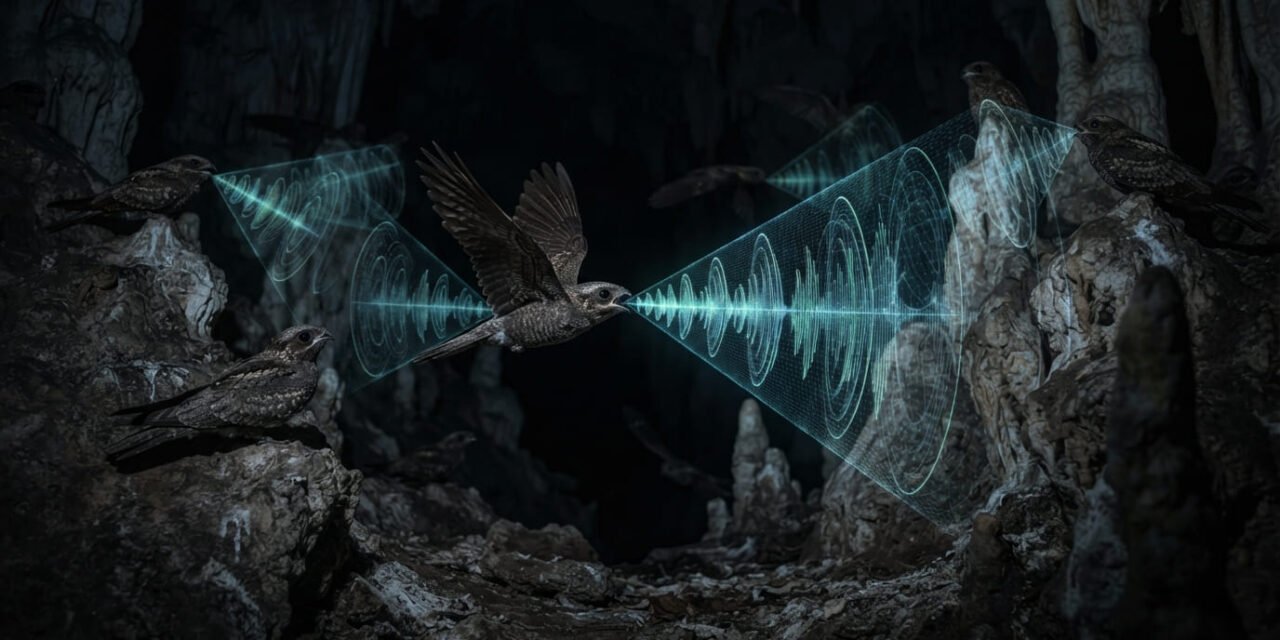
Imagine stepping into a cave so deep the sun does not just fade, it dies. Absolute, heavy darkness. It is the kind of blackness where you cannot see your own hand two inches from your face. If you stand perfectly still, you might expect dead silence. Instead, you are hit by a wall of sound. It is a chaotic mix of clicks, squawks, and metallic shrieks that sounds like a thousand rusty gates swinging in a windstorm.
If you shine a flashlight upward, you will see thousands of birds nesting on the high rocky ledges. These are oilbirds. They are the only nocturnal, fruit-eating birds on Earth that navigate their pitch-black homes using a biological sonar system.
The oilbird is known scientifically as Steatornis caripensis. Locally, in the South American forests where they live, people call them guácharos, which means “the ones who cry and lament.” They are medium-sized birds with a wingspan of about three feet, brown feathers speckled with white spots, and large, dark eyes.
But their eyes are useless in the deepest chambers of their caves. To get home, the oilbird had to borrow a trick from bats and dolphins. It developed a system of echolocation. It is a biological gadget that allows a bird to paint a picture of its environment using nothing but sound.
The Biology of the Audible Click
When we think of echolocation, we usually think of bats. But bats are high-frequency specialists. They emit ultrasonic pulses that are far too high-pitched for human ears to detect. These ultra-high frequencies are perfect for detecting tiny, fast-moving insects like mosquitoes.
The oilbird has a different problem. It does not hunt bugs. It eats fruit, mostly the oily nuts of palms, avocados, and tropical laurels. Because fruits do not run away or fly, the oilbird does not need a high-frequency system to pinpoint a moving target. It only needs to avoid smashing its face into a solid cave wall at thirty miles per hour.
Because of this, the oilbird’s echolocation is audible. They emit sharp, clicking sounds that humans can hear clearly. These clicks sit at a frequency of about two thousand to fifteen thousand Hertz. If you were to stand inside an oilbird cave, the sound would be deafening.
The bird produces these clicks using its syrinx, the avian vocal organ. The clicks are incredibly short, lasting only a couple of milliseconds. The bird sends out a rapid burst of these clicks and then listens for the return echo. By measuring the fraction of a second it takes for the sound to bounce off a cave wall and travel back to its ears, the oilbird’s brain calculates the distance to the obstacle.
The Limits of a Low-Frequency System
Because the oilbird uses lower, audible frequencies, its system has some built-in limitations. In physics, the wavelength of a sound wave determines the smallest object it can detect. High-frequency ultrasonic waves have short wavelengths, allowing bats to detect objects as thin as a human hair. The oilbird’s lower-frequency clicks have longer wavelengths.
This means the oilbird cannot “see” tiny details. Its acoustic resolution is limited to objects that are about twenty centimeters or larger. A thin wire or a small twig is invisible to the oilbird’s sonar. But a massive rock pillar, a cave wall, or another bird is easily detected.
The system is perfectly scaled to the bird’s needs. The oilbird does not need to dodge a spider web. It needs to find its nesting ledge in a cavern that might hold ten thousand other birds. Its audible clicks provide a reliable, low-energy map of the cave’s architecture.
Dual Sensory Mastery: Eyes Like Cameras
If you think the oilbird is just a feathered bat, you are missing half the story. The echolocation is only for the cave. Once the oilbird exits the cave mouth and enters the night forest, it turns its sonar off. In the open forest, the clicks would fade into the sky without returning an echo. Outside, the oilbird relies on its eyes.
And what eyes they are. The oilbird has some of the most light-sensitive eyes of any vertebrate. If you look at the structure of their eyes, they are shaped like high-aperture camera lenses. They have a massive pupillary aperture and a highly curved lens that focuses as much light as possible onto the retina.
The retina of the oilbird is packed with photoreceptor cells called rods, which are responsible for low-light vision. They have almost no cones, the cells used for color and bright light. The density of these rods is staggering. They have about one million rods per square millimeter. This is the highest density ever recorded in a vertebrate eye, far exceeding the visual capacity of cats, owls, or humans.
This dual system is a masterpiece of sensory compromise. In the pitch-black cave, where no amount of light-gathering power can help, the bird uses sound. In the moonlit forest, where sound is useless, the bird uses its ultra-sensitive eyes. This allows the oilbird to bridge two worlds that are usually closed to other species.
The Oily Diet and the “Fat Bird” History
The oilbird’s lifestyle is dictated by its diet. They are strict frugivores, eating only the fruits of specific tropical trees. These fruits are incredibly rich in fats and oils. Because the bird eats such high-energy food, its body accumulates a massive layer of fat.
This fat is the reason for the bird’s English name: the oilbird. It is also the reason the species was nearly wiped out in the past. In 1799, the famous explorer Alexander von Humboldt visited the Caripe cavern in Venezuela. He documented how the local indigenous people would enter the caves once a year to harvest the young, fat chicks.
The chicks are essentially balls of grease, often weighing half again as much as their parents. The people would boil the chicks in large clay pots to extract the oil. This oil was clear, odorless, and did not spoil easily. It was used for cooking and for fueling lamps.
Humboldt’s description of the harvest brought the bird to the attention of Western science, but it also highlighted the fragility of the species. Because oilbirds lay only two to four eggs and grow slowly, over-harvesting can easily destroy a colony that took centuries to build. Today, most oilbird caves are strictly protected by law.
A Nose for Fruit
Echolocation gets the bird through the cave, and its eyes get it through the forest. But how does the oilbird find a specific palm tree in a canopy of green? It uses its nose.
Most birds have a very poor sense of smell. We often assume that birds rely entirely on sight and sound. The oilbird is one of the few exceptions. It has highly developed olfactory bulbs in its brain. The oily fruits they eat, especially those in the laurel family, have a strong, aromatic scent when they are ripe.
The oilbird flies through the night forest, sniffing the air for the scent of ripe oil palm nuts. Once it locates the tree, it does not land on a branch to eat. It hovers. It has a low wing-loading ratio, meaning its wings are large compared to its body weight. This allows it to hover in place for a few seconds, pluck the fruit with its hooked beak, and swallow it whole.
Digestion in the Dark
The oilbird’s stomach is just as specialized as its nose. It lacks a typical muscular gizzard for grinding food. Instead, it has a highly acidic, thin-walled stomach that dissolves the soft, oily flesh of the fruit.
Once the oil is extracted, the bird cannot digest the large, hard seed. It regurgitates the seeds. If you visit an oilbird cave, you will find the floor covered in a thick layer of thousands of bare seeds. The birds act as the primary seed dispersers for the forest.
By carrying the seeds deep into the caves and then spitting them out, they create an unusual ecosystem on the cave floor. The seeds sprout in the dark, creating pale, white forests of seedlings that quickly die because they have no sunlight to perform photosynthesis. This constant input of organic material supports a massive community of cave insects, spiders, and fungi that would otherwise starve.
The Social Din of the Colony
Oilbirds are highly social. They nest in colonies that can number in the thousands. This social structure provides safety from predators like owls or small cats that might try to enter the cave mouth.
However, the sheer noise of a colony is also a defense. When a predator enters the cave, the birds begin to shriek. The combination of thousands of birds clicking and screaming at once creates a disorienting acoustic environment. The sound waves bounce off the walls, making it difficult for a predator to locate an individual bird.
The birds also use their calls to communicate with their neighbors. They have distinct social calls that are different from their navigation clicks. They grunt and cluck to establish territory on the narrow nesting ledges. A nesting ledge is a valuable piece of real estate, and a pair of oilbirds will defend their small patch of rock for their entire lives.
Why You Should Care
The oilbird is a reminder that nature does not care about our categories. It is a bird that lives like a bat, smells like an avocado, and navigates like a submarine. It shows us that if the evolutionary pressure is high enough, a species can develop entirely new sensory systems to survive.
You should care about these birds because they are the gardeners of the South American forests. By flying up to seventy miles in a single night to gather fruit, they distribute seeds over vast areas. They maintain the genetic diversity of tropical trees, which keeps the atmosphere healthy. If the oilbirds disappear, the forests will lose their most important planter, and the cave ecosystems will starve.
Final Thoughts
The oilbird is an ancient survivor. It has remained largely unchanged for millions of years because its design simply works. It took the darkness of the cave and turned it into a haven using the physics of sound. It took the darkness of the night forest and turned it into a banquet using the chemistry of smell and the sensitivity of its eyes.
When you think of the great navigators of the world, do not just think of humans with compasses and satellites. Think of the oilbird. It is a creature that flies through a pitch-black labyrinth, dodging stone pillars and finding its home using nothing but the echoes of its own voice. It is a silent partner to the forest and a master of the dark, proving that sometimes, the best way to see the world is to listen to it.