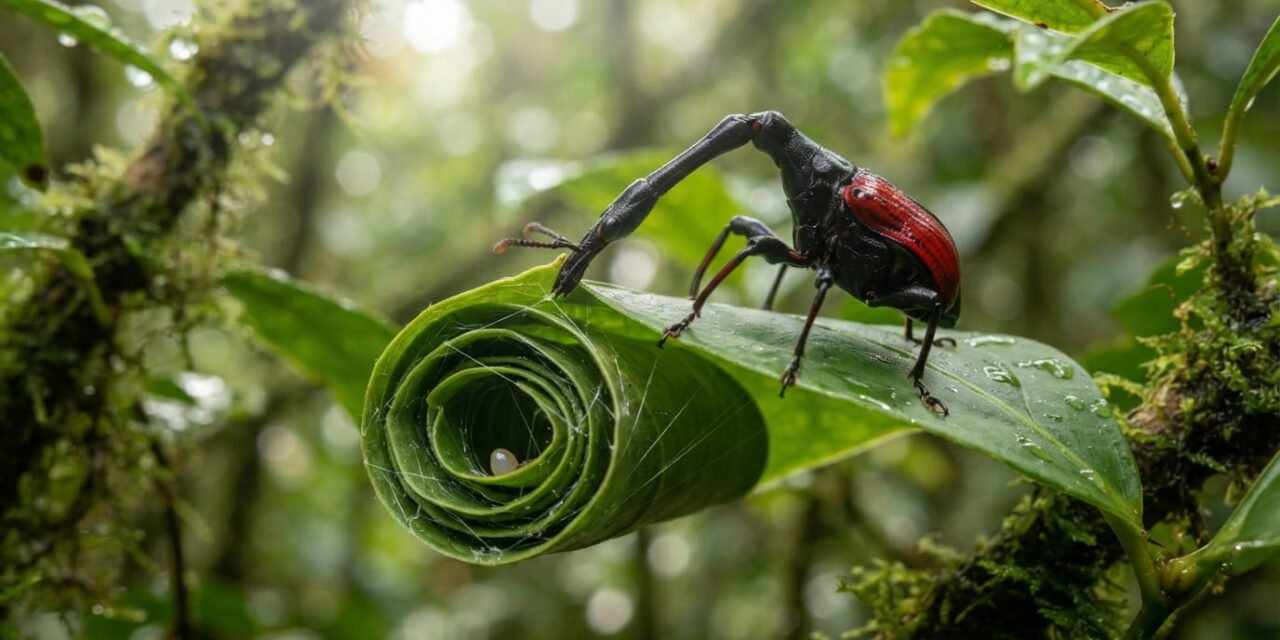
If you walk through the eastern rainforests of Madagascar, you will find yourself in a world of evolutionary experiments. It is an island where isolation has allowed nature to get weird. Among the mossy tree trunks and damp ferns, you might spot a flash of bright, berry-red on a green leaf. If you look closer, you will see a tiny creature that looks like a miniature crane. It has a glossy, pitch-black body, bright red wing cases, and a neck that is absurdly long. This is the giraffe weevil.
Known to science as Trachelophorus giraffa, this beetle is tiny, usually measuring between one and two inches long. Yet, it possesses one of the most striking shapes of any insect on Earth. The neck of the male is exceptionally long, stretching out from its body like a black tube. The female’s neck is much shorter, but she is the one who truly puts her anatomy to work. While the males spend their time showing off and fighting, the female executes a complex, highly precise engineering project. She folds, cuts, and rolls a single living leaf into a secure, self-locking nursery for her egg.
The Tools of a Master Crafter
To understand the leaf-rolling process, you first have to understand the family this insect belongs to. The giraffe weevil is a member of the Attelabidae family, commonly known as leaf-rolling weevils. These insects are found all over the world, but the Madagascar species has taken the behavior to an extreme level of precision.
The entire life of the giraffe weevil is bound to just two species of trees in Madagascar: Dichaetanthera arborea and Dichaetanthera cordifolia. These are small, bush-like trees with finely haired green leaves. The weevils eat the leaves, drink the sap, and use the foliage to build their nests. They rarely venture more than a few feet from these trees during their one-year lifespan.
When a female giraffe weevil is ready to lay an egg, she does not just drop it on a branch. She selects a young, tender leaf from her host tree. She tests the leaf’s flexibility by walking across it, using her feet to gauge its thickness and moisture content. If the leaf is too old and stiff, it will crack during the rolling process. If it is too young, it will rot too quickly. She needs a leaf that is just right.
Step One: Breaking the Leaf’s Defenses
A healthy leaf is a pressurized hydraulic system. It is filled with water and sap, which keeps it stiff and upright so it can catch sunlight. You cannot easily roll a pressurized leaf; it will snap and spring back into shape. The female weevil’s first task is to turn off the water pressure.
She starts at the base of the leaf, near the stem. Using her specialized, sharp mandibles, she bites a series of precise slits on either side of the main central vein, which is called the midrib. She is careful not to cut the vein all the way through. She only wants to sever the vessels that carry water to the outer parts of the leaf.
Once these cuts are made, she pauses. She will wait for up to half an hour. During this time, the lower portion of the leaf loses its water pressure. It goes limp, soft, and pliable. It hangs down from the branch like a piece of wet green paper. This preparatory step is crucial. By working with a limp leaf, the weevil ensures that she can bend the fibers without tearing them.
Step Two: Scoring and Folding
Once the leaf is limp, the construction begins. The weevil walks down the center of the leaf, straddling the midrib. She uses her jaws to bite small notches along the underside of the main vein. These notches act like perforated lines on a piece of cardboard. They break the structural strength of the vein and make it easy to bend at specific intervals.
Next, she bites notches in the side veins that branch out from the center. She is preparing the leaf to be folded in half. Working her way from the base to the tip, she uses her powerful legs to squeeze the two sides of the leaf together, folding it along the perforated center line.
This is where her extended neck becomes a valuable tool. She uses her head and neck as a lever, pressing down on the folds to crease them. Her neck acts as a mechanical press, flattening the leaf fibers so they stay folded. It is a slow, physically demanding process that requires the weevil to use her entire body weight to force the leaf into compliance.
Step Three: The Roll and the Secret Lock
With the leaf folded in half, the weevil begins to roll it from the tip upward. She uses her front legs to pull the leaf tip toward her body, curling it into a tight cylinder. She rolls it twice, creating a small, enclosed pocket at the core of the structure.
She stops rolling to prepare the nursery chamber. She walks to the center of the roll and bites a small slit. She then turns around, inserts her ovipositor into the slit, and lays a single, yellow egg deep inside the fold.
After laying the egg, she continues rolling. Every two turns, she stops to perform a vital securing maneuver. She uses her jaws to bite small wedges or flaps into the edges of the roll, pushing the cut tissue inward. These bites act like biological Velcro. The fibers of the cut edges interlock, preventing the roll from unraveling. She does not need silk or glue to hold the structure together; she uses the mechanical tension of the leaf itself, locked in place by her precise cuts.
Step Four: The Final Seal and the Drop
When she reaches the base of the leaf, she has a tight, neat green cylinder. It looks like a tiny, hand-rolled cigar. To finish the project, she tucks the loose flaps on the ends into the center of the roll, sealing the chamber from the outside world. This protects the egg from rain, wind, and parasites.
The final act of construction is the drop. The female walks back to the stem of the leaf. She bites through the remaining fibers of the stem until the connection breaks. The finished roll, called a nidus, falls through the canopy and lands on the damp forest floor.
The entire process takes about two hours of continuous labor. The female will repeat this process for every egg she lays during her short life. By dropping the nest to the ground, she is giving her offspring the best possible start. The forest floor is humid, which keeps the leaf roll from drying out. As the leaf slowly decays on the damp soil, it becomes soft and easy to digest. When the tiny larva hatches inside the roll, it finds itself surrounded by its first meal. It can eat its way from the inside out, completely protected from the dangers of the open forest.
The Showy Males
While the female is busy with her complex construction work, the male giraffe weevil leads a very different life. His neck is two to three times longer than the female’s, making up nearly half of his total body length. This extreme feature is a classic example of sexual dimorphism.
The male does not help with the nest. He spends his days walking along the branches of the Dichaetanthera trees, looking for females. When two males meet on the same branch, they fight. They do not have stingers or large jaws for biting. Instead, they use their long necks like clubs.
The males face each other on a leaf and begin to swing their necks, thwacking each other with their heads. They push, shove, and try to lean their weight on the opponent. The goal of the fight is simple: knock the other guy off the branch. The winner of the wrestling match gets the opportunity to mate with the nearby female.
Once the mating is over, the victorious male does not walk away. He hangs around the female while she builds her leaf roll. He acts as a guard, chasing off other males who might try to interrupt her work. This is his only contribution to the nesting process. The actual engineering remains entirely the responsibility of the female.
Lessons in Biological Folding
You should care about the giraffe weevil because its nesting technique is a perfect example of natural origami. Engineers and material scientists study how insects fold materials to solve human problems. The way the female weevil reduces water pressure, perforates the veins, and uses self-locking bites to hold a curved structure together is highly relevant to modern design.
We use similar principles when designing solar panels that must fold up inside a rocket and unfold automatically in space. We also use these ideas in packaging, trying to create cardboard boxes that lock together without the need for toxic glues or plastic tape. The weevil has been using these exact mechanical principles in the forests of Madagascar for millions of years.
Final Thoughts
The giraffe weevil is a reminder that complexity is not reserved for large animals. A tiny beetle, operating entirely on instinct, can execute a construction project that requires an understanding of hydraulics, geometry, and material strength.
When you see a picture of a giraffe weevil, do not just focus on its strange neck. Think of the female working quietly in the canopy of Madagascar. See her as an architect who turns a simple green leaf into a secure, self-locking home for her child. Her work is a quiet masterpiece of natural design, showing us that with the right cuts and folds, you can build a fortress out of a leaf.