Most of us have a pretty simple reaction when we see a wasp nest tucked under the eaves of our porch or hanging from a tree branch: we run. And hey, that’s fair. Wasps have a bit of a reputation for being the “grumpy” cousins of the bee world. But if you can get past the fear of the sting for a second, there is something absolutely incredible happening right above your head.
That grey, swirly, ball-shaped house isn’t just a nest. It’s a feat of chemical engineering and architecture. Long before humans figured out how to grind up trees to make notebooks and cardboard boxes, wasps were already master paper-makers. In fact, they’ve been using the same technology for millions of years.
The World’s Smallest Lumberjacks
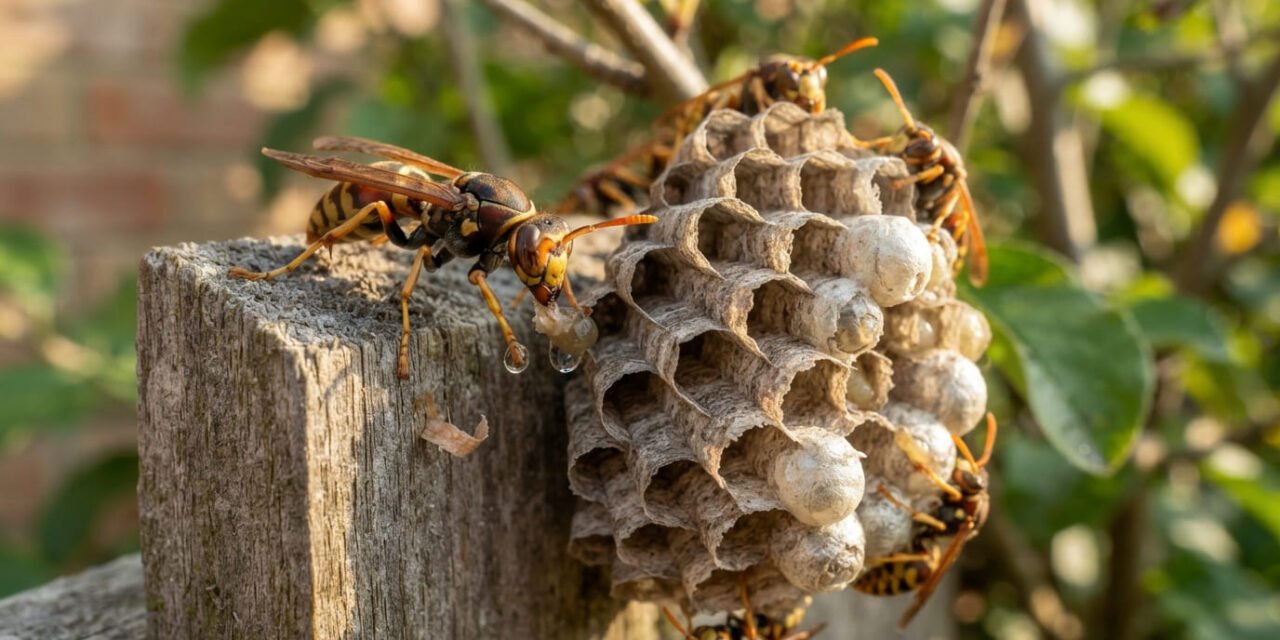
Have you ever sat on a wooden deck in the summer and heard a tiny “scritch-scritch” sound? If you look closely, you might see a wasp perched on the wood. She isn’t eating it for food. She’s harvesting raw materials.
A wasp’s mouth is equipped with powerful, scissor-like jaws. She uses these to scrape off tiny fibers of weathered wood from fence posts, old logs, or even your garden furniture. She gathers a little bundle of these fibers and then gets to work on the chemistry.
She mixes the wood fibers with her own saliva. This isn’t just regular spit; it’s a special cocktail of enzymes that breaks down the wood and turns it into a soft, mushy pulp. If you’ve ever seen a “paper mill” where trees are turned into paper, it’s the same basic process—just on a much smaller, wetter scale.
Creating the First Cardboard
Once she has a ball of this wood pulp, she flies back to the nest site. Using her legs and her mouth, she spreads the pulp out into a thin, flat ribbon. As the water in her saliva evaporates, the pulp dries and hardens into a material that is remarkably similar to the grey paper we use for egg cartons or heavy-duty cardboard.
What’s truly amazing is that this paper is incredibly strong but also very light. It’s also waterproof! Even during a heavy summer rainstorm, the inside of a wasp nest stays bone-dry. The wasps lay down the paper in layers, creating “envelopes” of air between the sheets. This acts like the insulation in your attic, keeping the nest warm when it’s cool outside and protecting the babies from the scorching afternoon sun.
A City of Hexagons
If you were to peel back the outer grey shell of a wasp nest (don’t actually do this!), you’d see a beautiful, complex interior. Inside are rows and rows of perfect hexagonal cells.
Why hexagons? Well, wasps are just as good at math as they are at chemistry. A hexagon is the most efficient shape in nature. It allows the wasps to build the maximum number of rooms for their larvae using the minimum amount of paper. If they built circles, there would be gaps between the cells. If they built squares, they’d use too much material. The hexagon is the “sweet spot” of engineering.
Inside these cells, the queen lays her eggs. The paper is strong enough to hold the weight of the growing larvae, but thin enough to allow air to flow through the colony. Every single cell is hand-crafted, one fiber at a time, by workers who are navigating a dark, cramped space using only their sense of touch and smell.
The Queen’s Master Plan
A wasp nest starts with a single female—the Queen. In the early spring, she emerges from her winter hiding spot. She is totally alone. She has to find a location, harvest the wood, make the first batch of paper, and build a small “starter home” with just a few cells.
She lays her first eggs and has to hunt for food to feed the larvae herself. But once those first workers hatch, the Queen “retires” from manual labor. She stays inside the nest and focuses entirely on laying eggs. The new workers take over the construction.
This is where the project really takes off. The workers don’t need a blueprint or a foreman. They just see where the nest needs to be expanded, and they keep adding more pulp. Some wasps specialize in finding wood, others in mixing the pulp, and others in the delicate work of shaping the cells. It’s an assembly line that would make Henry Ford jealous.
Architecture That Breathes
As the colony grows, the nest has to change. It’s not like a human house where the walls stay in one place. A wasp nest is a “living” structure.
When the colony gets bigger, the workers will actually chew away the inner walls of the outer shell to make room for more cells. Then, they add new layers to the outside. They are constantly renovating and expanding their home while they are still living in it.
They also have to manage the “climate” of the nest. On a very hot day, you might see wasps standing at the entrance of the nest, frantically vibrating their wings. They aren’t trying to fly; they’re acting like living fans. They pull cool air into the nest to prevent the paper from getting too brittle and to keep the larvae from overheating.
Why Do We Hate Them?
It’s easy to focus on the sting, but wasps are actually very helpful to have in your garden. While bees are the famous pollinators, wasps are the “pest control” team.
To feed their larvae, wasps hunt other insects like caterpillars, flies, and crickets that eat our crops and flowers. A single wasp colony can remove thousands of garden pests in one summer. They are the balance-keepers of the insect world. Without them, our farms would be overrun with “bad” bugs.
Plus, their invention of paper is something we use every day. Legend has it that thousands of years ago, a Chinese official named Cai Lun watched wasps building their nests and realized that humans could do the same thing. Whether that story is true or not, the “wasp method” of grinding wood into pulp is still how we make almost all of our paper today.
The Beauty of the Temporary
One of the most interesting things about a wasp nest is that it’s built for a single season. Unlike some ant colonies or beehives that last for years, a wasp nest is abandoned every autumn.
When the first hard frost hits, the workers and the old queen die. Only the new, young queens survive by hiding in old logs or under the soil. The beautiful, complex paper palace they spent all summer building is left to rot.
There’s a certain poetry in that. They spend their entire lives building something perfect, only for it to be used for a few months and then returned to the earth. It’s a reminder that beauty doesn’t have to be permanent to be valuable.
How to Live Together
If you find a wasp nest near your home, you don’t always have to call the exterminator. If the nest is high up or far away from where people walk, the best thing to do is just leave it alone. Wasps generally won’t bother you unless they feel their nest is being threatened.
If you watch them from a safe distance, you can see the “lumberjacks” coming and going, carrying their little balls of pulp. You’re watching a 100-million-year-old construction project.
Final Thoughts
The wasp is an insect that deserves a little more respect. She’s a chemist, an architect, a mathematician, and a mother. She takes a piece of a dead tree and turns it into a waterproof, insulated skyscraper using nothing but her own body and her own hard work.
The next time you see a scrap of grey paper in the woods or a nest under a roof, take a second to look at the patterns in the pulp. You’re looking at the world’s first cardboard. You’re looking at a design that hasn’t needed an upgrade since the dinosaurs were walking around.
We live in a world of complex machines and 3D printers, but we’re still just trying to keep up with the wasp. Maybe they aren’t “grumpy” at all—maybe they’re just busy working on the next masterpiece.