Imagine walking through a warm, damp forest in tropical Africa, Asia, or Australia. The air is humid, the leaves are slick with moisture, and tiny insects are flying between the trees. If you look closely at a web stretched across a bush, you might expect to see a typical spider sitting in the center, waiting for a fly to crash into its trap.
Most spiders are simple creatures of instinct. They build a web, feel for vibrations, and bite whatever gets stuck. If something goes wrong, they react on basic reflexes.
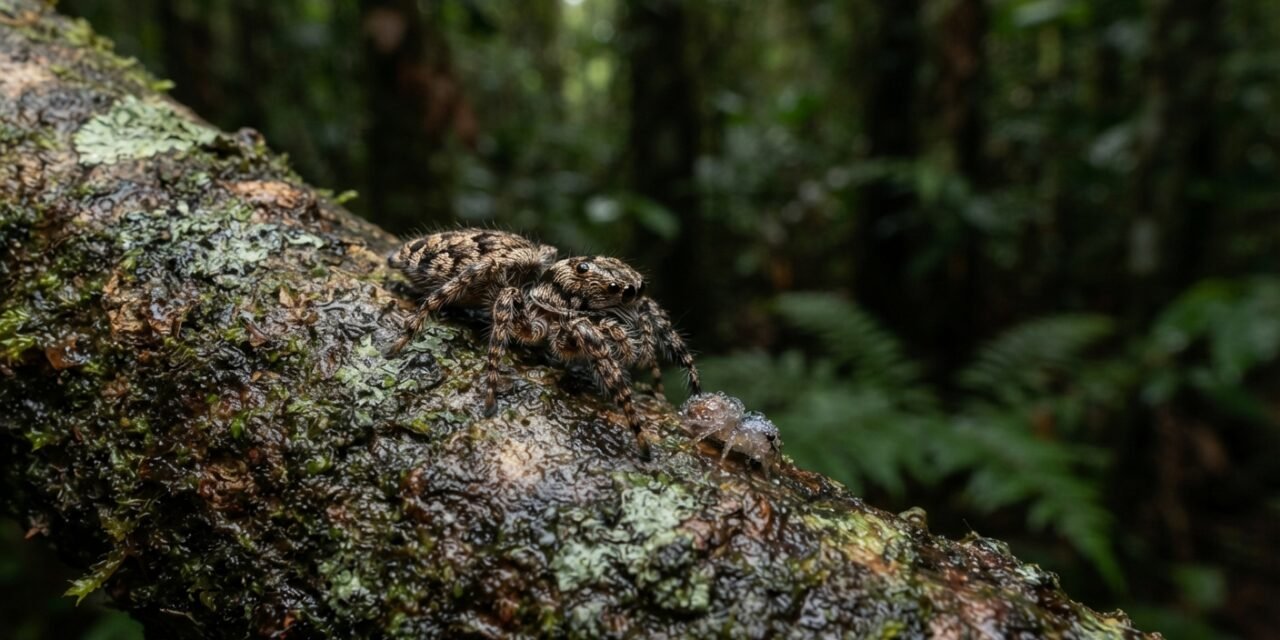
But if you look at the edge of that web, you might spot a tiny, fuzzy spider no bigger than a raisin. It has brownish, tufted fur and looks like a dry leaf or a bit of forest debris floating in the breeze. It is not building a web. It is sitting quietly, staring directly at the web’s owner with two massive, forward-facing eyes.
This is Portia, a genus of jumping spider that holds a unique title in the animal kingdom. It is a spider that hunts other spiders for a living.
To catch creatures that are armed with their own deadly venom, sharp jaws, and sensitive traps, Portia cannot rely on brute force. It is far too small and light for a head-on fight. Instead, it uses a level of problem-solving, strategic planning, and trial-and-error reasoning that you would expect from a mammal, all packed into a brain smaller than a single pinhead.
The Most Dangerous Game
To understand why Portia needs to be so smart, you first have to appreciate how dangerous its lifestyle is.
In the invertebrate world, hunting other predators is the ultimate high-risk job. Most spiders are well-armored, quick to react, and equipped with venom designed to immobilize prey instantly. A single mistake means that Portia goes from being the hunter to being someone else’s dinner.
To make matters harder, different species of spiders use completely different defense mechanisms. A web-building orb weaver sits in a web tuned to detect physical vibrations. A spitting spider can shoot a mixture of sticky silk and venom from several inches away in a fraction of a second. A jumping spider living in a rolled-up leaf has sharp vision and fast reflexes.
A hunter using a single, fixed attack strategy would not last a day against this variety of weapons. Portia needed a flexible mind that could assess a target, select a custom tactic, and adjust its plan when things did not go smoothly.
High-Definition Eyes in a Tiny Body
The foundation of Portia’s intelligence begins with its vision. Most spiders have eight eyes, but their eyesight is notoriously poor. They can usually detect light, shade, and nearby movement, relying mostly on tactile vibrations to navigate the world.
Portia is a member of the jumping spider family, which possesses some of the best eyes in the entire invertebrate world. It has two large eyes sitting right in the middle of its face that function like a pair of high-powered binoculars.
These main eyes have a narrow, highly detailed field of view with an exceptionally high spatial resolution. Inside the eye, the retina is actually shaped like a long, flexible tube that the spider can move side to side and up and down using tiny internal muscles. Portia can scan its surroundings, inspect distant objects, and judge depth with extreme accuracy.
Because its vision is so clear, Portia can spot another spider from several feet away. It does not just see a moving shape; it can recognize the specific species of spider sitting in a distant web, tell which direction the prey is facing, and check whether the target is carrying an egg sac or eating a meal. This visual identification is the first step in launching a custom-designed attack.
The Web-Plucking Con Artist
When Portia decides to hunt a web-building spider, it approaches the edge of the target’s web very quietly. It does not crash into the silk like a clumsy fly. It attaches a safety line of its own silk to a nearby twig and gently steps onto the outer threads of the web.
Now the psychological warfare begins. Portia reaches out with its front legs and begins to pluck the web threads.
It does not pluck randomly. It uses its legs and jaws to produce a vast range of different rhythmic patterns, frequencies, and tensions. It can make the silk twang like a guitar string, ripple gently like a soft breeze, or vibrate violently like a struggling insect.
The goal is to send a signal through the web to the owner sitting in the center. Portia plays a game of trial and error with the host spider’s nervous system.
It starts by trying one specific vibration rhythm. It plucks a thread and watches how the owner reacts. If the host spider ignores the sound, Portia stops and tries a completely different rhythm. If the host spider gets scared and runs away, Portia switches to a softer, gentler touch.
Portia continues testing different vibrations until it finds the exact rhythm that triggers the response it wants.
Sometimes, it mimics the soft, subtle twitch of a tiny fly stuck in the outer edge of the web. This lures the hungry host spider out toward Portia slowly and carelessly, expecting an easy snack.
Other times, Portia creates a heavy, chaotic vibration that mimics a large leaf bumping into the web. This causes the host spider to freeze or turn away, allowing Portia to walk right up to its back without being noticed.
If the hunt takes hours, Portia will sit patiently on the edge of the web, testing dozens of different pluck patterns until it finds the key that unlocks the host’s defense mechanism. It remembers which rhythm worked, using that knowledge to finish the strike.
The Art of the Long Detour
Using trial and error on a web is impressive, but Portia’s real mental breakthrough involves spatial reasoning and detour planning.
Imagine standing on a branch and looking across a three-foot gap to a target spider resting on a leaf. Direct jumping is impossible because the distance is too far. The only way to reach the target is to walk backward away from the prey, travel along a long, winding vine, climb up to a higher branch, walk across the canopy ceiling, and drop down from above on a silk line.
For almost all small animals, if a target disappears from view, it ceases to exist. They operate on an “out of sight, out of mind” brain model. If they have to turn around and walk away from food to reach it, their brain gets confused and forgets the goal.
Researchers tested Portia in elaborate laboratory mazes to see how it handled this problem. They placed Portia on a central platform where it could look out and see two different pathways made of artificial vines. Only one pathway led to a meal; the other led to a dead end.
To make the test even harder, the researchers arranged the pathways so that to take the correct route, Portia had to walk down off its platform, turn completely away from the food, and walk through a long, dark tube where it could no longer see the target.
Portia passed the test with ease.
Before stepping off the platform, the spider stood still for several minutes, scanning the maze with its high-definition eyes. It mapped out the entire layout in its mind, choosing the winning pathway before taking a single step.
Once it started moving, Portia walked down the pole, entered the dark tube, and walked away from the target. It maintained a mental map of the room, keeping track of where the food was located relative to its own body even when it could not see it. It would follow a detour path for over an hour, navigating complex twists and turns, finally emerging directly above the prey to deliver a drop strike.
Tailored Tactics for Deadly Targets
Portia’s ability to adapt its strategy becomes even more apparent when it hunts dangerous specialists.
One of its favorite targets is the spitting spider (Scytodes). Spitting spiders are exceptionally dangerous because they carry two large glands in their heads filled with a mixture of venom and sticky liquid silk. When threatened, they can shoot two pressurized, crisscrossing streams of sticky venom at a target in less than twenty milliseconds, pinning an attacker to a leaf instantly.
Facing a spitting spider from the front is suicide. Portia seems to know this.
When Portia spots a spitting spider, it completely changes its approach. It never attacks from the front, and it never uses web-plucking tricks. Instead, it carefully maneuvers around the spitting spider until it is positioned directly behind it. It will crawl along the underside of a leaf or drop down from a silk line to land on the spitting spider’s back, striking the one angle where the spitting spider cannot aim its weapon.
However, if the spitting spider is carrying an egg sac in its jaws, Portia changes its tactic again. Carrying an egg sac prevents the spitting spider from opening its mouth quickly to shoot its sticky venom. Recognizing that the weapon is temporarily disabled, Portia drops its cautious stealth approach and launches a direct, aggressive frontal attack.
Another target is Euryattus, a jumping spider that builds a home inside a dead, curled-up leaf suspended from a bush by silk threads. The female Euryattus sits safely inside her rolled-up leaf house, making a direct break-in almost impossible.
To hunt Euryattus, Portia climbs to the top of the suspended leaf and begins to rock the leaf back and forth using its body weight. It mimics the courtship signals of a male Euryattus.
The female Euryattus, thinking a potential mate has come to call, steps out of her leaf house to investigate. The moment her head emerges from the opening, Portia drops down from above and delivers a lethal bite.
Big Intelligence in a Micro Nervous System
How does a creature with a brain made of only about 600,000 neurons pull off these complex mental tasks? To put that number into perspective, a human brain contains roughly 86 billion neurons, and a common honeybee has about one million.
Part of the answer lies in execution speed. Portia processes information much more slowly than a mammal or a bird.
When you watch Portia in the wild, it moves with a strange, creeping slowness. It will sit on a branch for twenty minutes, staring at a target without twitching a single leg. It is not frozen in fear or resting; its tiny brain is taking a long time to process the high-definition visual data from its eyes, build a spatial map of the room, and calculate the best detour path.
Where a human brain makes complex spatial decisions in a split second, Portia achieves the exact same logical result by slowing down the clock. It trades physical speed for mental computing power. It takes its time to think through the problem before executing a move.
This slow, deliberate lifestyle is supported by a remarkably efficient memory system. Portia can store working memory for long periods, keeping a mental goal active even while navigating dark, featureless terrain. It uses a combination of visual landmarks, internal spatial awareness, and feedback from its own silk safety lines to keep track of where it is in the world.
Lessons in Natural Computing
You should care about Portia because it completely upends our understanding of animal intelligence. For a long time, scientists believed that complex behaviors—like strategic planning, mental mapping, and adaptive trial and error—required a large, heavy brain with millions of neural connections.
Portia proves that you can run high-level cognitive software on remarkably small biological hardware.
Computer engineers, roboticists, and artificial intelligence researchers study Portia to learn how to build smarter, lighter machines. Modern autonomous drones and self-driving systems require heavy microprocessors, massive battery packs, and cooling fans to process spatial maps and navigate obstacles in real time.
By studying how Portia uses simple visual algorithms, working memory, and slow-time processing to solve complex spatial navigation problems, engineers are developing new ways to design low-power micro-robots. We can build tiny, autonomous exploration drones that can navigate collapsed buildings or distant planets using a fraction of the energy traditionally required. Portia shows us that smart design and clever shortcuts are far more important than raw size.
Final Thoughts
Portia is a wonderful reminder that nature is full of quiet, unexpected brilliance. It is a tiny, dusty-looking spider crawling slowly across a leaf, yet it carries the mental equipment of a master chess player.
It took a body plan built for basic reflexes and transformed it into a flexible, problem-solving engine. By pairing high-definition vision with patience, spatial memory, and a willingness to try new tactics when old ones fail, this tiny predator dominates its forest world.
The next time you see a spider sitting on a wall or dangling from a thread, take a second look. It might just be operating on simple instinct. But if it is Portia, it might be taking a slow, quiet moment to look at the room, evaluate the options, and plan its next clever move.