Imagine you are floating through a quiet, humid mangrove swamp in Southeast Asia. The air is thick, the water is dark and brackish, and the twisted roots of the trees hang heavily over the surface. Up on a low-hanging leaf, about three feet above the water, a small insect is resting in the shade. It feels perfectly safe. After all, fish live in the water, and bugs live in the air. The boundary between the two worlds usually keeps them separated.
Suddenly, a high-speed, perfectly aimed jet of water strikes the insect dead center. The physical force of the water breaks the bug’s grip on the leaf. It tumbles through the air, crashes into the surface of the swamp, and is instantly swallowed by a waiting fish.
This was not a random splash or a lucky accident. It was a highly calculated sniper shot executed by the banded archerfish, scientifically known as Toxotes jaculatrix. While most fish are completely content to scavenge for whatever dead or dying material happens to fall into the water, the archerfish prefers to take a much more proactive approach. It hunts terrestrial insects by shooting them out of the sky.
To pull this off, the fish has to act as a master of both optical physics and fluid dynamics.
The Problem with Refraction
If you want to understand just how wildly impressive this hunting method is, you have to look at it from a physics perspective.
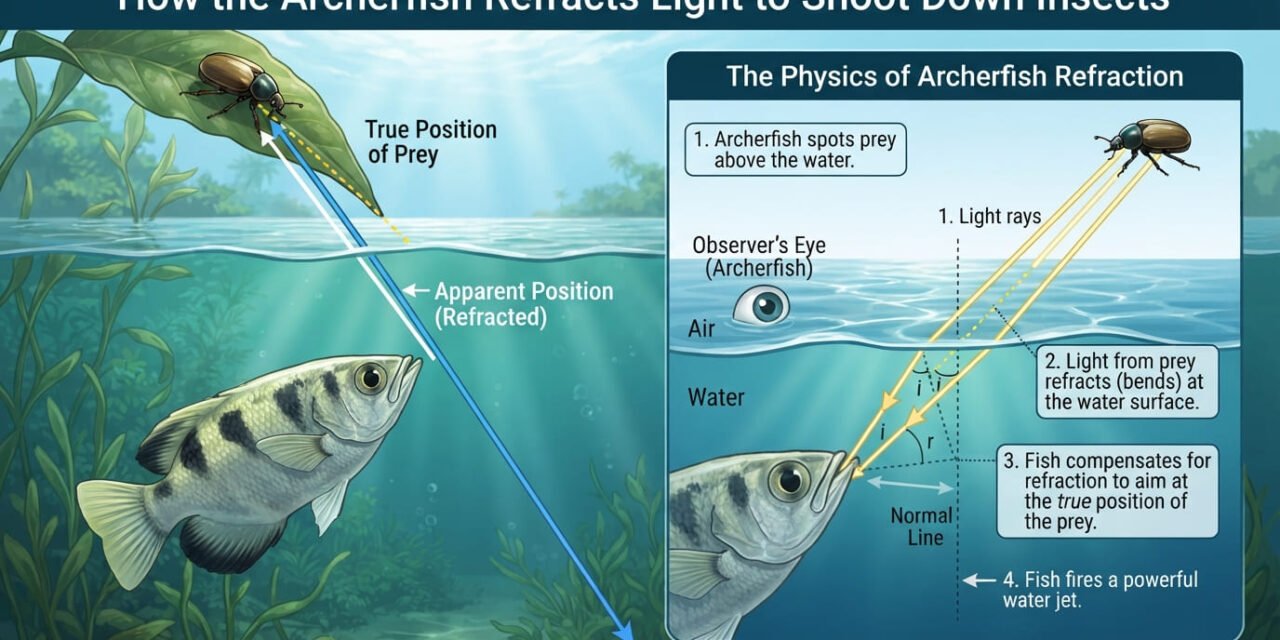
Have you ever dropped a pencil into a clear glass of water? If you look at the glass from the side, the pencil appears to be broken or bent right at the water line. This happens because light travels at different speeds when moving through air compared to when it moves through water. When light passes the boundary from the air into the water, it bends. This optical illusion is called refraction.
For an archerfish looking up from beneath the surface, the whole world above the water is severely distorted. Because of refraction, an insect sitting on a branch is not actually located where it appears to be. The light bending through the water projects an image of the bug in a false location.
If a human wanted to shoot a target underwater from the surface, or vice versa, they would have to sit down, draw a diagram, and do some complex trigonometric math to calculate the actual angle of the target versus the perceived angle. Toxotes jaculatrix does this math instinctively in a fraction of a second.
When the archerfish spots a potential meal, it swims right below it and angles its body almost vertically in the water. Pointing straight up minimizes the distortion of the light, but it doesn’t eliminate it. The fish still has to account for the bend. Using its large, forward-facing eyes, which give it excellent binocular vision and depth perception, the fish calculates exactly where the insect actually is, ignoring where the light makes it look like it is. It locks onto the true coordinates of the bug and prepares to fire.
Building a Biological Water Pistol
So, how exactly does a fish build a functional water gun? It doesn’t have moving lips to pucker up and blow, nor does it have lungs to force a breath of air outward. The secret to the archerfish’s weapon lies entirely in the specialized architecture of its mouth.
The archerfish has a deep, narrow groove running directly down the roof of its mouth. When it is ready to fire, it presses its tongue flat against the roof of its mouth. This action completely seals the groove, instantly turning it into a narrow, hollow tube. It is essentially forming the barrel of a rifle using its own flesh.
Once the barrel is formed, the fish snaps its heavy gill covers shut with explosive force. This works exactly like a hydraulic press. The sudden pressure violently forces the water from its gills, through the tube in its mouth, and out into the open air. The fish can even control the very tip of its tongue to aim the jet with frightening precision.
A mature Toxotes jaculatrix can accurately hit a target up to five or six feet above the surface of the water. That is a massive distance for a fish that only grows to be about ten inches long. If you scaled that up to human proportions, it would be like spitting a mouthful of water perfectly into a bucket resting on top of a three-story building.
The Fluid Dynamics of the Bullet
Hitting the target is only half the battle. If you gently squirt a bug with a plastic water gun, the bug will just get wet. It will likely hold onto the leaf even tighter. The archerfish needs to hit the insect with enough raw physical force to knock it completely off its feet.
This is where the fish proves it is a master of fluid dynamics. When the archerfish spits, it dynamically changes the shape of its mouth opening in the middle of the strike. It releases the water in such a way that the tail end of the water stream is moving significantly faster than the front end.
As the stream flies through the air, the faster water at the back catches up to the slower water at the front. Right before the stream hits the insect, all of that water crashes together, pooling into a thick, heavy, spherical blob.
This means the insect doesn’t just get sprayed with a steady, soft stream of water. It gets hit by a dense, high-impact bullet of water that delivers maximum kinetic energy exactly at the point of impact. It is the difference between getting sprayed by a garden hose and getting hit in the chest with a heavy water balloon. The sudden force is staggering for a small insect, easily breaking its grip and sending it plunging downward.
A Menu of Unsuspecting Insects
The archerfish is an opportunistic hunter, meaning it is not particularly picky about what it shoots down, as long as the target can fit inside its mouth. It constantly patrols the shallow edges of rivers and estuaries, looking upward for any signs of movement.
They are known to target a wide variety of prey, and their diet features many common terrestrial insects. A frequent target is the common housefly, Musca domestica, which lands on low vegetation and rarely has time to react to the high-speed water droplet. They will gladly shoot down crickets that venture too close to the water’s edge, such as the house cricket, scientifically known as Acheta domesticus.
Grasshoppers from the family Acrididae are a massive prize. A large grasshopper provides a highly nutritious, calorie-dense meal, though it requires a perfectly timed, heavy water bullet to knock a bug that large off a sturdy branch. The archerfish will even take aim at spiders. Jumping spiders from the family Salticidae often hunt along the branches in mangrove swamps. Even though these spiders have incredibly fast reflexes and often tether themselves to the branch with a line of silk, the water jet travels so quickly and hits with such force that the spider is dislodged before it even registers the attack.
The Race to the Catch
Once the insect is knocked loose, a completely new problem arises. Archerfish often live in schools, and the sound of an insect hitting the water is like a dinner bell ringing for every other fish in the immediate area. If an archerfish goes through the effort of calculating the physics, forming the water jet, and successfully shooting down an Acheta domesticus cricket, it definitely does not want a lazy neighbor stealing its hard-earned meal.
Because of this intense competition, the archerfish has evolved to be incredibly predictive. Before the water jet even makes contact with the target, the fish is already swimming. It mentally calculates the exact trajectory of the falling insect and darts directly to the spot where it will land. It catches the bug almost the exact instant it touches the surface, leaving its competitors completely empty-handed.
Interestingly, this whole process is a learned skill. Young archerfish do not start out as elite snipers. They miss constantly. They have to practice their aim, learn how to adjust for the light refraction, and figure out how to form the perfect water bullet. They actually learn by watching older, more experienced fish hunt. A young Toxotes jaculatrix will closely observe a successful adult, studying the angles and the timing until it figures out how to replicate the process itself.
If a bug hangs low enough on a branch, the fish won’t even bother wasting energy to spit. Instead, it will launch its entire body vertically out of the water, snapping the bug off the leaf with its jaws in mid-air. This jumping ability is just as explosive as the water jet, allowing the fish to secure a meal instantly.
It is very easy to look at nature and see brute force. Big teeth, sharp claws, and overwhelming physical speed are the usual tools of a top predator. But the archerfish uses observation, physics, and patience. It looks through the distorted mirror of the water’s surface, calculates its prey’s true position, forms a specialized rifle barrel with its tongue, and fires a dynamically shifting bullet of water to knock a meal out of the sky. It is a brilliant reminder that sometimes the most effective weapon in the animal kingdom isn’t brute strength at all. Sometimes, it is just a solid grasp of fluid dynamics and a really, really good spit.