Imagine snorkeling over a bright, warm coral reef in the tropical waters of the Pacific or Indian Ocean. Sunlight filters through the clear turquoise water, illuminating schools of tiny damselfish darting between coral heads. As you glide along the edge of a sandy channel, you notice a small hole in a mound of dead coral.
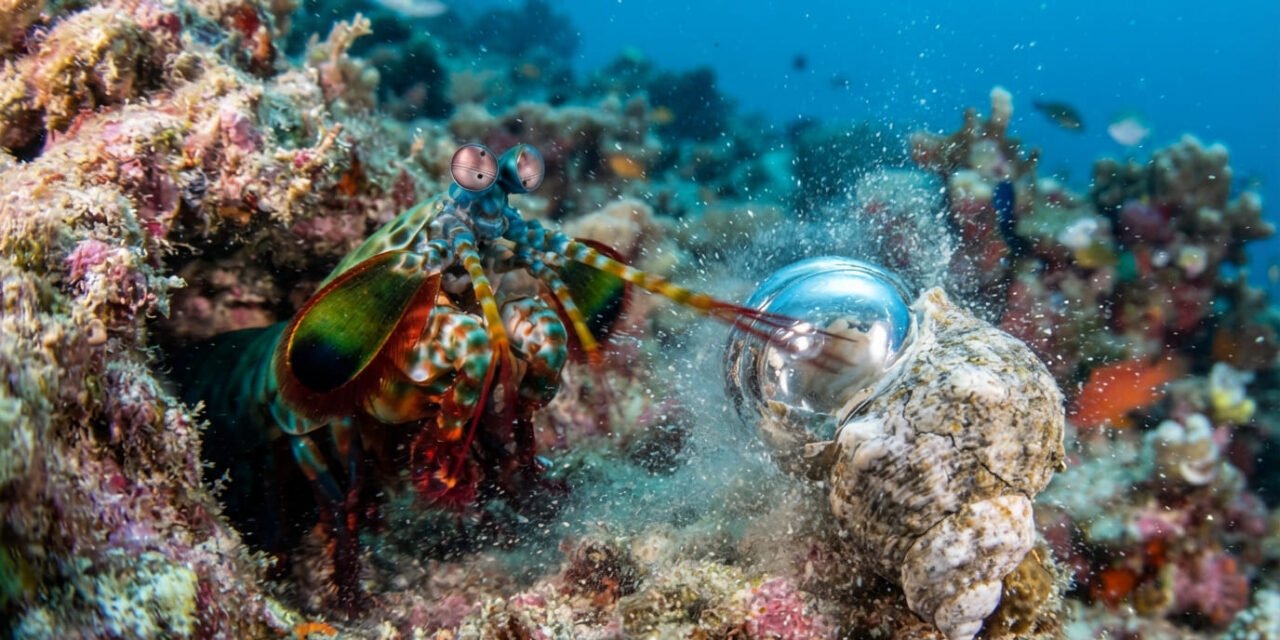
Peeking out from the opening is one of the most colorful creatures you will ever see. It is a peacock mantis shrimp (Odontodactylus scyllarus). Covered in vivid shades of electric green, bright orange, royal blue, and speckled red, it looks like an exotic alien crustacean designed for a sci-fi film. It sits quietly, flicking two large, jewel-like eyes mounted on independent stalks.
Despite its small size, usually measuring between three and seven inches long, this little ocean dweller holds a legendary reputation among marine biologists and aquarium owners. It does not carry sharp teeth, giant pincers, or deadly venom. Instead, it carries two biological hammers folded under its chest that can strike with the speed and force of a twenty-two caliber bullet.
Faced with a diet of hard-shelled prey like crabs, clams, and sea snails, the mantis shrimp turned itself into the ultimate biological boxer. It mastered a mix of spring mechanics, fluid physics, and material science to shatter thick shells, boil underwater bubbles, and dominate the shallow sea floor.
The Limits of Muscle Power
To understand why the mantis shrimp’s punch is so famous, you first have to look at the physical limits of normal animal muscles.
If a human boxer tries to throw a jab underwater, the punch is painfully slow. Water is nearly eight hundred times denser than air, creating intense fluid drag that acts like a heavy wall. Even on land, human muscles can only contract so fast. Muscles generate force by sliding microscopic protein filaments past one another, a chemical process that takes time to execute.
If the mantis shrimp relied on muscle contractions alone to swing its arms underwater, the strike would be far too slow to break a heavy clam shell. Water resistance would cushion the blow, and the prey would simply tumble away unhurt.
To break through thick calcium carbonate shells, the mantis shrimp needed an acceleration rate that far exceeds the speed of muscle tissue. It solved this biological hurdle by changing its mechanics. It stopped using its muscles to push its arms directly. Instead, it turned its muscles into a tool for loading a high-powered internal spring.
The Saddle Spring Mechanism
The mantis shrimp’s secret lies in the structure of its front appendages, known as dactyl clubs. Under its chest, the shrimp carries a complex system of levers, joints, and a specialized piece of natural armor shaped like a tiny horse saddle.
This saddle-shaped structure is a hyperbolic paraboloid made of a mix of chitin and hard minerals. It functions like an ultra-dense spring.
Here is how the shrimp cocks its biological gun:
First, the mantis shrimp contracts a pair of large, heavy flexor muscles inside its front limbs. As these muscles pull back, they compress the saddle structure, squeezing it tight and storing a massive amount of elastic potential energy. It is the exact physical equivalent of an archer pulling back a heavy bowstring or a carpenter pulling back the hammer of a nail gun.
Second, while the spring is being compressed, a set of tiny latch bones inside the joint locks the arm in place. This latch prevents the arm from moving while the muscles continue to squeeze, allowing energy to build up to extreme levels.
Third, when a crab or snail steps within striking distance, the shrimp twitches a small trigger muscle. This releases the internal latch instantly.
Because the energy was already stored inside the spring, the dactyl club launches forward without waiting for muscle contraction. The spring snaps open in a fraction of a millisecond, dumping all its stored kinetic energy into the strike at once.
The resulting acceleration is mind-boggling. The club moves from complete stillness to a top speed of over fifty miles per hour in less than three milliseconds. The peak acceleration exceeds ten thousand Gs. To put that number into perspective, a human jet pilot taking a sharp turn might experience nine or ten Gs before passing out, while a launched space rocket experiences around three to four Gs. The mantis shrimp accelerates its fists thousands of times faster than a fighter jet.
The One-Two Punch: Cavitation Shockwaves
The sheer physical speed of the dactyl club striking a shell is dangerous enough on its own, but the mantis shrimp has a secondary, invisible weapon built into every punch.
When the club moves through the water at fifty miles per hour, it travels so fast that the surrounding water cannot move out of the way quickly enough. This creates a region of extreme, localized low pressure right in front of the advancing fist.
Just as we saw with high-speed fluid dynamics in other sea creatures, this sudden drop in pressure causes the liquid water to split apart, turning into low-pressure gas bubbles. This process is called acoustic cavitation.
The mantis shrimp creates a expanding cavitation bubble right between its club and the shell of its target.
As the club continues its forward push, the initial physical impact hits the shell first. But a microsecond later, the surrounding water pressure comes slamming back in, causing the low-pressure cavitation bubble to implode violently.
The collapse of this bubble generates an explosive shockwave. The energy compressed inside the shrinking bubble creates a sudden spike in temperature, briefly reaching thousands of degrees, while generating a loud acoustic pop and a tiny flash of light.
This means that every single strike delivers a double punch. First, the hard mineral club hits the shell. Second, the collapsing cavitation bubble hits the exact same spot with a powerful secondary shockwave.
Even if the mantis shrimp completely misses its target by a fraction of an inch, the physical shockwave from the collapsing bubble is strong enough to stun swimming fish, knock out crabs, and shatter delicate shells.
The Uncrushable Armor
If a human punched a solid brick wall at fifty miles per hour, their hand would shatter into dozens of broken bones. How does the mantis shrimp hit heavy stone shells thousands of times throughout its life without smashing its own clubs to pieces?
The answer lies in the microscopic engineering of the mantis shrimp’s dactyl club.
If you cut a cross-section of the club and look at it under an electron microscope, you will see a material design that puts modern human armor to shame. The club is divided into three distinct functional layers:
The outermost layer, called the impact region, is made of a dense, highly mineralized compound composed mostly of hydroxyapatite. This is the exact same hard mineral found in human bones and tooth enamel. It provides a stiff, unyielding surface that can crush hard stone without scratching.
Directly beneath this outer shield sits the periodic region. This layer is made of thousands of chitin fibers arranged in a spiraling, twisted pattern known as a Bouligand structure. Think of it like a stack of plywood sheets where every sheet is rotated a few degrees relative to the one beneath it.
This spiraling design is a masterpiece of shock absorption. When a crack begins to form on the outer surface during a high-speed strike, the energy of the crack travels inward and hits these twisted chitin layers. Instead of traveling straight through the arm and breaking the limb, the crack is forced to turn and follow the spiraling paths, losing its energy and stopping before it can cause structural failure.
Finally, the innermost layer of the club is a soft, elastic cushion that acts like a built-in shock absorber, dampening the recoil energy so it does not shatter the shrimp’s joint socket.
Through this combination of a hard outer surface, a crack-deflecting middle layer, and a soft inner cushion, the mantis shrimp can punch hard objects hundreds of times a day for years without suffering a single fracture.
Eyes Like No Other
While its high-speed fists get most of the attention, the mantis shrimp possesses another physical feature that leaves scientists in awe: its vision.
Humans see the world using three types of color-sensing cells, called photoreceptor cones, which detect red, green, and blue light. By mixing these three signals together, our brain can process millions of distinct shades.
The peacock mantis shrimp has up to sixteen distinct types of photoreceptors packed into its large, bulbous eyes.
Twelve of these sensors are dedicated to color vision, allowing the shrimp to see light wavelengths extending far beyond the human visual spectrum. It can see deep ultraviolet light, broad infrared tones, and subtle variations in underwater colors that human eyes cannot even perceive.
Furthermore, the mantis shrimp is the only animal known to science capable of detecting circular polarized light.
Light waves usually vibrate in random directions. When light bounces off certain surfaces, it can align into straight lines, creating linear polarized light, which humans can filter using polarized sunglasses. Circular polarized light is special; it travels in a corkscrew pattern, spiraling through the water as it moves.
The mantis shrimp uses its specialized eyes to read these spiraling light patterns. They use polarized markings on their bodies to send secret, invisible signals to potential mates and rivals without alerting flying birds or large fish overhead.
Each eye sits on an independent stalk and can move in every direction, providing two separate visual fields. In fact, a single mantis shrimp eye has built-in depth perception because its upper and lower halves can focus on the same object independently, giving the shrimp trinocular vision in each eye.
This super-charged vision is essential for a high-speed hunter. Before launching a strike that takes less than three milliseconds, the mantis shrimp uses its advanced eyes to calculate the exact distance, depth, and shell structure of its prey, ensuring that its explosive punch lands with pinpoint accuracy.
Home Improvement and Aquarium Terrors
The mantis shrimp uses its biological hammers for more than just getting a meal. It is also an active subterranean home builder.
Peacock mantis shrimp live in deep burrows dug into sandy sea floors or hollowed out of dead coral heads. If a piece of hard rock or solid coral blocks its tunnel construction, the shrimp simply faces the barrier and fires a series of punches. It chips away at solid limestone brick by brick, clearing out custom-shaped living rooms beneath the sea floor.
This destructive power makes the mantis shrimp famous among marine aquarium hobbyists.
Occasionally, a tiny mantis shrimp hitsches a ride into a home aquarium inside a piece of live rock. As it grows, the hobbyist might notice that their small fish, crabs, and snails are disappearing one by one at night, accompanied by a loud, metallic popping sound echoing from the tank.
If a full-grown peacock mantis shrimp decides to smash its way out of a home aquarium, its clubs can crack standard glass walls, causing water to spill out onto the floor. Public aquariums that house these animals must use thick, shatterproof acrylic tanks to keep the little boxers contained.
Lessons for Human Engineering and Technology
You should care about the mantis shrimp because its unique adaptations are helping scientists build better materials and tools for the human world.
Engineers studying the spiraling Bouligand structure inside the shrimp’s dactyl clubs are designing new composite materials. By arranging carbon fibers in the same twisted, layer-by-layer pattern used in the shrimp’s arm, researchers have built ultra-lightweight, impact-resistant body armor, stronger military helmets, safer football helmets, and lightweight panels for sports cars and airplanes that can absorb massive collisions without cracking.
At the same time, camera engineers are building advanced optical sensors based on the mantis shrimp’s polarized vision.
Because cancerous tissues and early-stage tumors reflect polarized light differently than healthy tissue, cameras inspired by the mantis shrimp’s eye can help doctors detect early skin cancer and internal tumors during routine medical scans long before traditional cameras can spot them. A small sea creature’s eyes are actively helping human medicine save lives.
A True Master of the Shallow Reef
The peacock mantis shrimp is a wonderful reminder that size can be deeply deceiving in the wild. It is an animal no longer than a pencil, decorated in vibrant rainbow colors, living in a quiet hole under a coral head.
Yet, it mastered the physical laws of nature to build a weapon system that redefines what we thought was possible for animal tissue. It turned its muscles into a spring, its fists into uncrushable hammers, and the surrounding ocean into a shockwave generator.
The next time you look out over a calm, blue tropical sea, remember the quiet drama unfolding on the reef below. Beneath the gentle surface ripples, a small, multi-colored boxer is sitting in the dark, checking its target with sixteen color sensors, cocking its biological spring, and preparing to launch a punch that turns water into light and stone into dust.