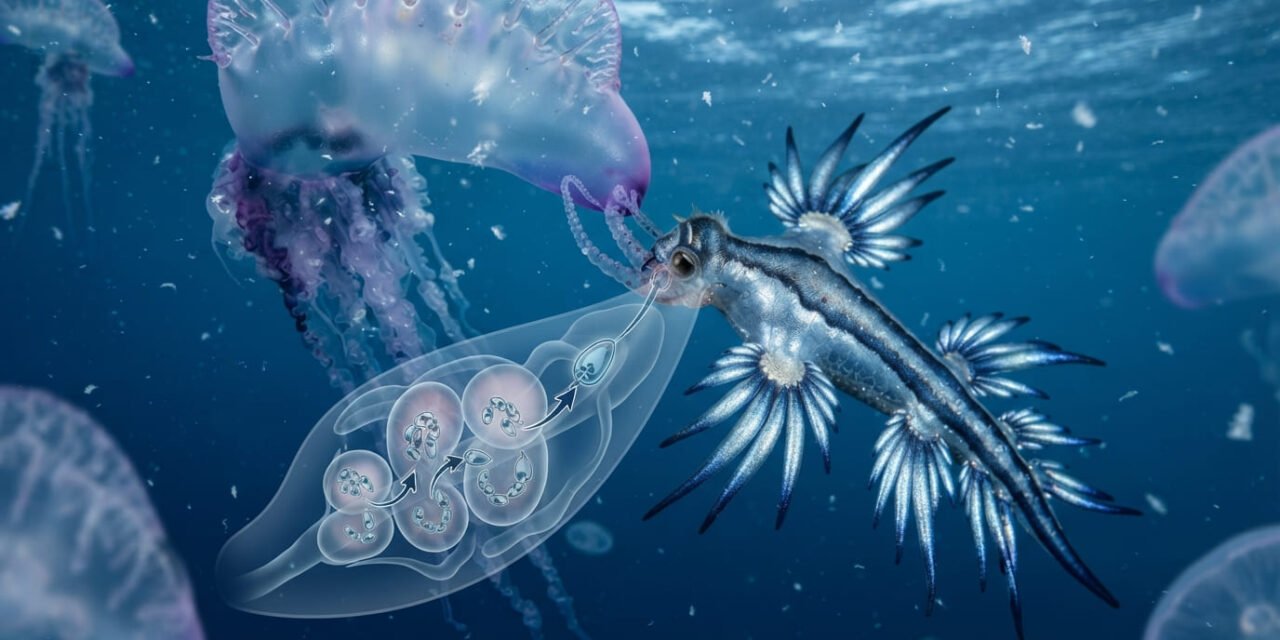
Imagine floating on the warm, turquoise surface of the open ocean, miles from any shore. The water beneath you is thousands of feet deep, stretching out to an endless horizon. As you look down at the gentle ripples, you spot something tiny floating right on the surface film. It is barely an inch long, with a brilliant metallic blue belly, silver markings, and several pairs of wing-like frills spreading out from its sides. It looks like a miniature dragon straight out of a fantasy story.
At first glance, this soft, wing-fingered creature seems delicate and defenseless. It has no shell, no hard scales, no sharp teeth, and no claws. It simply drifts wherever the wind and ocean currents push it.
Yet, if a predator tries to bite this tiny swimmer, or if an unsuspecting human picks it up out of the water, they will receive a shock of agonizing pain. Within seconds, a burning sting will spread across the skin, potentially causing nausea, intense swelling, and severe medical complications.
This is the blue dragon (Glaucus atlanticus), also known as the blue sea slug, blue angel, or sea swallow. It is a nudibranch that turned the ocean surface into its personal hunting ground. Faced with floating predators armed with some of the most painful venom in the sea, this unassuming sea slug did not evolve its own poison. Instead, it became a biological thief. It eats venomous jellyfish, steals their unfired weapons intact, and loads them onto the tips of its own body to use as a far deadlier shield.
The Upside-Down Sailor
To understand how the blue dragon survives in the open ocean, you first have to look at its unusual way of moving.
Most sea slugs live on the ocean floor, crawling slowly over rocks, coral reefs, and sandy bottoms. The blue dragon left the sea floor behind entirely to spend its whole life floating on the very top of the water.
It stays afloat using a simple physical trick. The blue dragon swallows a small bubble of air into its stomach. This gas pocket acts like a built-in life jacket, giving the slug exact neutral buoyancy so it floats right beneath the surface tension.
Because of the way the air bubble sits inside its body, the blue dragon actually floats completely upside down. Its belly faces up toward the sky, while its back points down toward the dark depths below.
This upside-down lifestyle provides the sea slug with a double-layered disguise known as countershading.
When a seabird flies overhead looking down at the ocean, it sees the sea slug’s bright, metallic blue belly. The deep blue color matches the surface of the open sea perfectly, making the slug almost invisible from above.
When a fish swims below looking up toward the light, it sees the sea slug’s silver and pale gray back. The light color blends right into the bright, sunlit surface of the water above. By using two different colors on opposite sides of its body, the blue dragon hides from sky predators and sea predators at the exact same time.
Hunting the Floating Giant
Floating aimlessly on the ocean surface presents a major problem: finding food. The blue dragon cannot swim against strong currents to chase after prey. It relies on the wind and ocean tides to bring dinner to its front door.
Fortunately, the wind also drives its favorite prey across the ocean. The blue dragon hunts floating siphonophores, most notably the Portuguese man o’ war (Physalia physalis).
A Portuguese man o’ war is a formidable creature. It is not a single jellyfish, but a floating colony of organisms with a gas-filled sail on top and long, trailing tentacles below that can reach up to thirty feet in length. These tentacles are covered in millions of microscopic stinging capsules called nematocysts. Each nematocyst is a tiny, pressurized harpoon filled with potent venom, designed to paralyze fish on contact. A single brush against a man o’ war’s tentacle can cause excruciating pain for humans and instant death for small creatures.
To a tiny sea slug barely an inch long, attacking a Portuguese man o’ war should be suicide. The man o’ war is hundreds of times larger than the blue dragon, carrying enough venom to wipe out an entire school of fish.
Yet, when a blue dragon drifts into a man o’ war’s tentacles, it does not run away. It opens its mouth, clamps its hard jaws onto the trailing tentacle, and begins to eat the giant alive.
The Secret of the Unfired Harpoon
How does a soft-bodied sea slug eat a tentacle packed with millions of venomous harpoons without getting stung to death from the inside out?
The secret lies in the blue dragon’s digestive system and protective coating.
When a normal animal touches a man o’ war tentacle, the physical pressure triggers the nematocysts. The tiny capsules burst open, launching microscopic poison barbs directly into the victim’s tissue.
The blue dragon prevents this trigger using a specialized chemical barrier. Its skin and mouth lining produce a thick, viscous layer of protective mucus. This heavy slime acts as a physical buffer and a chemical neutralizer, preventing the stinging cells from sensing the skin and firing their barbs during the bite.
Furthermore, the sea slug has a chitinous lining inside its throat and stomach. This tough, protective layer acts like an internal coat of armor, preventing any stray barbs from puncturing its internal organs as it chews and swallows the tentacle.
As the blue dragon digests the man o’ war, it breaks down the soft tissues of the tentacle for food. But when it comes to the dangerous, unfired stinging cells, the sea slug does something astonishing.
Instead of digesting the nematocysts or breaking them down with stomach acid, the blue dragon selectively preserves the most dangerous, fully loaded stinging cells. It passes them completely intact through specialized channels in its digestive tract, routing the stolen weapons straight up into its own body walls.
Arming the Winged Frills
Once the unfired stinging cells are sorted, the blue dragon moves them to its external defense system.
Sticking out from the sides of the sea slug’s body are three paired sets of finger-like frills called cerata. These frills spread out sideways, looking like the feathery wings of a miniature dragon. Inside each individual finger of these frills sits a small, specialized storage pouch called a cnidosac.
The blue dragon transports the stolen, unfired nematocysts directly into these cnidosacs. The stinging cells are packed tightly into the tips of the frills, pointing outward toward the open water.
Through this process, known as kleptocnidae (literally “stinger stealing”), the sea slug turns its own body into a loaded weapon. The stolen harpoons remain fully functional, pressurized, and ready to fire.
If a fish attempts to take a bite out of the blue dragon, or if a human steps on one that has washed ashore on a beach, the physical pressure squeezes the tips of the frills. The stolen nematocysts fire instantly, launching their venomous barbs into the attacker’s skin.
Deadlier Than the Original Owner
There is a terrifying twist to the blue dragon’s weapon theft: the sea slug can be far more dangerous to touch than the Portuguese man o’ war itself.
When a Portuguese man o’ war floats across the sea, its stinging cells are spread out across long, thin tentacles that stretch for dozens of feet. The venom is diluted across thousands of individual contact points.
The blue dragon, however, is a selective harvester. As it eats the man o’ war, it collects thousands of the most potent, mature stinging cells and squeezes them together into the small tips of its frills.
It essentially concentrates the jellyfish’s venom into a high-density payload. When you touch a blue dragon, you are not touching a single stinging cell; you are triggering thousands of concentrated, high-potency harpoons all at once in a tiny area.
Beachgoers who spot these beautiful blue creatures washed up on the sand often make the mistake of picking them up to take a closer look. The resulting sting can cause severe pain, skin blistering, fever, and severe allergic reactions. Even when the sea slug is dead and drying on the sand, the stolen stinging cells inside its frills remain pressurized and dangerous for long periods.
Life on the Surface Drift
Living as a tiny, floating predator on the open sea requires unique social and reproductive adaptations.
Because blue dragons cannot swim across long distances to find mates, they must take advantage of every encounter. Every single blue dragon is a hermaphrodite, meaning it possesses both male and female reproductive organs.
When two blue dragons drift past each other in the ocean currents, both individuals can mate with one another. This doubles the reproductive success of every meeting, ensuring that every encounter can result in new eggs.
After mating, the sea slug needs a safe place to lay its eggs. Out in the deep ocean, there are no rocks or plants to anchor an egg mass. To solve this, the blue dragon uses floating debris.
The female side of the sea slug produces long, sticky strings of white eggs. It wraps these egg strings around floating pieces of wood, drift plastic, or even the empty, floating sails of the Portuguese man o’ war it just finished eating. The eggs float safely on the surface until they hatch into tiny, swimming larvae, which eventually gulp their first air bubble and begin the cycle all over again.
Lessons for Science and Medicine
You should care about the blue dragon because its ability to steal and store active biological weapons is helping human scientists solve complex medical and chemical problems.
Medical researchers are fascinated by how the blue dragon handles potent venoms without suffering damage. By studying the specialized mucus and cellular membranes that protect the sea slug’s stomach from firing harpoons, bio-engineers are designing new protective coatings for medical devices, surgical tools, and targeted drug-delivery capsules.
Researchers are also studying the sea slug’s digestive sorting mechanism. The ability to separate nutritional material from dangerous cellular structures could inspire new micro-fluidic sorting systems used in blood labs to isolate cancer cells or pathogens from healthy tissue without damaging the surrounding sample.
A Tiny Master of the High Seas
The blue dragon is a wonderful reminder that nature does not always require massive size or heavy armor to build an effective predator. It is an animal no larger than a paperclip, floating upside down on a bubble of air in the middle of a vast ocean.
It did not need to grow sharp teeth or manufacture its own venom to dominate its environment. Instead, it looked at the most dangerous, venomous creature floating in the sea, turned it into a meal, and stole its weapons to build an unbeatable defense.
The next time you look out over the ocean, remember the tiny blue dragon floating just beneath the surface film. It is a quiet, beautiful performer floating across the sea, proving that with the right chemical armor, even the smallest creature can carry the biggest sting.