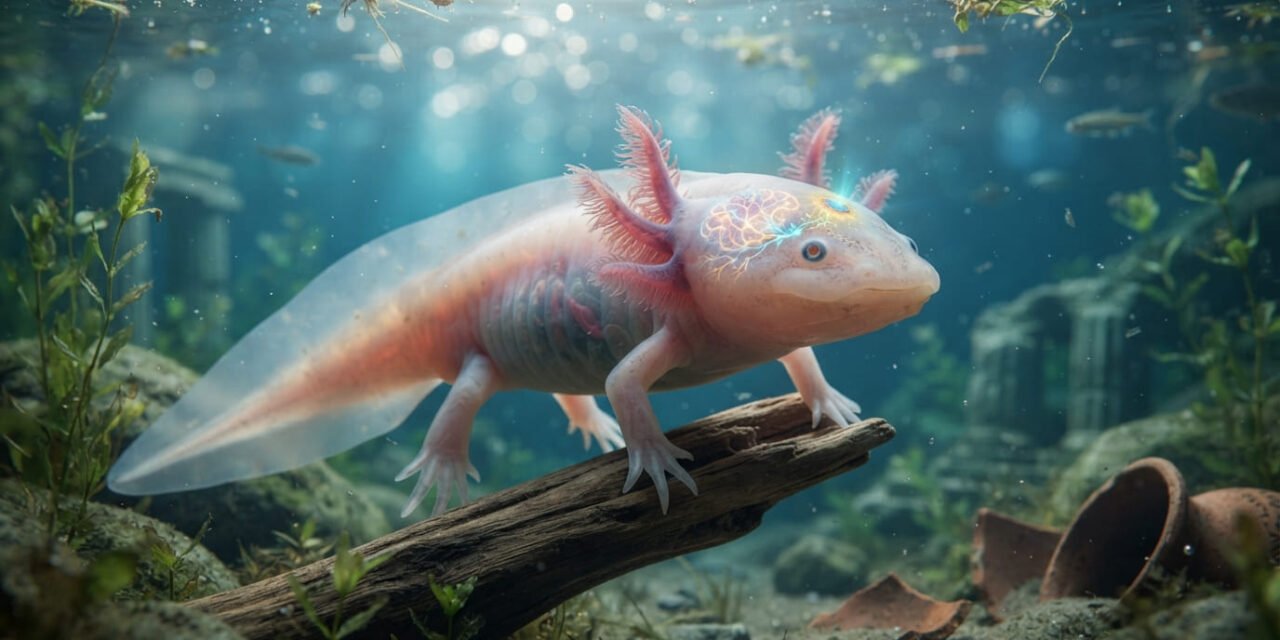
If you look at an axolotl, you are looking at a creature that refused to grow up. Most salamanders start their lives in the water with feathery external gills and then transform into land-dwelling adults with lungs. The axolotl does things differently. It stays in its larval form for its entire life. It keeps its gills, its finned tail, and its aquatic lifestyle even when it is old enough to reproduce. This trait is called neoteny. It is a biological choice to stay young, and it is the foundation of the animal’s incredible survival skills.
The axolotl (Ambystoma mexicanum) is native only to the Lake Xochimilco complex near Mexico City. While it looks like a smiling, soft-bodied toy, it is one of the most resilient vertebrates on the planet. It can regrow lost limbs, its tail, parts of its heart, and even sections of its brain without leaving any scars. If you cut a human’s skin, you get a scar. If an axolotl loses an arm, it grows a perfect replacement that is indistinguishable from the original in about forty days.
The Science of Neoteny
Most amphibians go through a hormonal surge that tells their bodies to change. Their gills shrink, their skin thickens, and they develop eyelids. The axolotl lacks the specific thyroid-stimulating hormone required to trigger this change. It essentially lives in a state of permanent childhood.
This state is why the axolotl has such a high capacity for healing. Young animals generally heal better than old ones. By staying in a larval stage, the axolotl keeps its cells in a “pluripotent” state. These are cells that haven’t fully decided what they want to be yet. In a human adult, a skin cell is just a skin cell. In an axolotl, those cells can revert to a stem-cell-like state and rebuild whatever is missing.
If you were to inject an axolotl with iodine, it might actually transform into a terrestrial salamander. It loses its gills and moves onto land. However, this is extremely stressful for the animal and usually shortens its lifespan significantly. The axolotl has evolved to survive specifically by avoiding adulthood.
How Regeneration Works
When an axolotl loses a limb, it doesn’t just heal the wound. It restarts the growth process. First, a layer of skin cells grows over the injury. Underneath that skin, a mass of cells called a blastema begins to form. These cells are like the building blocks of an embryo.
The blastema knows exactly what was lost. If the arm is cut at the elbow, the blastema only grows the forearm and hand. It doesn’t regrow the entire arm from scratch. It has a biological “GPS” that tells it where it is in the body. The new nerves, blood vessels, and bone knit together perfectly with the old ones. There is no scar tissue to block the connection.
This ability extends to the most complex organs. Researchers have removed up to one-third of an axolotl’s heart and watched it grow back and resume a normal beat within weeks. They have also damaged sections of the axolotl’s brain. The animal simply regrows the neurons and reconnects the neural pathways. It maintains its memories and motor functions as if the injury never happened.
Why the Axolotl is a Medical Model
Researchers spend millions of dollars studying the axolotl because they want to understand how to trigger similar responses in humans. We have the same genes that the axolotl uses for regeneration. The difference is that our genes are “switched off” after we are born. When we get injured, our bodies prioritize closing the wound quickly to prevent infection, which leads to scarring. The axolotl prioritizes perfect reconstruction.
If we can learn how the axolotl manages its blastema cells, we could change how we treat spinal cord injuries or heart disease. Instead of trying to patch a damaged heart with synthetic valves, we could theoretically tell the heart to regrow its own tissue.
The axolotl also has a genome that is ten times larger than the human genome. It is packed with repetitive sequences that seem to help with cell regulation. Mapping this genome is one of the biggest challenges in modern biology. We are trying to find the “play” button for regeneration that is hidden in that massive amount of DNA.
The Crisis in the Wild
While there are millions of axolotls in labs and pet stores around the world, they are almost extinct in the wild. Their home in Lake Xochimilco has been destroyed by urban sprawl and pollution. Invasive fish, like tilapia and carp, eat the young axolotls.
In 1998, there were about 6,000 axolotls per square kilometer in the lake. Today, researchers often go months without finding a single one. This is a problem because the axolotls in labs are all descended from a very small group of ancestors. They are inbred and lack the genetic diversity of the wild population. If the wild axolotls disappear, we lose the original blueprint for their survival.
Local farmers in Mexico are trying to save the species by building “chinampas.” These are traditional floating gardens that create natural filters for the water. By creating small, clean pockets of the lake, they are giving the axolotl a place to live away from the invasive fish and polluted runoff.
Sensory Life Underwater
The axolotl doesn’t see very well. It relies on its “lateral line” system to hunt. This is a series of sensory organs along its sides that detect vibrations and pressure changes in the water. If a small crustacean or worm swims nearby, the axolotl feels the movement and snaps its mouth shut.
They use a “suction feeding” method. When they open their mouths suddenly, the pressure drop sucks the prey inside. They have tiny, vestigial teeth that are only meant for gripping, not chewing. They swallow their food whole. This low-energy hunting style matches their slow metabolism and long lifespan. An axolotl can live for 15 years in a clean environment.
Final Thoughts
The axolotl is a biological contradiction. It is a fragile creature that can survive being torn apart. It is an adult that remains a baby. It is a local Mexican animal that has become a global scientific priority.
Its ability to regrow a brain is the ultimate example of biological resilience. It shows that the body has the capacity to rebuild itself if it just knows how to access the right instructions. We study the axolotl because we want to learn its secrets, but we also need to protect it because it is a unique piece of Earth’s history. The “Peter Pan” of the lake is running out of places to hide, and if it goes extinct in the wild, we lose one of nature’s most important lessons on how to heal.