Imagine standing on the jagged black lava rocks of Wolf Island, a tiny, remote speck of land in the far northern Galápagos archipelago. The midday sun is brutal, baking the bare stone until the air glimmers with heat waves. Ocean swells slam against high sea cliffs, throwing white spray into the dry wind. There are no rivers here, no freshwater ponds, and no shade trees. Rain might not fall for over a year at a time.
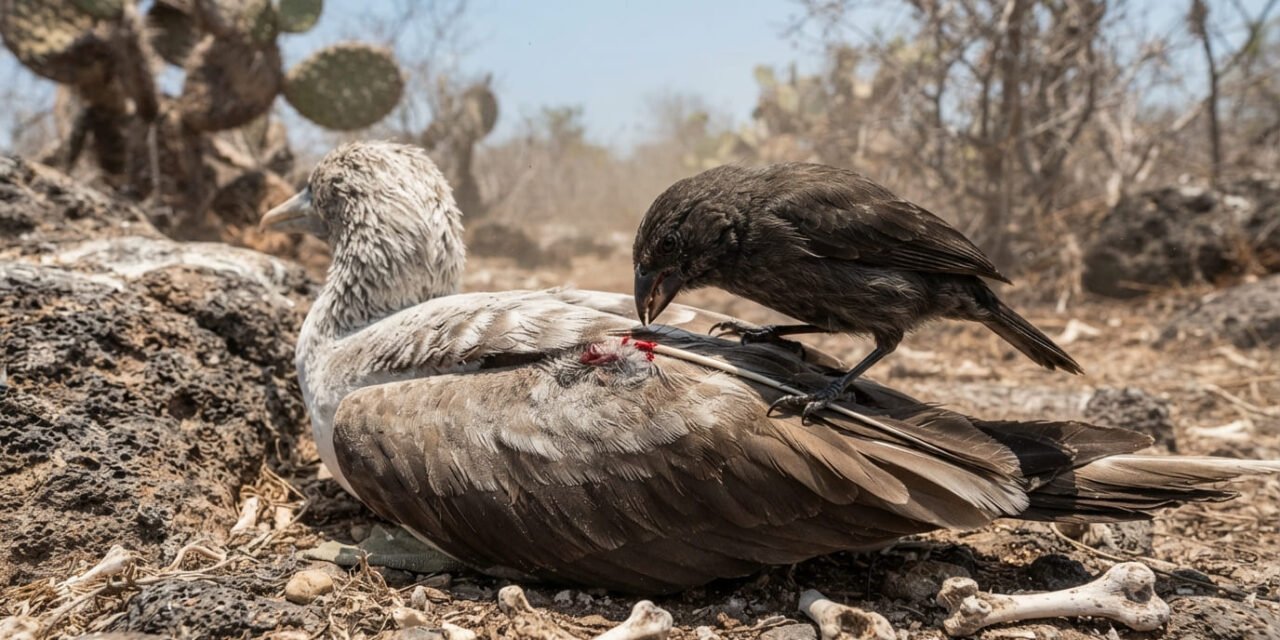
As you look up at the cliffs, you see thousands of large seabirds, mostly Nazca boobies and blue-footed boobies, resting between fishing trips. Perched right on the back of one of those giant white seabirds is a small, dark songbird. It looks almost identical to a harmless sparrow or house finch you might see at a backyard bird feeder in North America.
Then you notice what the small bird is doing.
It is using its sharp, pointed beak to peck repeatedly at the base of the seabird’s wing feathers. It pecks until the skin breaks, and a small bead of bright red blood appears. The tiny bird leans down, laps up the liquid, and waits for more to pool. The giant seabird barely even flinches, looking out over the ocean as if nothing unusual is happening.
This is the vampire finch (Geospiza septentrionalis), a small subspecies of the sharp-beaked ground finch found only on Wolf and Darwin islands. It is one of the rarest and most unusual birds on Earth. Faced with one of the harshest, driest environments in the world, this unassuming songbird broke all the traditional rules of bird behavior and turned itself into a blood-drinking parasite to survive.
The Brutal Reality of Island Isolation
To understand how a songbird becomes a vampire, you first have to look at the extreme geography of its home.
Wolf and Darwin islands are not like the lush, green Galápagos islands you often see in nature documentaries. They are small, steep volcanic rocks sticking out of the open Pacific Ocean, hundreds of miles from the South American mainland. They are completely isolated and surrounded by deep, salty water.
During good years, seasonal rains bring brief flushes of green grass, wild seeds, and caterpillars. But the Galápagos climate is notoriously unpredictable. Periodic droughts caused by climate shifts can wipe out vegetation for months or years at a time. When the plants die, the seeds disappear, and the insect population collapses.
For a land bird that relies on seeds, nectar, or bugs, a long drought is a death sentence. Most birds on small islands simply starve to death when the plants stop producing.
The vampire finch faced a choice: adapt to an alternative, reliable source of moisture and food, or go extinct. Surrounding the finches on those dry cliffs were millions of large, healthy seabirds that spent their days diving into the rich ocean currents, returning to the rocks full of food, water, and fresh blood. The seabirds were a walking, swimming goldmine of nutrients.
From Groomer to Parasite
How does a seed-eating songbird make the jump to drinking the blood of giant seabirds?
Biologists believe the behavior started as a helpful cleaning service. Seabirds like Nazca boobies are heavily infested with biting parasites, including flat flies, ticks, and mites that live deep within their feathers. These parasites cause intense itching and irritation for the boobies.
Originally, the sharp-beaked ground finches would hop onto the backs of resting boobies to pick off these parasites. For the booby, this was a great deal. The large bird got rid of annoying bugs, and the small finch got a quick meal of protein-rich insects. The boobies learned to tolerate the finches landing on their backs because the relationship was mutually beneficial.
Over time, an opportunistic finch likely accidentally pecked a bit too deep while pulling off a tick, breaking the booby’s skin and causing a drop of blood to flow.
In a dry, sun-baked landscape where fresh water does not exist, blood is an incredible resource. It is mostly water, packed with salt, iron, and rich proteins. The finch that tasted the blood realized it had found something far more hydrating than a dry bug.
Over generations, the behavior shifted from mutual cleaning to intentional blood-feeding, a rare biological phenomenon known as facultative hematophagy. The finch stopped looking for ticks and started using its beak as a surgical tool to open fresh wounds.
The Precision Pecking Technique
Drinking the blood of a bird that is ten times your size requires speed, accuracy, and patience.
The vampire finch does not have large, crushing jaws or venom. Instead, it relies on its beak shape, which has evolved to be longer, thinner, and significantly sharper than the beaks of other ground finches. It works like a pair of precision needle-nose pliers.
When a vampire finch decides to feed, it targets large adult boobies resting on the cliff edges. It glides down quietly and lands directly on the booby’s lower back or wing joint.
The finch carefully parts the dense outer feathers using its beak, exposing the soft, bare skin near the base of the growing flight feathers. This area is rich in small blood vessels that feed the developing quills.
Once the skin is exposed, the finch begins a series of fast, sharp pecks. It does not try to tear large chunks of flesh. It acts like a tiny woodpecker, making small, shallow punctures in the skin.
As soon as the blood starts to pool, the finch uses its tongue to lap up the liquid. Often, several finches will gather around a single booby, lining up patiently to take turns drinking from the same open wound. Once a wound is opened, the finches will revisit the same bird throughout the day to keep the blood flowing.
Why Don’t the Boobies Fight Back?
One of the biggest mysteries for scientists studying the vampire finch is the reaction of the boobies.
A Nazca booby is a formidable predator. It has a heavy, dagger-like beak that can easily spear fish or crush a small bird. If a booby wanted to kill a vampire finch, it could easily snap its neck with a single strike of its head.
Yet, when a finch lands on a booby’s back and begins pecking a hole in its skin, the booby usually sits there passively, staring out at the ocean. Occasionally, a booby might turn its head and give a lazy shake of its wings, but it rarely attacks or flies away.
There are a few reasons for this strange tolerance.
First, the amount of blood a single finch drinks is tiny compared to the total blood volume of a large seabird. To the booby, the bite is a minor, annoying itch rather than a life-threatening attack. It is simply not worth the massive amount of energy it would take to stand up, fight off, or fly away from a tiny bird every five minutes.
Second, evolutionary history plays a role. Because the behavior evolved from a peaceful cleaning relationship, the booby’s brain still registers the finch as a helpful groomer rather than a dangerous predator. The booby has not developed a hardwired defensive instinct against the finches.
Finally, nesting boobies are often exhausted from long fishing trips out at sea. When they return to the hot rocks to rest or guard their chicks, they enter a state of deep energy conservation. They are reluctant to give up their hard-won resting spots on the cliffs just to chase off a tiny pest.
Social Learning and Cultural Tradition
Drinking blood is not just a hardwired physical instinct; it is also a cultural tradition passed down through social learning.
Young vampire finches learn how to drink blood by watching their parents and other adults in the flock. When an adult finch opens a fresh wound on a booby, fledglings will hop over to watch the process. The young birds learn exactly where to peck, which feathers to move, and how to avoid the booby’s occasional wing shakes.
In fact, this blood-drinking behavior is not found in sharp-beaked ground finches on other Galápagos islands. Finches of the same species living on larger islands like Santa Cruz or San Cristóbal eat normal diets of seeds and insects. They have plenty of freshwater and plant life, so they never developed the habit of pecking seabirds.
This proves that the behavior on Wolf and Darwin islands is a localized cultural adaptation, driven by the extreme isolation and drought conditions of those specific volcanic rocks.
The Egg-Rolling Heist
Blood is not the only extreme item on the vampire finch’s menu. These birds have developed a secondary survival trick that is just as impressive: egg stealing.
During the breeding season, thousands of seabirds lay large, thick, shelled eggs on the bare ground. For a tiny songbird, a seabird egg is a massive vault filled with liquid yolk and protein. But breaking a heavy booby egg with a small beak is almost impossible.
To get inside, the vampire finches use physics and teamwork.
A finch will find an unattended egg sitting on a rocky slope. The bird walks up to the egg, places its beak against the shell, and pushes with its head while pushing backward with its feet. If the egg is too heavy for one bird, multiple finches will join in, pushing the egg together.
They roll the egg across the rough lava rock until it bumps into a sharp stone or rolls over a small ledge. The impact cracks the hard outer shell. Once the shell breaks, the finches swarm the egg, using their sharp beaks to enlarge the hole so they can drink the rich yolk and white inside.
They will also scavenge on dead seabird chicks, fish dropped by returning parents, and even marine iguana eggs, ensuring that no potential source of calories goes to waste on their barren island.
Lessons in Natural Adaptation
You should care about the vampire finch because it is a living demonstration of evolutionary flexibility. It shows us that when environmental conditions become extreme, nature does not hold back.
For a long time, scientists thought that specialized dietary habits, like eating seeds versus drinking blood, were fixed traits that took millions of years to change. The vampire finch proves that a species can rapidly reshape its behavior and fine-tune its anatomy to exploit a completely unexpected niche when survival depends on it.
Charles Darwin famously studied the finches of the Galápagos to form his theories on natural selection, focusing on how different beak shapes allowed birds to eat different types of seeds and fruits. If Darwin had visited Wolf and Darwin islands and witnessed a songbird drinking the blood of a seabird, he would have found the ultimate proof that nature is far more creative, dynamic, and unpredictable than anyone ever imagined.
A Quiet Survivor on the Rocks
The vampire finch is a wonderful reminder that survival in the wild is about resourcefulness. It is a tiny, dark bird with soft feathers and a simple song, living on a baking rock in the middle of the ocean.
It did not need to grow giant talons or turn into an aggressive eagle to dominate its home. Instead, it looked at the massive seabirds resting on the cliffs, found a clever way to bypass their defenses, and turned a drop of blood into a lifetime guarantee of survival in a waterless world.
The next time you see a quiet songbird sitting on a fence post, take a moment to appreciate the hidden resilience inside that little frame. Under the right pressure, even the most innocent seed-eater can turn its beak into a dagger and find a way to thrive where almost everything else dies.