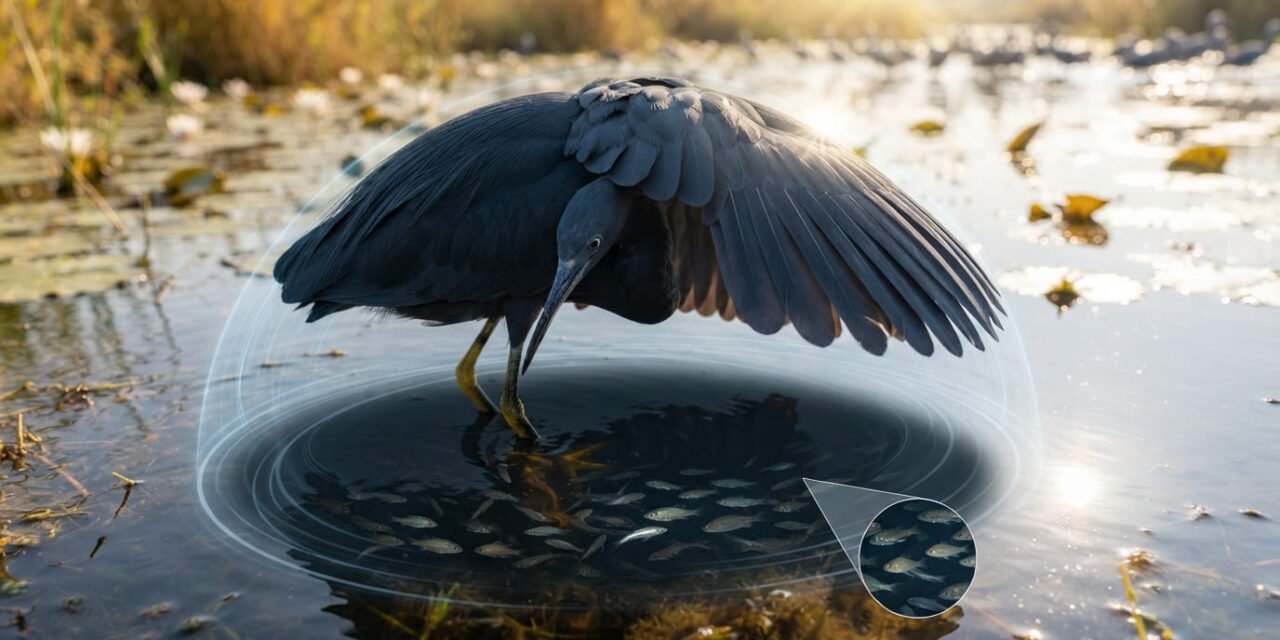
Imagine standing on the muddy shore of a shallow lake in Sub-Saharan Africa. The morning sun is already high in the sky, beating down on the water and creating a blinding, white glare across the surface. The air is warm and filled with the low hum of insects. As you scan the shallows, you spot a medium-sized bird stepping slowly through the mud. It is a striking creature, covered in dark, slate-black feathers from head to toe, with a slender neck and thin, black legs.
For a few moments, the bird behaves like any other heron, taking cautious steps and scanning the water. But then, it stops.
In a single, smooth movement, the bird raises its wings, curves them forward over its head, and tucks its beak down. The wingtips meet in front of its chest, forming a perfect, dome-shaped circle. From a distance, the bird completely disappears. In its place sits what looks like a tiny, black umbrella floating in the shallows.
This is the black heron, Egretta ardesiaca, often called the black egret. While other water birds rely on pure speed, sharp eyesight, or endless patience to catch their dinner, this bird uses a clever mix of optics and psychology. By turning its own wings into a portable sunshade, the black heron solves two of the biggest problems a wading bird faces: seeing through the water’s glare and getting fast-moving fish to swim directly toward it.
The Blindness of the Glare
To understand why the black heron’s trick is so brilliant, you have to look at the world from a typical wading bird’s perspective. Hunting in shallow water on a sunny day is a constant struggle against light.
When sunlight hits the surface of a lake or pond, the water acts like a mirror. It reflects the bright sky, the clouds, and the glare of the sun directly into the bird’s eyes. If you have ever tried to look for a dropped coin at the bottom of a sunny swimming pool, you know how difficult this is. The reflection makes the water look opaque and white, hiding everything beneath the surface.
For a bird like a heron or an egret, this glare is a major barrier. If the bird cannot see through the surface, it cannot tell where the fish are. It might see a vague shape move, but it cannot calculate the depth or direction needed for a precise strike. Many herons try to solve this by hunting only on cloudy days, waiting in the deep shade of overhanging trees, or positioning their bodies so their heads are in their own narrow body shadows.
But the black heron does not want to be limited by where the trees grow or whether the sky is cloudy. It decided to carry its own shade wherever it goes.
Building the Umbrella
The physical transformation of the black heron into an umbrella is a beautiful display of movement. The bird does not just flap its wings randomly. It executes a highly coordinated, self-contained shape-shift.
When the heron finds a promising spot in the shallow water, it takes a firm stance in the mud. It then raises both of its broad, rounded wings. Instead of spreading them wide for flight, it curves them forward and downward, wrapping them around its head and neck like a dark cloak.
The primary feathers on the tips of the wings touch the surface of the water, and the feathers at the top of the wings overlap above the bird’s head. This creates a solid, circular canopy of feathers that blocks the sun from every angle. The bird’s head and beak are tucked neatly inside the center of this dark dome.
This umbrella structure has an immediate, mechanical benefit: it eliminates the glare.
Inside the dome, the water is dark, quiet, and clear. Because the direct sunlight is blocked, no bright reflections are bouncing off the surface. The heron can see through the water with crystal-clear clarity. It can spot the tiniest movement of a shrimp, a tadpole, or a small fish against the muddy lake bed. It is the biological equivalent of wearing a pair of high-performance, polarized sunglasses.
The Optical Trap
If the umbrella only helped the bird see better, it would already be a great tool. But the real genius of the black heron’s strategy lies in how the shadow affects the fish. The heron is not just blocking the light to improve its own vision; it is actively setting an optical trap.
To a small fish swimming in a hot, sunny lake, the open water is a dangerous place. The bright light makes the fish highly visible to predators flying overhead, like hawks and eagles. The water in the shallows can also get uncomfortably warm under the direct midday sun.
In this bright, hot environment, shade is a highly valuable resource. To a fish, a patch of cool, dark water looks like a haven, a place to hide from the burning sun and from the eyes of flying predators.
When the black heron folds its wings into an umbrella, it creates a sudden, inviting patch of deep shadow in the middle of the bright shallows. To any small fish swimming nearby, this dark dome looks like the perfect hiding spot. The fish will swim directly toward the shadow, seeking shelter from the heat and the light.
They have no idea that the “shelter” they are entering is actually the inside of a predator’s mouth. The fish do not make a mistake; they do exactly what their survival instincts tell them to do. They seek out the shade, completely unaware that the ceiling of their haven is made of hungry black feathers.
The Bright Yellow Toes
While the shadow does most of the heavy lifting, the black heron has a secondary tool that helps make the trap even more effective.
If you look at a black heron standing on the shore, the dark blue-black color of its body is interrupted by one bright, contrasting detail: its feet. While its legs are a dusty black, its toes are a brilliant, banana-yellow.
For a long time, birdwatchers and scientists wondered why a bird that is so perfectly camouflaged in black would have such loud, colorful feet. Some thought it was just a visual signal for attracting mates during the breeding season. But researchers watching the birds fish in the wild noticed a fascinating behavior.
Before the heron folds its wings into the umbrella shape, it will often take a few quick steps forward and vigorously wiggle its toes in the muddy bottom of the lake.
This toe-wiggling action serves a very practical purpose. The movement disturbs the soft mud and leaf litter on the lake bed, waking up small fish, crabs, and insects that were hiding or sleeping in the silt. As these creatures startle and swim upward to escape the mud, they look around for the nearest dark, safe place to hide.
Just as they panic and look for shelter, the heron drops its wings, creating the perfect dark shadow. The startled fish shoot directly into the canopy trap, rushing right toward the yellow toes and into the path of the waiting beak.
The Quick Strike
Once the fish are inside the shadow, the heron does not wait. It does not have to worry about the fish swimming away, because the contrast between the dark interior of the umbrella and the bright, sunny water outside is incredibly sharp. The fish are highly reluctant to leave the dark safety of the dome to head back into the bright, dangerous open water.
The heron peers down into the clear, glare-free water beneath its wings. When a fish swims into range, the bird strikes with incredible speed. Its neck, which was coiled inside the dome, launches forward like a spring. The sharp, dagger-like beak snaps shut around the fish, pulling it out of the water.
The heron then lifts its head, opens its wings, and swallows the fish whole. The entire process, from stepping into the water, setting the umbrella, attracting the fish, and swallowing the meal, can happen in a matter of seconds. The bird can repeat this process dozens of times in a single hour, moving from spot to spot across the lake and setting up its little black tent over and over again.
A Social Canopy
Black herons are highly social birds, and they often hunt in large groups. If you visit a shallow marsh in places like Madagascar or East Africa, you might see dozens of these birds fishing together in a loose line.
When a group of black herons fishes together, the scene is hilarious and beautiful. The shallow water is dotted with dozens of little black domes, looking like a collection of umbrellas left on a beach.
This group fishing style is highly beneficial for all the birds involved. As dozens of herons move through the shallows, the movement of their legs and the shuffling of their bright yellow toes create a massive panic among the fish populations. Thousands of small fish are sent swimming frantically through the water, desperate for a place to hide.
With so many dark umbrella shadows scattered across the lake, the fish have plenty of traps to choose from. The herons work together to keep the fish moving, ensuring that every bird in the group walks away with a full stomach.
Final Thoughts
The black heron is a wonderful reminder that survival in the wild does not always require high-speed chases, deadly poison, or heavy armor. Sometimes, the most successful strategy is a simple, clever shortcut that works with the laws of light and the psychology of your prey.
By using its own wings to solve the problem of glare and turn a bright solar barrier into an inviting trap, this quiet black bird has carved out a highly successful niche in the African wetlands. It proves that with a little creativity and a great set of wings, you can turn your own shadow into a lifetime guarantee of a free meal.