Imagine walking through a warm, damp forest in Australia, Florida, or the tropical parts of South America late at night. The canopy overhead blocks out most of the starlight, leaving the forest floor in almost complete, heavy darkness. If you shine a flashlight down onto the low-hanging branches of a shrub, you might spot a long, slender spider hanging upside down from a few thin lines of silk.
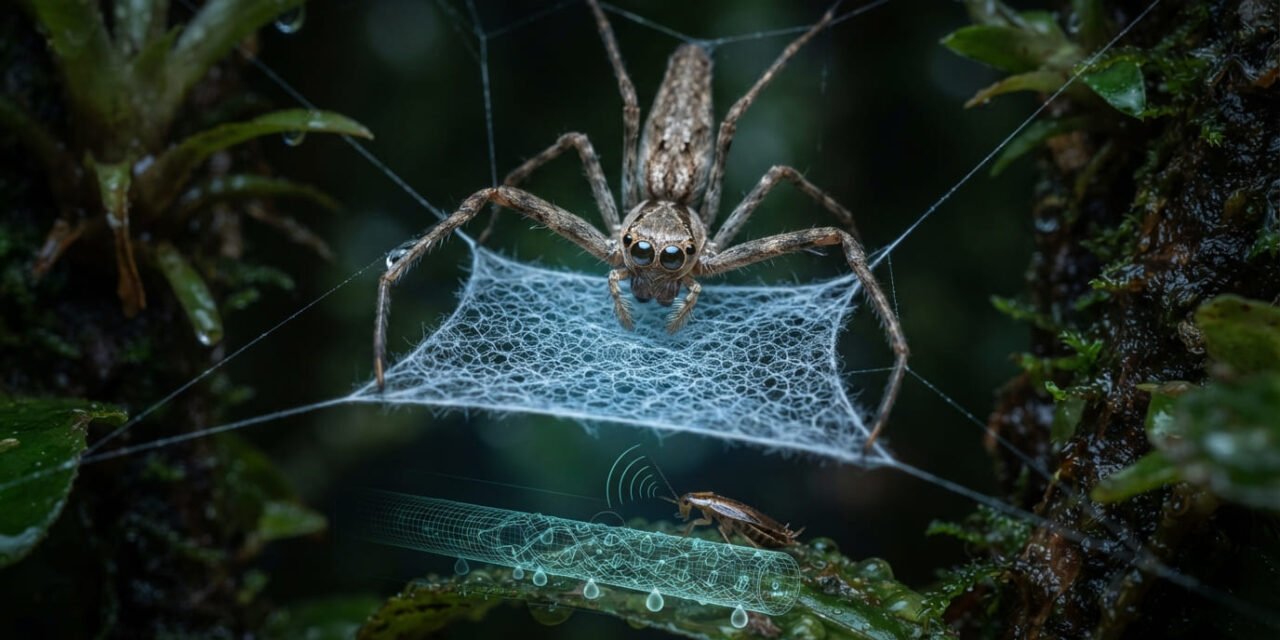
At first glance, it looks like a harmless, dead twig. It has a long, narrow body and exceptionally thin legs. But if you lean in closer to look at its face, you will find yourself staring into two massive, dark, and glassy eyes that dominate its head. They look like the giant headlights of a tiny car, giving the spider a stern, almost human expression.
This is the ogre-faced spider, also known to science as Deinopis. It is one of the most unusual and highly active hunters in the invertebrate world.
While most spiders are passive builders that spin a giant, sticky web and wait for days for a fly to accidentally crash into it, the ogre-faced spider is a dynamic predator. It does not wait for a collision. It weaves a small, elastic, hand-held net, hangs upside down above a forest trail, and literally throws the stretching trap directly over passing bugs. It is a biological gladiator, using a mix of advanced night vision, precise carpentry, and high-speed reflexes to catch its dinner in the pitch black.
The Headlight Eyes
To understand why the ogre-faced spider’s strategy is so successful, you have to look at how it sees the world. Hunting on the forest floor at night is a constant struggle against the darkness. Most spiders have very poor eyesight, relying instead on the vibrations of their webs to tell them when a meal has arrived.
But the ogre-faced spider cannot rely on web vibrations because its net is not attached to branches or leaves. It holds the net in its own claws. To catch an ant or a beetle walking on the ground below, the spider must be able to see the prey clearly in near-total darkness.
To solve this, the spider evolved some of the most powerful eyes on the planet. It has eight eyes in total, but two of them are abnormally large. These two forward-facing eyes are so massive that they take up almost the entire front of its head.
These eyes do not have a reflective backing like the eyes of a cat or a deer. A cat’s eyes shine in the dark because a mirror-like layer reflects light through the retina to double their vision power. The ogre-faced spider has a much more radical, active solution: it literally grows a new, highly sensitive light-detecting membrane inside its eyes every single night.
As the sun goes down, the spider’s body goes to work, rapidly assembling a fresh layer of light-sensitive cells across its massive retina. This membrane is incredibly delicate and thousands of times more sensitive to light than a human eye. It can capture the tiniest, most microscopic bits of moonlight or starlight filtering through the leaves.
But this super-powered vision has a catch. The membrane is so sensitive that the bright light of the morning sun would instantly burn it away and blind the spider.
Therefore, every single morning, as the first rays of dawn appear, the spider’s body systematically destroys the light-sensitive membrane, absorbing the cells back into its system. The spider spends its days resting as a blind, twig-like camouflage shape, waiting for the safety of dusk to rebuild its biological night-vision goggles all over again.
Weaving the Hand-Held Net
The construction of the gladiator’s net is a beautiful, highly calculated process that takes about an hour of continuous labor every evening. The spider starts by spinning a simple, A-shaped scaffold of strong, dry silk between a few twigs. This frame will support the spider’s body during the hunt.
Once the support structure is secure, the spider begins to weave the actual net. It does not use the wet, sticky silk that common garden spiders use. That kind of glue-heavy silk is heavy, dries out quickly in the night air, and is not very stretchy.
Instead, the ogre-faced spider uses a specialized, dry, and woolly silk called cribellate silk.
To make this silk, the spider uses a specialized plate near its spinnerets that acts like a tiny comb. As the silk is extruded, the spider rapidly combs the fibers, curling and crimping them until they look like a tangled mass of woolly yarn. Under a microscope, this silk looks like thousands of tiny, microscopic loops.
This woolly texture has a brilliant physical property: it does not need glue to be sticky. When an insect touches the crimped silk, the tiny, woolly loops snag on the microscopic hairs, ridges, and scales on the insect’s legs and body. It acts exactly like a piece of high-quality Velcro. The more the prey struggles, the more the woolly fibers tangle around its joints, locking it in place.
The spider weaves this woolly silk into a tight, neat rectangle about the size of a postage stamp. The rectangle is highly elastic, capable of stretching to several times its original size without breaking. Once the net is finished, the spider grabs the four corners of the rectangle using its four front legs.
Setting the Aiming Target
With the net held firmly in its front claws, the spider takes up its hunting position. It climbs onto the scaffold, turns upside down, and hangs by its back legs, suspended just an inch or two above the leaf litter or a flat green leaf where crawling insects like to travel.
It holds the tiny, unstretched net close to its chest, looking like a baseball player waiting for a pitch. But hanging upside down in the dark makes it difficult to judge distances. If the spider throws the net too early, it will miss. If it throws it too late, the insect will walk right past.
To guarantee a perfect hit, the spider uses a clever aiming trick.
Before it takes up its hanging position, the spider drops down to the leaf or ground below and deposits a tiny, bright white spot of waste. It then climbs back up to its perch.
This white spot acts like a visual aiming target on the dark forest floor. Because the spider’s eyes are so incredibly sensitive to light, the white spot shines like a beacon in the dark. The spider positions its body so that its giant eyes are focused directly on this white dot.
The dot is placed at the exact distance where the spider’s net can reach. The spider does not have to worry about tracking the movement of a fast ant in the dark; it simply watches the white dot. As soon as the dark silhouette of a crawling bug passes over the white target, the spider knows the prey is in the absolute center of the strike zone.
The Gladiator Strike
The strike itself is one of the most athletic and rapid movements in the invertebrate world, taking only a fraction of a second to complete.
When an ant or a small beetle walks over the white target, the spider launches its body forward. It does not let go of its safety line. It keeps a tight grip on the scaffold with its rear legs while stretching its front legs wide apart.
This sudden movement stretches the woolly net to three or four times its original size, turning the tiny postage stamp into a wide, open canopy. The spider thrusts the expanded net downward, slapping it directly over the passing insect.
As soon as the net touches the ground, the spider relaxes its front legs. The elastic silk snaps back to its original size, wrapping around the body of the prey like a tight, suffocating straightjacket. The woolly fibers instantly snag on the insect’s shell and legs, preventing it from running or kicking.
The entire process, from hanging still, detecting the prey, launching forward, stretching the net, and capturing the target, happens so fast that a human eye can barely follow it without the help of a high-speed camera. The insect is caught before its own nervous system can even register that a predator has dropped from the sky.
If a flying moth or a mosquito buzzed past the spider’s head instead of walking below, the ogre-faced spider can also perform a backward strike. It can twist its body midair and flip the net upward to catch flying insects, demonstrating an incredible level of spatial awareness and athletic flexibility.
Sucking the Juice and Daily Clean-Up
Once the insect is tangled in the net, the spider pulls the bundle up toward its mouth. It delivers a quick bite, injecting digestive fluid that paralyzes the prey and liquefies its internal organs.
The spider then spends several hours quietly sucking up this rich, liquefied soup.
When the meal is finished, the spider is left with a dry, empty shell of an insect and the remains of its woolly net. Just like the velvet worm and the hognose snake, the spider is highly efficient with its resources. It does not waste the valuable proteins used to make the silk. It eats the dirty, collapsed net along with the prey, recycling the amino acids to make a fresh batch of silk for the next night’s hunt.
As the sun begins to rise, the spider climbs up to a branch, stretches its long, thin legs out straight along its body, and becomes a stiff, gray stick. It blends in perfectly with the dry twigs of the bush, invisible to passing birds and lizards, waiting for the dark to return so it can rebuild its eyes, spin a new net, and set the trap once more.
Final Thoughts
The ogre-faced spider is a wonderful reminder that survival in the wild does not always require massive size or heavy armor. Sometimes, the most successful strategy is a clever mix of smart construction, physical flexibility, and a deep understanding of light and shadow.
By turning its own silk into a stretchy weapon and its own eyes into high-precision night cameras, this quiet, long-legged spider has carved out a highly successful niche in the dark forests of the world. It proves that with a great eye, a good set of elastic threads, and an absolute commitment to the hunt, you can turn the empty night into a lifetime guarantee of a free meal.