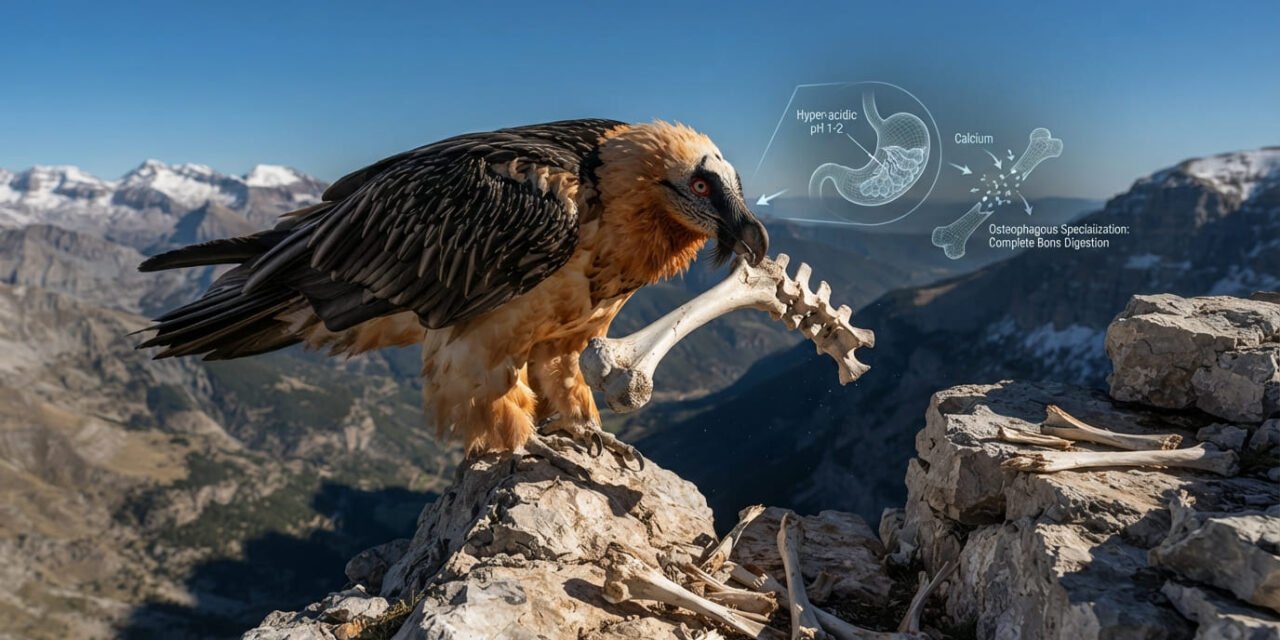
Imagine standing on a windswept ridge in the Pyrenees mountains. The wind is freezing, and the peaks are jagged. Below you, the carcass of a mountain goat lies in a ravine. Wolves have already taken the prime meat. Common griffon vultures have stripped the remaining muscle and tissue. By the time they leave, nothing remains but a dry, bare skeleton. For almost every animal on Earth, the meal is over.
Then, a bird with a nearly nine-foot wingspan glides down from the clouds. It ignores the tiny scraps of flesh. Instead, it reaches for a dry rib bone, swallows it whole, and looks around for more.
This is the bearded vulture, also known as the lammergeier. It is the only bird on Earth that survives almost entirely on bones. While other scavengers fight over meat, this bird waits for the chaos to end so it can claim the skeleton. Ninety percent of its diet consists of bone. This bizarre preference is not a desperate survival strategy. It is a highly successful evolutionary choice. Bones are packed with high-quality fat, protein, and marrow. They also do not rot as quickly as meat, which means the bearded vulture has a reliable food supply all year.
To make this diet work, the bearded vulture relies on two incredible adaptations. First, it uses gravity as a tool to smash bones that are too large to swallow. Second, it possesses a digestive tract that acts like an industrial acid vat.
The Carcass Hierarchy
To understand the lifestyle of the bearded vulture, you have to look at how scavengers share a meal in the wild. When a large animal dies in the mountains, a strict social order determines who eats first.
First come the apex predators, like wolves or golden eagles, which take the softest, most choice cuts of meat. Once they are full, the typical scavengers arrive. In Europe and Asia, these are usually griffon vultures and cinereous vultures. These birds have bald heads and long, featherless necks designed for reaching deep inside a carcass to pull out muscle and internal organs. They are aggressive, noisy, and fight viciously over every scrap of meat.
The bearded vulture does not participate in this violent struggle. It sits quietly on a nearby rock, waiting. Because its head and neck are fully feathered, it cannot reach into wet carcasses without ruinous matting to its plumage. Instead, it waits until the other birds have picked the bones completely clean and departed.
When the field is clear, the bearded vulture moves in to collect the prize. While the other birds left hungry because the meat ran out, the bearded vulture finds a massive, untouched feast of calcium, protein, and fat locked inside the dry skeleton.
The High-Altitude Drop
A bearded vulture can easily swallow bones up to ten inches long, but a large mammal carcass contains bones much larger than that. When the bird encounters a thick leg bone or a heavy skull, it cannot use its beak to crush the hard material. Its beak is sharp, but it lacks the crushing power of a hyena’s jaw.
Instead of using brute force, the bird uses the sky.
When a vulture finds a large bone, it grips the skeleton tightly in its massive, yellow-skinned talons. It takes off, flapping its long wings to gain altitude. The bird climbs to a height between one hundred fifty and three hundred feet above the rocky mountain slopes. It searches for a very specific target: a flat, exposed face of hard rock. Biologists call these favored rock formations ossuaries, or breaking yards.
Once the bird is positioned directly above the ossuary, it drops the bone.
The bone falls through the mountain air, gathering speed until it crashes against the rock. If the drop is successful, the bone shatters into bite-sized splinters. The vulture spirals down immediately to collect the pieces. If the bone does not break on the first attempt, the bird simply picks it up and repeats the process. Some older, experienced vultures can break a thick femur on their first try, while younger birds must practice for years to master the correct release angle and height.
This dropping behavior is a learned skill. Young vultures watch their parents and practice with sticks or small stones before they attempt to crack real bones. It requires precise spatial awareness and aerodynamic control.
Unlike other vultures, the bearded vulture has a long, wedge-shaped tail. This tail acts like a powerful rudder, allowing the bird to hover and maneuver in the turbulent mountain drafts while carrying heavy bone payloads that can weigh up to four pounds. The bird must calculate the wind drift so the bone lands on the flat rock rather than in soft grass or deep snow, where it would be lost.
The Acid Engine
Once the vulture shatters the bone, the next challenge begins. The bird swallows the sharp, jagged splinters whole. A human would suffer fatal internal bleeding if they swallowed a sharp piece of bone, but the bearded vulture has a highly elastic esophagus and a specialized stomach lining that can handle the rough edges.
The real magic happens inside the stomach.
The stomach of a bearded vulture is a biological marvel. It secretes an incredibly concentrated hydrochloric acid. The pH level of this stomach acid is estimated to be less than 1, making it more acidic than battery acid.
This extreme acidity serves a vital purpose. It allows the bird to dissolve solid bone. When a bone fragment enters the stomach, the acid immediately begins to strip away the calcium phosphate matrix. Within twenty-four hours, the solid bone is completely dissolved, leaving behind a rich soup of proteins, fats, and minerals.
The stomach itself is lined with specialized, highly active oxynticopeptic cells that produce this acid at a staggering rate. To support this intense chemical environment, the stomach walls are covered in a thick, protective layer of mucus that prevents the acid from digesting the vulture’s own tissues.
This chemical process is highly efficient. Bone marrow is exceptionally dense in energy, containing valuable lipids that meat alone cannot provide. By digesting the entire bone, the bearded vulture accesses a food source that is richer in calories than the soft tissues preferred by other scavengers. It also avoids competition. While eagles and other vultures fight over a fresh carcass, the bearded vulture can wait patiently nearby, knowing its meal is safe from competitors.
The Iron Mud Bath
If you look closely at a bearded vulture, you will notice its chest and belly feathers are a striking, rusty orange. You might assume this is their natural feather color, but it is actually a cosmetic choice.
Wild bearded vultures are born with white or pale grey underparts. As they mature, they seek out secret mountain pools rich in iron oxide. They wade into the red mud and rub the mineral-rich sludge into their feathers using their claws and beak.
Biologists have debated why the birds do this. The leading theory is that the iron oxide acts as a status symbol. The birds with the brightest orange feathers are often the most dominant in the territory.
Because finding these specialized red mud pools requires a deep knowledge of the local landscape, a bright orange chest tells other vultures that the bird is an experienced, healthy survivor. The mud may also provide a practical benefit. Iron oxide has natural antibacterial properties, which may kill parasites and protect the feathers from wear in the harsh, dry mountain air. It is a rare example of a bird using external tools to alter its physical appearance.
The Lamb-Slayer Myth
Despite their peaceful nature as scavengers, bearded vultures were feared and hated by humans for centuries. Because they are so massive, people assumed they were active, lethal predators.
In German-speaking regions, the bird was named the Lämmergeier, which translates literally to “lamb-vulture.” Folklore claimed that these birds would fly down, grab lambs from the pastures, and carry them off to their nests. Some stories went even further, claiming that the vultures would snatch young children playing in alpine villages.
These myths were physically impossible. While a bearded vulture has a massive wingspan, its feet are relatively weak compared to those of an eagle. Its talons are flat and designed for walking on rocks and carrying inanimate bones, not for grasping and killing struggling prey.
However, the power of these stories led to active persecution. European governments placed bounties on the birds, and hunters shot them by the thousands. By the early twentieth century, the bearded vulture was completely extinct in the Alps and critically endangered across the rest of Western Europe.
Why the Bone Breaker Matters
The bearded vulture plays a critical role in mountain ecosystems. By consuming skeletons, these birds act as natural cleanup crews. They prevent the accumulation of rotting bones that could otherwise harbor dangerous pathogens or pollute mountain water sources.
Fortunately, dedicated conservation programs have helped the species return to the Alps and the Pyrenees. Scientists breed the birds in captivity and release them back into the wild, monitoring them closely to ensure they find enough food.
Today, hikers in southern Europe can once again look up and see these magnificent gliders searching the cliffs for their next meal. They are protected by strict laws, and local communities have learned to celebrate them as symbols of wild mountain wilderness rather than active threats to livestock.
The next time you see a dry, discarded bone in the wild, you will likely think of it as useless waste. To the bearded vulture, that same bone is a feast. By combining simple gravity with extreme internal chemistry, this bird turned the wasteland of a carcass into an exclusive mountain buffet.