If you stand on a towering granite cliff on the coast of Scotland, Iceland, or Norway, you are looking out over one of the most punishing environments on the planet. The North Atlantic Ocean churns relentlessly below. The wind blows with furious force, bringing freezing rain and dense coastal fog. The sea spray is cold enough to numb human skin in seconds.
High up on the sheer rocky ledges, thousands of white and gray birds nest tightly together. To an untrained eye, they look almost identical to ordinary seagulls. They have pale gray wings, white bellies, and stout yellow beaks.
However, assuming this bird is just a gull is a mistake that many predators only make once.
This is Fulmarus glacialis, commonly known as the Northern fulmar.
While it looks like a typical seagull, the fulmar is actually a member of an entirely different family of oceanic wanderers. It is a tubenose, closely related to albatrosses and petrels. It spends almost its entire life out over the open ocean, braving massive ocean storms and freezing waves with effortless grace.
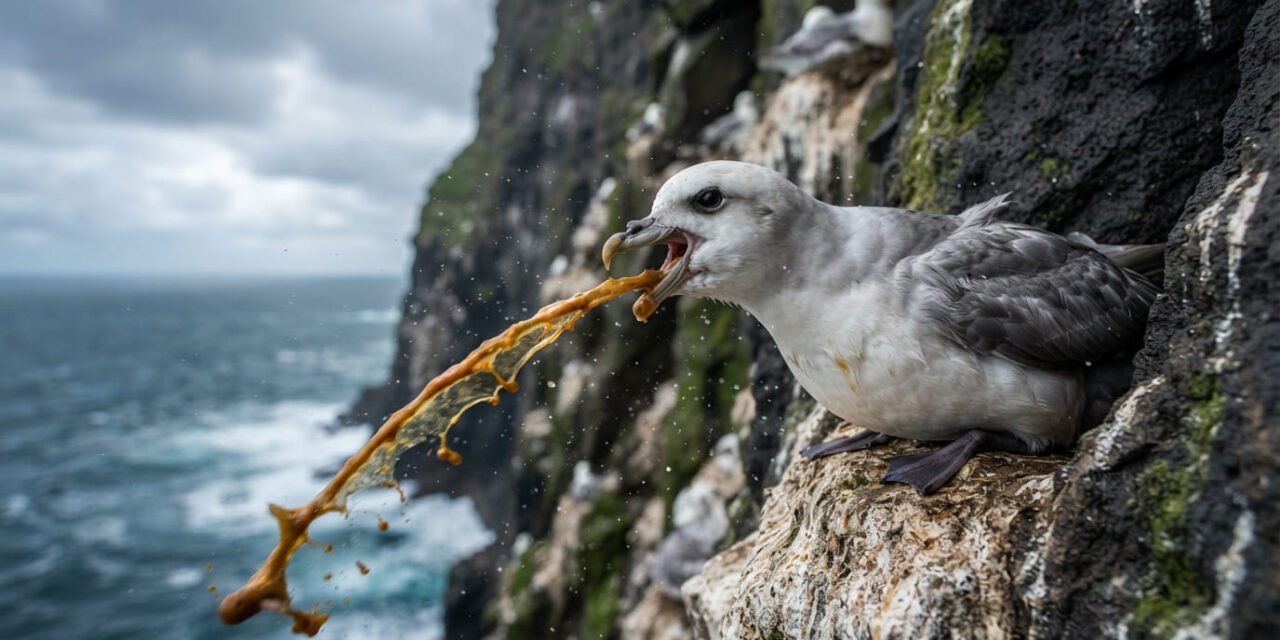
Yet its true claim to fame is not its flying ability. It is the fact that Fulmarus glacialis possesses one of the most disgusting, lethal, and chemically terrifying defensive weapons in the entire avian world. When threatened, the Northern fulmar does not fly away. It simply opens its mouth and launches a continuous spray of boiling, foul smelling stomach oil directly at its enemy.
The Chemistry of Ocean Oil
To understand where this chemical weapon comes from, you have to look at how the Northern fulmar lives out at sea.
Unlike birds that return to land every evening to sleep, the fulmar spends months at a time floating on the open ocean. It feeds on calorie rich marine life, diving beneath the surface to snatch small fish, squid, and ocean crustaceans.
When the bird digests its food, it extracts the rich fats and lipids, processing them in a specialized upper section of its stomach called the proventriculus. Instead of passing all these fats through its digestive tract, the fulmar concentrates them into a thick, viscous, energy dense oil. This stomach oil ranges in color from bright yellow to a deep amber orange.
For an ocean wanderer, this stomach oil is primarily a survival storage tank. It is an incredibly dense source of emergency energy. If a storm prevents the fulmar from hunting for several days, its body slowly absorbs the stored oil to stay alive. Parents also use this rich oil to feed their growing chicks, regurgitating small amounts of the fat liquid into the chick’s open beak.
However, over millions of years of evolution, this dense energy reserve was adapted into a devastating ranged weapon.
The Physics of the Vomit Strike
When a fulmar is sitting on its narrow cliff ledge, it is surprisingly clumsy on land. Its legs are set far back on its body, perfectly positioned for swimming and paddling through ocean waves, but completely useless for walking or running. If a predator corners a fulmar on a ledge, the bird cannot simply run away.
So, it prepares to shoot.
When a threat approaches, the fulmar first gives a series of clear visual warnings. It opens its beak, coughs loudly, and rusticates its throat. This muscle action pumps the stomach oil up from the proventriculus into the throat cavity.
If the intruder ignores the warning and takes another step forward, the fulmar contracts its stomach muscles with explosive force. It squirts a heavy jet of orange oil out through its open mouth.
The range and accuracy of this attack are staggering. A fully grown adult fulmar can accurately target an intruder up to six feet away. The bird does not just spit a few random droplets; it unleashes a continuous, high pressure stream of sticky liquid. It can rotate its head while firing, ensuring that the target is thoroughly coated in the foul smelling goo.
Destruction of the Feathers
Getting hit with vomit is unpleasant for any animal, but for a bird of prey or a mammal, getting hit by fulmar oil is often a slow death sentence.
The stomach oil of Fulmarus glacialis is not just smelly. It is chemically designed to ruin waterproofing.
Sea birds and birds of prey rely entirely on the complex structure of their feathers to stay warm and fly. Their feathers feature thousands of microscopic hooks called barbules that interlock tightly, creating a smooth, windproof, and waterproof barrier. This trap of clean air between the feathers and the skin is the only thing keeping a bird warm in freezing temperatures.
When the fulmar’s wax rich stomach oil hits another bird’s feathers, it acts like a harsh solvent. It completely strips away the natural preen oils that keep the feathers waterproof. The interlocking barbules instantly mat together, collapsing the insulating layer of air.
If a Great skua, scientifically known as Stercorarius skua, tries to attack a fulmar nest and gets sprayed in the chest, the consequences are immediate and terrible. The skua’s feathers lose all structural integrity. Water from the sea or rain soaks directly through to the skin.
If the skua tries to land on the ocean, it instantly waterlogs and drowns because its wet feathers can no longer keep it afloat. If it remains on land, the freezing arctic wind cuts directly to its skin, causing the bird to die of severe hypothermia within hours. Even if the bird manages to preen its feathers, the oil is so thick and persistent that washing it out in seawater is almost impossible. The bird usually dies trying to clean itself.
The Chick Defense
This projectile weapon is so deeply hardwired into the biology of the species that even freshly hatched chicks can use it.
Northern fulmars lay a single egg each year on bare rock ledges. They do not build comfortable nests out of twigs or grass; the egg sits directly on the stone. Both parents take turns incubating the egg for nearly two months.
When the chick hatches, it is a fluffy, helpless ball of white down. It is far too small to fight off any predator. However, within just a few hours of emerging from the eggshell, the chick’s proventriculus is already capable of storing and firing stomach oil.
If an adult parent leaves the chick alone on the cliff ledge for a few minutes while searching for food, the chick is completely capable of defending itself. If an intruder approaches, the tiny chick will puff up its downy feathers, cough to build pressure, and launch a jet of orange oil straight at the threat.
Researchers studying fulmar colonies have to wear heavy waterproof suits and protective eye shields. A single careless step near a chick can result in a face full of sticky, permanent, foul smelling oil that will ruin clothing and gear instantly.
Enemies of the High Cliffs
Because of this terrifying defensive spray, adult Northern fulmars have very few natural predators. Most animals that live near the sea cliffs have learned to give the birds a wide berth.
However, a few tough predators still attempt the raid.
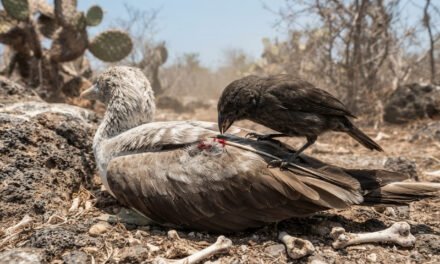
The Great skua (Stercorarius skua) is one of the few birds aggressive enough to risk an attack. Skuas will attempt to ambush fulmars from behind, grabbing the bird before it has a chance to turn its head and aim its stomach oil.
From the air, the White tailed eagle, scientifically known as Haliaeetus albicilla, will occasionally swoop down on fulmar ledges. The eagle relies on immense speed, dropping from the sky like a stone to kill the fulmar before the ocean bird registers the threat and pumps the oil into its throat.
On land, the Arctic fox, Vulpes lagopus, patrols the bases of the cliffs looking for eggs or chicks that have fallen from the high ledges. If a fox tries to climb up to an accessible nest ledge, it risks getting sprayed in the face. While the oil does not kill a mammal by drowning, it ruins the insulating quality of the fox’s winter fur and causes intense eye irritation, often forcing the fox to abandon the hunt.
Life on the Open Swell
When Fulmarus glacialis is not defending its nesting ledge on the cliff face, it lives a life of quiet mastery over the ocean waves.
They are long lived birds, often surviving for forty, fifty, or even sixty years in the wild. They form dedicated pair bonds that can last for decades, returning to the exact same rocky ledge every single spring to meet their mate.
Their diet is broad and highly flexible, which has allowed their populations to thrive across the northern hemisphere. They actively follow school of fish, diving up to several meters below the icy surface to catch capelin, known scientifically as Mallotus villosus, as well as small sand lances from the Ammodytes genus.
They also consume large amounts of krill, such as Thysanoessa inermis, and small deep water squid. In modern times, fulmars have learned to follow commercial fishing trawlers, gathering in massive screaming flocks behind the boats to feast on discarded offal and fish scraps thrown overboard.
To survive drinking pure seawater, they possess specialized salt glands located right above their eyes inside their nasal passages. These glands extract excess salt from the blood, dripping a concentrated brine out through the tubular nostrils on top of their beak. This gives their bill a distinctive double barrel appearance, which is why early sailors gave them their unique scientific classification.
The Absolute Power of Being Disgusting
It is easy to view nature through a lens of majestic beauty. We like to admire the soaring flight of an eagle, the speed of a falcon, or the brilliant colors of a tropical parrot. We prefer our wildlife to look clean and heroic.
The Northern fulmar completely rejects that visual standard. It is a plain looking bird that conquered the brutal cold of the northern oceans by adopting a strategy that is utterly repulsive.
It did not evolve powerful talons, and it did not develop toxic venom. Instead, it took its own emergency food reserves, concentrated them into a sticky chemical liquid, and learned how to spit it with deadly precision. It turned the simple act of indigestion into an absolute defense shield that can drown a rival bird or freeze a predator in its tracks.
Fulmarus glacialis is a quiet, enduring master of the North Atlantic. It proves that out on the freezing, storm whipped edges of the earth, staying alive is not about looking noble. It is simply about having a defense mechanism so deeply horrifying that the rest of the world decides to leave you completely alone.