If you walk across the sunbaked deserts of the American Southwest or northern Mexico during the high heat of summer, the landscape looks almost empty of life. The Sonoran and Chihuahuan deserts are harsh, uncompromising environments. The soil is dry and hard packed, the sun glares down relentlessly, and rain is a rare, unpredictable luxury.
For most creatures, finding water and food out here is a daily struggle. A sudden rainstorm might cause desert plants to burst into brief, violent bloom, producing a sudden flood of sweet nectar. But just a few weeks later, the flowers fade, the moisture evaporates, and the desert returns to a long, punishing drought.
If you are a tiny insect living in a colony of thousands of hungry nestmates, how do you survive months of absolute famine? You cannot build wooden granaries, and you cannot freeze food to preserve it.
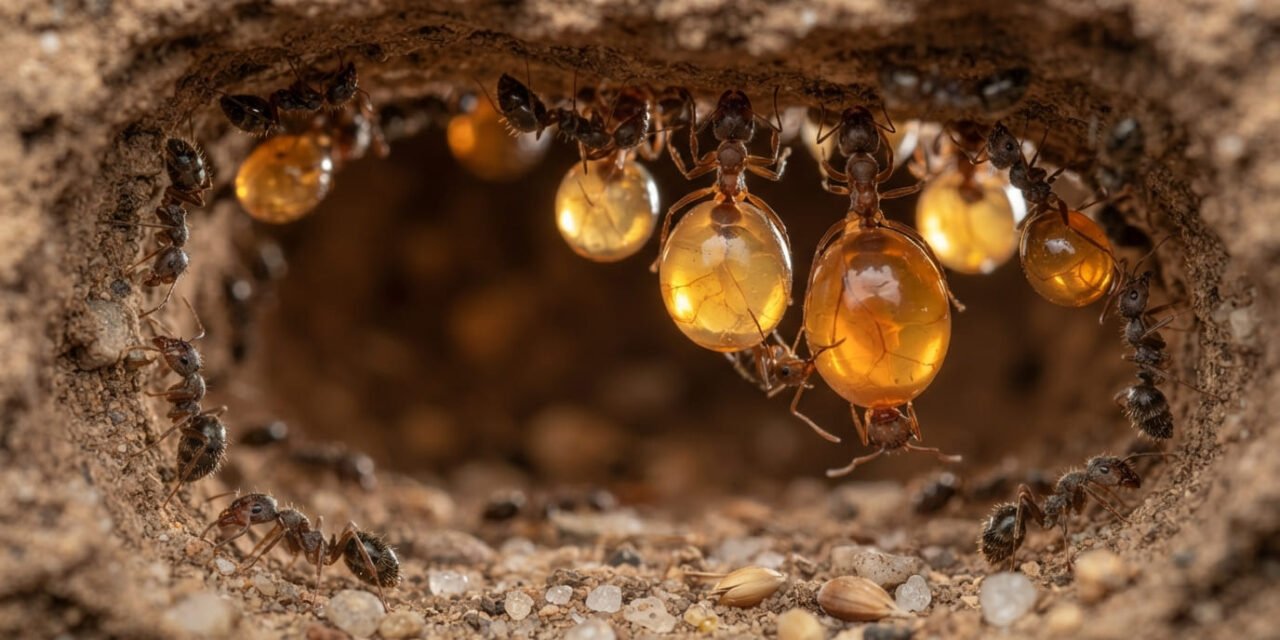
The honeypot ant, known scientifically as Myrmecocystus mexicanus, solved this fundamental survival problem through a mechanism that seems almost bizarre: it turned its own workers into living, hanging storage barrels.
These specialized ants spend their entire adult lives suspended upside down in pitch black underground vaults, their bodies swollen to the size of small amber marbles, packed to bursting with liquid sugar. They are living canteens, holding the key to survival for their entire colony.
The Birth of a Living Barrel
To understand how a tiny ant transforms into a giant sphere of liquid nectar, you first have to look inside the social structure of the ant nest.
In a colony of Myrmecocystus mexicanus, not all worker ants are created equal. When new worker ants emerge from their pupal cases, they all look fairly similar. They are slender, pale yellow or light brown insects built for running across the sand. But as the colony grows, certain young workers are selected for a very specific, motionless destiny.
These specialized workers are known as repletes, or plerergates.
When a fresh hatch of workers is assigned to become repletes, they are led down into the deepest, coolest chambers of the nest. They climb up the walls and attach themselves firmly to the domed ceilings of these earthen rooms using the sharp claws on their feet. Once positioned, they rarely move again.
Other worker ants, known as foragers, venture out into the desert at night to gather food. When the desert blooms, these foragers collect massive amounts of liquid calories. They gather sugary nectar from blooming desert plants, such as the soapweed yucca, known scientifically as Yucca elata. They also seek out tiny, sap sucking insects from the family Coccidae, harvesting the rich honeydew droplets these insects secrete.
The foragers return to the nest bloated with liquid. They climb down into the deep vaults, find the hanging repletes, and begin a process called trophallaxis.
Trophallaxis is the mouth to mouth transfer of liquid food common among social insects. The foraging ant regurgitates a tiny droplet of nectar and passes it directly to the waiting replete. The replete drinks the nectar, storing it in a specialized internal organ called the crop, or social stomach.
As days pass and more foragers return with food, the replete is fed continuously. The social stomach expands dramatically.
The Physics of a Stretched Abdomen
The physical transformation of a replete is a incredible feat of insect anatomy.
Most insects are encased in a rigid, hard exoskeleton made of chitin. This outer shell acts like a suit of armor, protecting delicate internal organs and providing structural support. If a typical beetle or ant tries to overeat, its hard shell simply limits how much food its body can hold.
However, the abdomen of Myrmecocystus mexicanus features thin, highly elastic sheets of membrane connecting the hard plates of chitin. These flexible intersegmental membranes act like biological accordion folds.
As the replete absorbs more and more nectar, these hidden membranes stretch outward to an astonishing degree. The hard chitin plates that once covered the entire abdomen are pushed far apart, looking like tiny dark islands floating on a massive, translucent, amber balloon.
Eventually, the replete’s abdomen swells to several times its original size. It becomes a smooth, delicate, golden sphere roughly the size of a small grape or a glass marble. The liquid inside is clearly visible through the stretched, paper thin membrane.
At this point, the ant is completely immobile. The weight of the liquid in its stomach is far heavier than the rest of its body combined. If a replete loses its grip on the ceiling and falls to the dirt floor, its swollen abdomen can easily rupture, killing the ant instantly.
The Architecture of the Cool Vaults
Having dozens or hundreds of fragile, liquid filled ants hanging around presents a major engineering challenge. If the air is too dry, the water inside the nectar will evaporate through their stretched skins. If the temperature gets too hot, the sugar can spoil or ferment. If the chamber collapses, the living vaults will pop.
Because of this, Myrmecocystus mexicanus nests are marvels of subterranean engineering.
The ants dig their nests deep into the desert soil, sometimes reaching depths of over six or seven feet beneath the surface. At these depths, the temperature remains remarkably stable year round, completely insulated from the scorching heat of the summer sun and the cold of desert winter nights.
The storage chambers are carved with great care. The walls and ceilings are made of packed clay or fine sand, meticulously smoothed by the workers’ jaws. The ceiling is purposely given a rough, textured finish, providing plenty of tiny footholds for the repletes to clamp onto with their tarsal claws.
By hanging upside down from the ceiling, the repletes are kept completely suspended in midair. This keeps their delicate, stretched bodies off the rough dirt floor, preventing sharp sand grains from puncturing their abdomens and protecting them from soil dwelling fungi or bacteria.
The repletes hang side by side in tight, golden clusters, looking like tiny, glowing chandeliers hanging in a dark basement.
The Reverse Flow During the Drought
During the short, rainy months when the desert is lush and flowers are producing nectar, the subterranean vaults fill. Row after row of repletes swell with golden liquid.
Then, the rain stops. The desert sun bakes the earth dry, the flowers wither, and the sap sucking Coccidae insects disappear. For months on end, the foragers return from their nightly patrols with empty stomachs. The colony enters a period of severe food shortage.
This is the moment the repletes were created for.
When a hungry worker ant or a nurse caring for young larvae needs food, it travels down into the storage vaults. It approaches one of the hanging repletes and uses its antennae to gently tap the replete on its head and mouthparts.
This physical touch acts as a biological request. The replete responds immediately. It contracts the muscles surrounding its swollen crop, forcing a tiny droplet of golden, energy rich nectar up through its throat and into its mouth.
The hungry worker drinks the drop directly from the replete’s jaws, receiving the calories it needs to continue working, digging, or nursing the queen’s offspring.
A single replete can feed dozens of its nestmates over the course of a dry season. As the long months pass and the liquid reserves are slowly drawn down, the replete’s abdomen gradually shrinks. The stretched intersegmental membranes fold back up, the hard chitin plates slide back together, and the ant slowly returns toward its normal shape, ready to be refilled whenever the next big rainstorm arrives.
The Constant Threat of Invasion
A hidden underground room packed with high energy liquid sugar is an incredible asset for an ant colony. But it is also a massive target for every hungry predator in the desert.
Out in the scrublands, many animals actively seek out Myrmecocystus mexicanus nests.
Desert mammals like the coyote, scientifically named Canis latrans, and the American badger, Taxidea taxus, possess a keen sense of smell. They can detect the scent of a large ant nest from far away. Badgers, in particular, will use their powerful front claws to excavate massive trenches into the hard desert soil, tearing through the upper galleries of the nest until they break into the cool storage vaults deep below. They greedily lap up the sweet, high calorie repletes, destroying years of colony work in a matter of minutes.
An even more terrifying threat comes from other ants.
Rival ant species, such as the aggressive harvester ants from the Pogonomyrmex genus, constantly compete for territory and resources. Worse yet, neighboring colonies of Myrmecocystus mexicanus will actively wage war on one another.
When a large honeypot ant colony detects a weaker neighboring colony, they will launch a full scale raid. Hundreds of worker ants march across the sand, invade the neighboring nest, and fight through the tunnels to reach the storage vaults.
If the invading colony wins the battle, they do not just kill their rivals. They steal the living treasure. The invaders carefully unhook the plump, helpless repletes from the ceiling of the conquered nest, drag them through the dark tunnels, and haul them back to their own fortress to be integrated into their own living vaults.
Humans have also long appreciated the golden treasure of the honeypot ant. For thousands of years, Indigenous peoples across the American Southwest and the Australian Outback have harvested honeypot ants as a valuable, high energy food source and a sweet delicacy. They carefully excavate the nests, picking out the repletes and consuming the sweet liquid directly, which tastes remarkably like floral honey mixed with a slight tang of formic acid.
The Ultimate Form of Social Altruism
When we look at the animal kingdom, we often measure evolutionary success by individual traits. We admire the speed of a sprinting predator or the sharp claws of an eagle. We think of survival as a lone animal fighting for its own life.
The honeypot ant completely shatters that individualistic view of nature.
A replete Myrmecocystus mexicanus worker gives up almost everything that makes an insect an individual. It surrenders the ability to walk, to explore the outside world, to hunt, or to see the sun. It spends its long life locked in a dark, cold underground room, hanging upside down from a clay ceiling, bearing an immense physical weight that stretches its body to the absolute limit of survival.
It becomes a living organ of a larger superorganism.
The success of the colony does not depend on any individual ant staying alive or living a comfortable life. It depends entirely on the collective ability of the nest to store resources, endure the brutal desert droughts, and protect their living vaults until the rains return.
Myrmecocystus mexicanus proves that in the unforgiving, sunbaked heart of the desert, brute strength is not the only way to survive. Sometimes, the most effective survival strategy on Earth is simply turning yourself into a vault of sweetness, clinging tightly to the dark ceiling, and quietly keeping your entire family alive through the longest drought of the year.