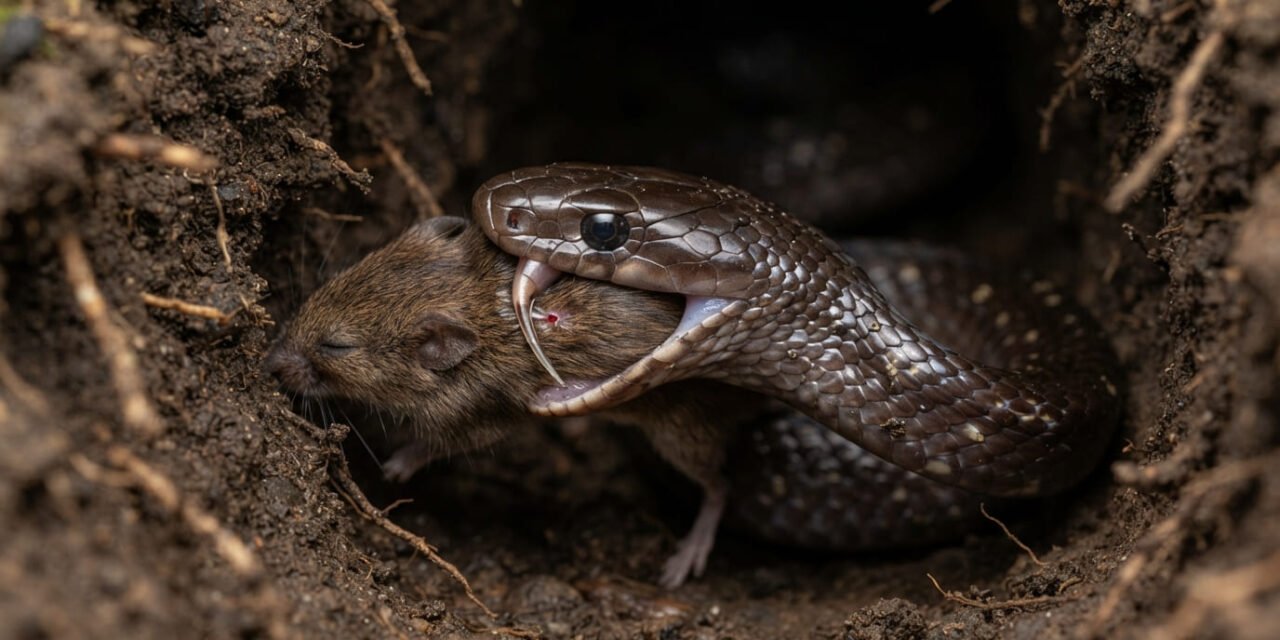
Imagine taking a quiet evening walk along a dirt path in Sub-Saharan Africa or parts of the Middle East. The warm night air is humid, and recent rain has softened the dark soil. As you light your way with a flashlight, you spot a small, glossy dark reptile crawling across the damp earth. It is less than two feet long, with a smooth, shiny body, small eyes, and a blunt head that looks almost identical to its short tail.
At first glance, it looks like a completely harmless garter snake, a legless lizard, or a burrowing mole viper. If you were a snake collector or an amateur enthusiast, your instinct might be to reach down, pin its neck gently with your thumb and forefinger right behind its head, and pick it up. In the reptile world, holding a snake behind the head is considered the safest way to prevent a bite.
If you try that with this specific snake, you will make a painful, life-altering mistake.
Without ever opening its mouth, the snake will simply tilt its head sideways, move a single muscle in its jaw, and slide a long, needle-sharp fang straight out the side of its closed lip. It will drive that fang deep into your thumb with a swift, backward twitch of its neck. Within seconds, a burning, excruciating pain will spread through your hand, followed by severe swelling, blistering, and tissue destruction that antivenom cannot cure.
This is the stiletto snake (Atractaspis), also known as the burrowing asp or mole viper. It is an extraordinary reptile that broke all the traditional rules of snake biology. To survive a life spent hunting in narrow, dark underground tunnels, the stiletto snake developed a mechanical marvel inside its skull. It is the only snake on Earth that can rotate its fangs independently out the side of its mouth, allowing it to stab prey sideways without ever opening its jaws or swallowing a single grain of dirt.
The Physical Challenge of Underground Hunting
To understand why the stiletto snake evolved such a bizarre weapon system, you first have to look at the environment where it spends most of its life.
The world beneath the soil is a challenging place for a predator. Most snakes hunt in wide, open spaces like forest floors, grassy meadows, or tree canopies. When a rattlesnake or a cobra strikes, it needs room. It coils its body into an S-shape, opens its jaws at a wide angle, and launches its entire head forward at high speed to sink its fangs into a rodent or bird.
Now imagine trying to execute that high-speed, wide-mouth strike while crammed inside a narrow earthworm tunnel three feet under the ground.
Underground burrows are tight, dark, and restrictive. There is no room to coil up for a launching strike. There is no space to open a wide jaw, because the walls of the dirt tunnel push directly against the snake’s face. If a typical snake tried to open its mouth wide inside a soil tunnel, it would simply slam its jaws into wet clay and get a mouthful of choking dirt.
Furthermore, many of the animals that live underground, like burrowing rodents, blind lizards, and amphisbaenians, build tight nests in dead-end tunnels. If a predator encounters a nest of baby mice deep inside a narrow burrow, it cannot back up to get a running start. It must be able to attack in extremely close quarters, where its head is pressed flush against the prey or the tunnel wall.
The stiletto snake solved this spatial dilemma by ditching the traditional forward strike entirely. It created an anatomical workaround that allows it to turn its head into a side-stabbing weapon.
The Rotating Skull and Side-Folding Fangs
If you were to look at a medical X-ray of a stiletto snake’s skull, you would see a jaw structure unlike anything else in the animal kingdom.
In normal venomous snakes, like vipers, the long fangs are attached to a small jawbone called the maxilla. When the viper opens its mouth wide, a series of lever-like bones push the maxilla forward, erecting the fangs so they point straight ahead toward the prey. When the mouth closes, the fangs fold flat against the roof of the mouth.
The stiletto snake re-engineered this entire apparatus for lateral movement.
First, its fangs are exceptionally long compared to the size of its small, narrow head. In some species of stiletto snake, the fangs account for up to one-third of the total length of the entire skull. If the snake tried to open its mouth straight forward, those massive fangs would be clumsy and difficult to maneuver in a narrow space.
Second, the maxilla bone carrying the fang sits on a unique, saddle-shaped joint that allows for independent rotation. The snake does not need to move both sides of its jaw at the same time, nor does it need to drop its lower jaw down.
Instead, when the stiletto snake senses prey lying beside it in a narrow tunnel, it uses specialized internal muscles to rotate the maxilla bone on just one side of its face. As the maxilla pivots outward, it pushes open a small, flexible slit along the upper lip line. The long, curved fang swings outward and backward, protruding out from the side of the snake’s mouth like a tiny retractable dagger.
The snake’s mouth remains pressed tightly shut, keeping its throat protected and preventing dirt from entering its mouth. The snake simply twitches its neck backward and sideways, hooking the exposed fang deep into the side of the prey. It is the biological equivalent of a switchblade opening sideways from a pocketknife.
The Efficiency of the Underground Ambush
This side-stabbing mechanism makes the stiletto snake one of the most efficient subterranean hunters on the planet.
When a stiletto snake crawls into a rodent burrow, it often finds a mother rodent and a nest full of small offspring packed together in a tight dirt chamber. A typical predator might struggle to maneuver, allowing some of the prey to scramble past or bite back in the dark.
The stiletto snake does not struggle. It glides silently into the chamber, presses its body alongside the cornered animals, and begins to work with quiet precision.
It swings one fang out to the left and stabs the nearest rodent with a fast, backward jerk of its head. Without pausing to swallow, it swings its head toward another target, deploys its right fang, and strikes again. Because it does not need to open its jaws or reset its body position between attacks, it can quickly envenom multiple prey items in a matter of seconds.
The snake’s teeth also feature a unique anatomical detail: a sharp, raised ridge or keel running along the back edge of each fang. As the fang penetrates the prey’s skin, this sharp keel cuts a tiny slit in the tissue. This mechanical cut enlarges the wound, allowing the venom to be absorbed rapidly into the victim’s body while helping the snake pull its long, hooked fang back out without getting snagged.
Once all the occupants of the burrow are paralyzed by the venom, the stiletto snake calmly turns around in the dark tunnel and swallows its meal headfirst at its own pace.
A Chemical Cocktail with No Antivenom
While the physical mechanics of the strike are fascinating, the chemical payload inside the stiletto snake’s venom glands is equally terrifying.
Most venomous snakes rely on one primary type of venom. Vipers typically use hemotoxins that destroy tissue and break down blood vessels, while cobras use neurotoxins that paralyze the nervous system. The stiletto snake uses a complex, highly destructive chemical mix dominated by powerful cytotoxins and unique cardiotoxins called sarafotoxins.
Sarafotoxins are biological compounds that act directly on the heart and blood vessels. When injected into a small mammal, these molecules cause intense, immediate constriction of the coronary arteries, leading to severe heart disturbances, rapid drops in blood pressure, and swift death.
For humans who encounter a stiletto snake, the results are painful and long-lasting.
Because stiletto snakes are small, dark, and unremarkable in appearance, people frequently misidentify them as harmless garter snakes or blind snakes. They pick the snake up by hand, often holding it right behind the head. The snake simply rotates a fang out the side of its mouth, stabs the handler’s finger, and injects its venom.
The bite causes immediate, overwhelming pain that victims describe as feeling like hot liquid iron being poured into the bone. Massive swelling, blistering, and dark tissue death set in within hours.
To make matters worse, traditional antivenom does not work against stiletto snake bites. Standard antivenoms produced for African cobras and vipers do not contain the specific antibodies needed to neutralize sarafotoxins. Medical treatment relies entirely on pain management, antibiotics, and surgical removal of dead tissue. In many cases, bites to fingers or toes result in permanent nerve damage or surgical amputation.
The Inverted U-Turn and Tail Tricks
The stiletto snake’s survival kit is not limited to its fangs. Life underground has shaped its entire body plan, from its snout to the tip of its tail.
Its head is wedge-shaped and smooth, with a lower jaw that is slightly recessed beneath its upper snout. This countersunk jaw acts like a miniature bulldozer, allowing the snake to push its head directly into loose soil, leaf litter, and mud without forcing dirt into its mouth. Its scales are exceptionally smooth and polished, reducing friction as it glides through tight earth.
If a stiletto snake is uncovered on the surface by a predator like a bird or a mongoose, it does not try to run away at top speed. Instead, it uses a series of strange, defensive poses designed to buy time.
First, it will arch its neck into a tight, upside-down horseshoe shape, pointing its nose directly into the dirt. It begins to dig furiously with its hard snout, attempting to re-enter the soil within seconds.
If a predator grabs its body, the snake will coil tightly, flip its head upside down, and begin lashing its body violently from side to side. At the same time, it can release a foul-smelling liquid from its cloaca to disgust the attacker.
Even its tail plays a role in defense. The tail of a stiletto snake is very short, ending in a hard, sharp, horny spine. If an animal grabs the snake from behind, the snake can thrust its tail backward, pressing the sharp spine into the attacker’s skin. The sudden prick feels remarkably like a bite, tricking the predator into releasing its grip and giving the snake a chance to dive into the nearest hole.
Lessons for Medical Science and Engineering
You should care about the stiletto snake because its unique biology is helping human scientists solve complex medical and mechanical problems.
For medical researchers, the cardiotoxins found in stiletto snake venom provide valuable clues about how the human heart responds to sudden arterial constriction. By studying how sarafotoxins interact with cell receptors in blood vessels, biochemists are developing new medications to treat severe high blood pressure, heart failure, and complex vascular conditions.
Engineers and roboticists are also studying the stiletto snake’s skull mechanics. Modern surgical tools and micro-robotic arms often need to operate inside tight, delicate spaces within the human body during non-invasive procedures.
Traditional robotic tools require wide clearance to open their jaws or rotate their tips. By copying the stiletto snake’s saddle-joint jaw and side-deploying mechanics, engineers are designing tiny surgical devices that can extend needles and cutters sideways inside narrow blood vessels or tissue tracts without needing extra room to open. The snake proved millions of years ago that you do not need wide open spaces to deliver a precise point of contact.
A Quiet Master of the Dark
The stiletto snake is a wonderful example of how evolutionary pressure can reshape even the most established body plans. It took a simple, legless frame designed for crawling and rebuilt the skull into a masterpiece of mechanical efficiency.
It did not need to grow giant jaws, develop long wings, or build massive muscles to become an effective predator. Instead, it looked at the claustrophobic walls of the underground world and found a clever way to bypass them entirely. It turned its mouth into a sealed vault, its fangs into side-deploying blades, and its entire life into a quiet success story beneath our feet.
The next time you walk along a dark dirt path on a warm, rainy night, take a moment to look at the ground beneath you. Somewhere down in the dark earth, a tiny, glossy performer is moving through the soil, proving that you do not need to open your mouth to make sure the world knows you are a master of your craft.