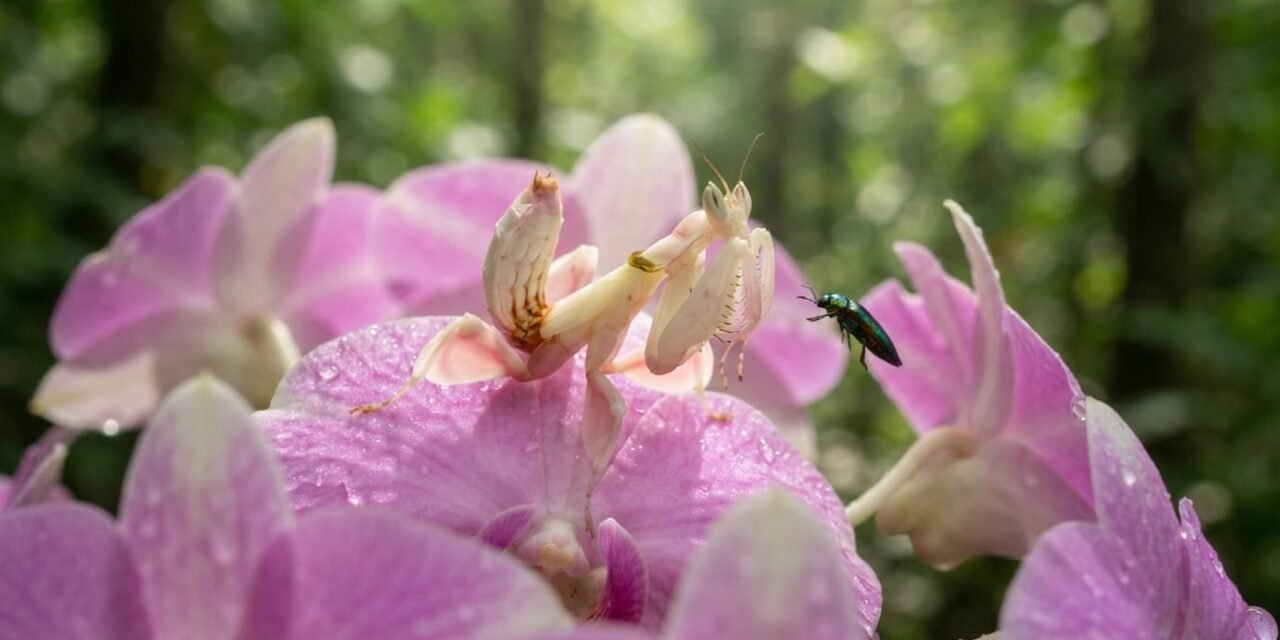
Imagine walking through the warm, humid rainforests of Southeast Asia, across the lush canopy trails of Malaysia or Indonesia. The air is thick with the scent of tropical blossoms, damp soil, and wild orchids. As you scan the green foliage of a low-hanging vine, you spot a single, pristine blossom resting on a broad green leaf.
It is a striking shade of soft pink and creamy white, with delicate, teardrop-shaped petals that look like they were sculpted from polished porcelain. A honeybee buzzes through the warm air, searching for nectar. Drawn by the vivid color resting against the green background, the bee glides down toward the blossom, preparing to land right on the soft petals.
Then, the flower moves.
In a fraction of a second, the pink petals unfold into spiked claws. The center of the flower expands, two dark compound eyes lock onto the bee, and the blossom slams shut like a steel trap. The bee is caught before it even registers that there is no nectar.
This is the orchid mantis (Hymenopus coronatus). Found across the tropical rainforests of Southeast Asia, this insect is one of the most remarkable masters of disguise in the natural world. But unlike most camouflaged animals that hide to avoid danger, the orchid mantis uses its beautiful form for aggressive deception. It turns its own body into a living flower, shaping its legs into delicate petals and using visual optics to attract more pollinators than the actual blossoms blooming around it.
The Strategy of Aggressive Mimicry
To appreciate why the orchid mantis looks the way it does, you first have to understand the difference between passive camouflage and aggressive mimicry.
Most camouflaged creatures use a defensive strategy. A stick insect looks like a dry twig so that hungry birds will walk right past it. A leaf-tail gecko looks like a dead leaf so it can sleep safely on a tree trunk during the day. Their goal is to blend into the background and become completely invisible.
The orchid mantis uses a strategy called aggressive mimicry. It does not try to blend into the background or hide from view. Instead, it advertises itself. It dresses up as a highly desirable object, a fresh, nectar-rich flower, to trick other animals into coming directly to it.
In the world of biology, this is the ultimate role reversal. Instead of a predator chasing down its prey, the predator stands completely still in the open sunlight and forces the prey to chase the predator.
Anatomical Sculpture: From Legs to Petals
The physical transformation of the orchid mantis is a masterpiece of evolutionary engineering.
While a typical praying mantis has long, thin, stick-like legs designed for crawling through grass, the orchid mantis modified its limbs into floral structures. The four walking legs feature wide, flattened lobes shaped remarkably like the heart-shaped or teardrop-shaped petals of a tropical orchid.
Its abdomen is soft, rounded, and features a subtle, semi-translucent ridge that mimics the central lip, or labellum, of an orchid flower. Even the color of the mantis is customized for the illusion. Depending on environmental factors like humidity, temperature, and light levels, the orchid mantis can adjust its coloration through shades of brilliant white, soft pink, magenta, and gentle yellow.
When the mantis takes up its hunting posture, it tucks its thin thorax downward, lifts its abdomen, and spreads its broad, petal-like legs out to the sides. It relaxes its spiked front raptorial legs, holding them close to its chest like the inner reproductive column of a flower.
To a human observer standing a few feet away, the insect no longer looks like a legless animal or an insect at all. It looks like a fresh, blooming flower resting on a leaf.
The Supernormal Stimulus: Out-Attracting Real Flowers
For over a century, naturalists assumed that the orchid mantis survived by sitting directly inside clusters of real orchid flowers, using its body to hide among the genuine petals while waiting for visiting bees.
In the early two thousands, an Australian evolutionary biologist named Dr. James O’Hanlon traveled to the rainforests of Malaysia to test this theory. What he discovered completely overturned a hundred years of scientific assumptions.
The orchid mantis almost never sits on real flowers. In fact, it prefers to sit all by itself on plain, bare green leaves.
Dr. O’Hanlon and his research team tracked the behavior of wild orchid mantises and used specialized spectrophotometers to measure how pollinators, like honeyflies, stingless bees, and butterflies, perceive the mantis compared to real flowers.
Insect vision is vastly different from human vision. Bees and butterflies do not see the world in simple colors; they see light across the ultraviolet spectrum. They are hardwired to look for strong visual contrasts, specifically bright, color-saturated shapes sitting against dark green backgrounds.
When the researchers analyzed the visual signal produced by the orchid mantis, they realized that the mantis was not just copying a specific species of orchid. It was presenting an idealized, universal visual signal.
To a flying bee scanning the forest, the pink-and-white body of the mantis produces a brighter, more saturated visual contrast against a green leaf than almost any real tropical flower in the surrounding forest. The mantis acts as a supernormal stimulus, an artificial exaggeration of a natural cue that triggers an irresistible impulse in the brain of the prey.
In controlled field tests, pollinators actually chose to fly toward and attempt to land on the orchid mantis more frequently than they did on real, nectar-producing flowers nearby. The mantis does not just hide among flowers; it out-attracts them.
The High-Speed Strike Mechanics
Once an unsuspecting pollinator is lured into range by the optical trap, the mantis switches from a passive statue to a high-speed hunter.
The orchid mantis possesses exceptional vision. Its two large compound eyes sit on the upper corners of its triangular head, providing a three-hundred-degree field of view. Like other mantis species, it uses binocular vision to calculate depth, distance, and movement with high accuracy.
As the bee glides in, expecting to land on a soft petal, the mantis tracks the insect’s flight path with subtle, precise turns of its head. It waits until the prey crosses into its immediate strike zone, usually a distance of less than two centimeters.
The strike itself is one of the fastest mechanical movements in the invertebrate world, taking roughly 15 to 30 milliseconds. To put that into perspective, a single human eye blink takes over 100 milliseconds.
The mantis launches its front raptorial legs forward. These legs are lined with sharp, interlocking rows of hard chitin spines. When the legs snap shut around the bee, the spines interlock like a row of steel teeth, pinning the prey instantly.
Because the mantis catches insects mid-air before they can even touch its body, the struggling prey rarely gets an opportunity to sting or bite back. The mantis then begins to feed immediately, using its sharp mandibles to chew through the prey’s outer shell.
Ontogeny: The Changing Disguises of Life
One of the most fascinating aspects of the orchid mantis is that its floral disguise is not permanent. It changes its appearance throughout its lifetime to adapt to different threats and hunting needs.
When a clutch of orchid mantis eggs hatches from its papery egg case, known as an ootheca, the tiny first-instar nymphs do not look like pink orchids. Instead, they hatch with brilliant red and black bodies, dark legs, and orange heads.
This early stage is an example of Batesian mimicry. The newborn nymphs resemble toxic, foul-tasting assassin bugs or fire bugs found on the forest floor. Birds and jumping spiders avoid these red-and-black nymphs, assuming they are venomous or bitter.
After their first molt, the young mantises shed their red-and-black skin and emerge in their famous pink-and-white floral costumes. This juvenile nymph stage is when the floral mimicry is at its absolute peak. Their leg lobes are broad, their pink coloration is vivid, and their appetite for flying pollinators is massive.
As the mantis reaches adulthood, a dramatic difference between the sexes emerges, a phenomenon known as extreme sexual dimorphism.
The female orchid mantis grows to be large and heavy, reaching lengths of about six to seven centimeters. She retains her broad petal legs and bright pink-and-white tones because her primary job is to stay stationary, attract massive amounts of food, and gather the energy needed to produce heavy egg cases.
The male orchid mantis remains tiny, growing to only about two or three centimeters long, roughly half the size of the female. He loses much of his pink coloration, turning a duller, pale brownish-white, and his leg lobes become much narrower.
Because the male is small and lightweight, he develops strong, functional wings that allow him to fly through the rainforest canopy. His life is not spent standing still and attracting bees; he must actively fly through the trees to locate large, stationary females while avoiding being eaten by them during courtship.
Lessons for Science and Optical Design
You should care about the orchid mantis because its unique hunting strategy is helping scientists solve complex problems in evolutionary biology, visual perception, and sensor technology.
For decades, biologists believed that animal mimicry required a strict, one-to-one visual copy of a specific target in nature. The orchid mantis proved that evolution can produce generalized sensory traps that exploit the fundamental cognitive shortcuts of other animals’ brains.
Engineers and optical scientists are studying the physical structure of the orchid mantis’s exoskeleton to understand how its microscopic scale textures manipulate light.
By analyzing how the mantis’s skin scatters ultraviolet and visible light to create high-contrast signals, material scientists are developing new bio-inspired coatings, non-fading dyes, and visual sensors for autonomous drones that need to identify objects against complex, noisy backgrounds without using high amounts of electrical power.
Master of the Canopy Illusion
The orchid mantis is a wonderful reminder that nature’s most effective tools are often hidden behind a mask of incredible beauty. It is an insect that took the classic body plan of a hunter and reshaped it into a delicate floral sculpture.
It did not achieve its success by running fast, growing sharp teeth, or manufacturing potent venom. Instead, it studied the visual desires of its prey, built a living blossom out of its own skin, and proved that in the dense rainforests of the world, a beautiful flower can be the most dangerous hunter of all.