If you take a slow walk through a damp meadow or along the chalky, grass-covered hillsides of southern England and central Europe, you might decide to overturn a rotting log or a flat stone. Underneath, scrambling frantically to get out of the sudden sunlight, you will likely find a chaotic mix of pillbugs, earthworms, and spiders.
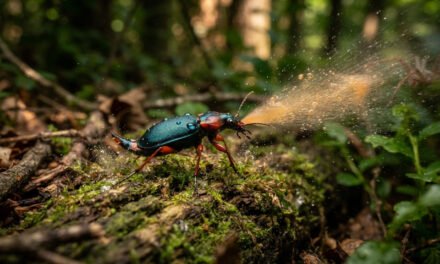
Among them, you might spot a relatively small, unassuming beetle. It is barely half an inch long. It has a dull, rusty-red head and legs, paired with a dark, ribbed abdomen that shines with a faint bluish-green tint. If you try to pick it up, it won’t bite you. It doesn’t have massive, crushing mandibles like a stag beetle. It doesn’t possess a venomous stinger like a wasp.
At first glance, it just looks like standard, harmless bird food.
But you are actually looking at Brachinus crepitans, commonly known as the bombardier beetle. And if you handle it too roughly, you are going to hear an audible, sharp pop. A split second later, your fingers will feel a sudden, burning pain, and the air around you will instantly smell like burnt chemicals and ozone.
You haven’t just been bitten or stung. You have been shot.
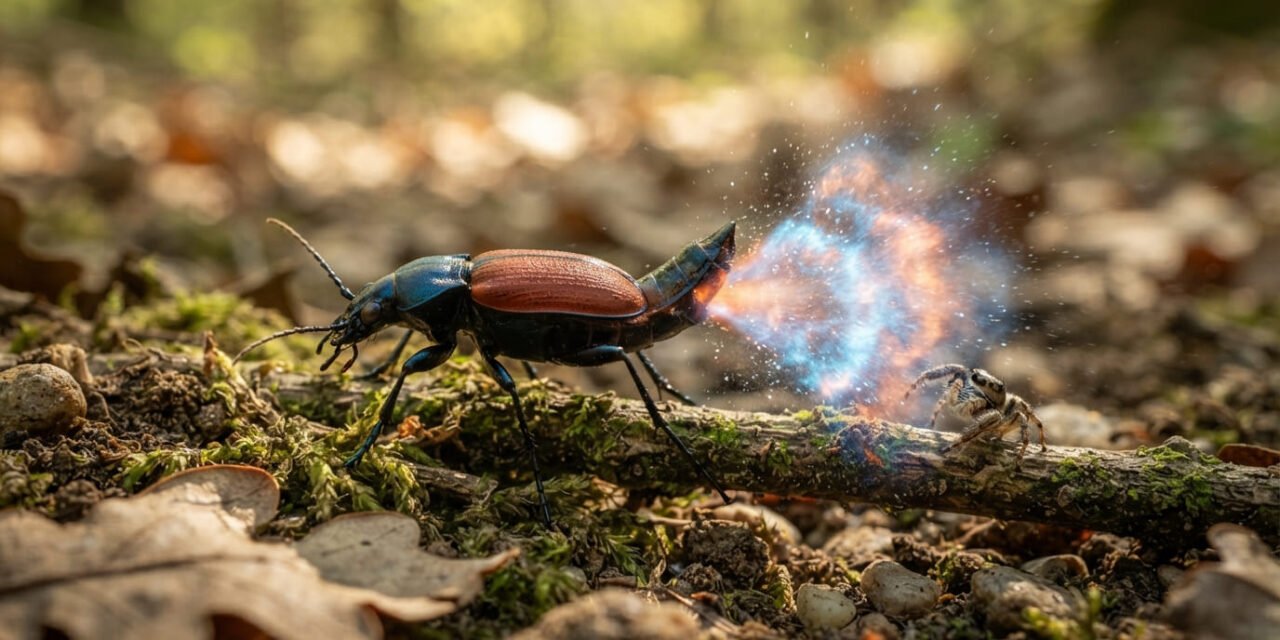
This tiny, fragile-looking insect is a walking artillery unit. It has evolved one of the most incredibly complex, violent, and highly engineered defense mechanisms in the entire animal kingdom. When backed into a corner, the bombardier beetle survives by essentially mixing a batch of volatile rocket fuel inside its own stomach and firing a boiling, toxic spray directly into the face of its attacker.
To understand how a bug manages to shoot boiling liquid out of its rear end without accidentally blowing itself to pieces, we have to look closely at a masterpiece of internal biological plumbing.
The Dangers of the Forest Floor
Before we get into the explosive chemistry, we have to understand the sheer pressure of the beetle’s environment. The damp undergrowth is a brutal, unforgiving place. It is a world entirely populated by hungry, heavily armed predators.
If a bombardier beetle is simply walking through the leaf litter looking for insect larvae to eat, it is constantly being hunted. A hungry European toad, scientifically known as Bufo bufo, might spot the movement and prepare to strike with its sticky tongue. A passing flock of foraging birds will happily snap up any beetle left exposed. Or, perhaps most terrifyingly, the beetle might accidentally stumble into the territory of the southern wood ant, Formica rufa. These large, highly aggressive ants travel in swarms and will gladly rip a small beetle apart, piece by piece, to drag the meat back to their massive mound.
Because the bombardier beetle is small and lacks heavy armor, it cannot wrestle a toad or outrun a swarm of ants. It needs a defense mechanism that works instantly, requires zero physical strength, and guarantees that the predator will immediately drop it and run away.
Evolution provided the ultimate solution: chemical warfare.
The Dual-Chambered Chemistry Lab
The secret to the bombardier beetle’s firepower lies hidden in the back half of its abdomen. Inside the insect’s tiny body is a highly specialized, multi-chambered chemical refinery.
The system relies on keeping two highly reactive substances strictly separated until the exact moment they are needed. In the first chamber, which acts as a large biological storage tank, the beetle produces and stores a mixture of two chemicals: hydroquinones and hydrogen peroxide. On their own, these chemicals are irritating, but they are relatively stable as long as they just sit there.
Right next to this storage tank is a second, much smaller cavity called the reaction chamber. This chamber is lined with incredibly tough, heat-resistant tissue. The walls of this second chamber secrete a specialized mixture of enzymes, primarily catalases and peroxidases.
A tight, muscular valve keeps the storage tank firmly sealed off from the reaction chamber. As long as the beetle is relaxed and going about its day, the chemicals stay in their respective tanks, and nothing happens.
But the moment a Bufo bufo toad suddenly strikes from the shadows, grabbing the beetle in its mouth, the insect panics.
The beetle flexes the muscles in its abdomen. This violently squeezes the large storage tank, forcing the valve open. The hydroquinones and hydrogen peroxide flood directly into the reaction chamber and mix with the waiting enzymes.
The result is catastrophic.
The Boiling Explosion
The enzymes act as a massive chemical catalyst. The hydrogen peroxide is instantly broken down into water and free oxygen gas. At the same time, the hydroquinones are violently oxidized into highly toxic compounds called benzoquinones.
This chemical reaction is intensely exothermic, meaning it releases a massive, sudden burst of heat.
In a fraction of a second, the temperature of the liquid inside the reaction chamber skyrockets to roughly 100 degrees Celsius (212 degrees Fahrenheit), the exact boiling point of water. As the liquid boils, the sudden release of oxygen gas creates an immense amount of physical pressure inside the beetle’s tiny body.
The pressure builds instantly, pushing against the walls of the reaction chamber until it finds the path of least resistance: an exhaust valve located right at the tip of the beetle’s abdomen. The boiling, toxic liquid is forced out of the beetle’s rear end with an explosive, audible pop.
But here is where the engineering gets truly insane. The beetle doesn’t just spray a single, continuous stream of fluid like a squirt gun. If it did that, the sudden release of pressure might actually tear the insect’s internal organs apart.
Instead, researchers using high-speed audio and visual recording equipment discovered that the bombardier beetle employs a pulsed delivery system. The exhaust valve rapidly opens and closes, firing the boiling chemical spray in a machine-gun-like burst of microscopic pulses. It fires about 500 individual pulses of boiling liquid per second. This rapid-fire pulsing regulates the internal pressure and prevents the beetle’s rear end from exploding, while still delivering a devastating volume of chemical spray.
A Highly Articulated Turret
Having a boiling chemical weapon is a massive advantage, but it is completely useless if you can’t aim it.
When a predator attacks, the bombardier beetle doesn’t just spray blindly and hope for the best. The tip of its abdomen is highly flexible, acting exactly like an articulated gun turret. The beetle has specialized deflector plates near the exhaust valve that allow it to bounce the spray in incredibly precise directions.
If a Formica rufa ant bites the beetle’s front left leg, the beetle will physically twist its abdomen, aim the nozzle forward over its own shoulder, and shoot the boiling liquid directly into the ant’s face. If a spider attacks from the side, the beetle aims sideways. It can spray between its legs, over its back, and directly behind it with pinpoint accuracy.
The effect on the predator is instantaneous.
Imagine being a toad expecting a crunchy snack, only to suddenly have the inside of your mouth coated in a boiling, highly toxic chemical foam. The heat causes immediate physical burns. The benzoquinones act as a powerful respiratory irritant, making the predator choke and gag.
Almost every time a bombardier beetle is attacked, the predator drops it immediately. Toads will frantically paw at their own mouths, spitting the beetle out and throwing up dirt trying to get the burning taste off their tongues. Ants will immediately let go, curling up in agony as the boiling liquid melts through their sensory antennae.
While the predator is completely incapacitated, dealing with the shock and the burns, the bombardier beetle simply flips itself over, dusts itself off, and walks away into the undergrowth unharmed.
The Cost of Reloading
As brilliant as this defense mechanism is, it does come with a biological limit. The beetle cannot just walk around the forest firing boiling spray at everything that startles it.
Producing hydroquinones and hydrogen peroxide costs the beetle a massive amount of metabolic energy. A healthy, fully loaded bombardier beetle usually stores enough chemical ammunition to fire off about twenty individual blasts before its tanks are empty.
If it gets attacked repeatedly and runs dry, it is entirely defenseless. It takes a significant amount of time, food, and rest for the beetle to synthesize a new batch of chemicals and refill its internal tanks. Because of this, they are surprisingly reluctant to fire. They won’t shoot if you simply cast a shadow over them. They wait until they are physically grabbed or trapped, holding their fire until it is necessary to save their lives.
Rethinking the Rules of the Undergrowth
When you look at Brachinus crepitans, it completely upends the traditional hierarchy of the food chain. We tend to assume that size and jaw strength dictate who survives in the dirt. We look at a toad and assume it holds absolute power over a tiny beetle.
But the bombardier beetle proves that biological engineering can easily trump brute force. It is an insect that looked at a world full of giant mouths and crushing mandibles and decided to evolve an internal combustion chamber instead of thicker armor. It harnessed the power of an exothermic chemical reaction, learned how to bottle it safely inside its own stomach, and built a machine-gun turret to deliver boiling toxic foam into the eyes of anything foolish enough to bite it.
It is a small, quiet, and deeply terrifying reminder that sometimes, the most unassuming creatures on the planet are packing the heaviest artillery.