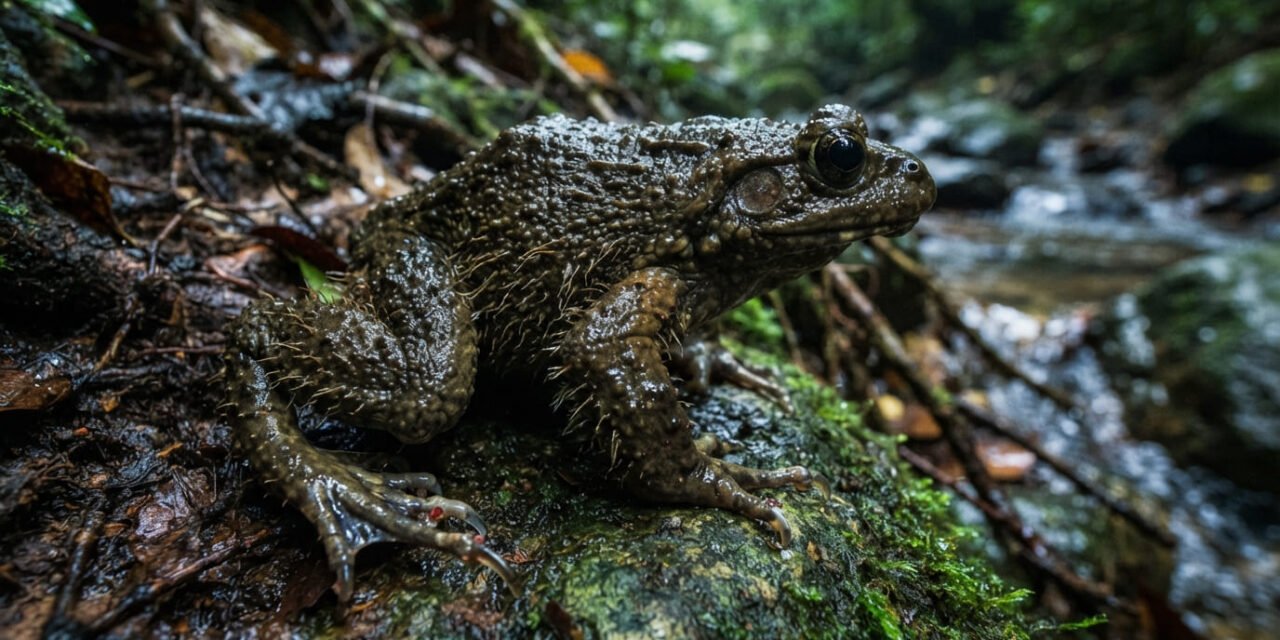
If you spend enough time exploring the dense, fast-flowing river basins of Central Africa, specifically in places like Cameroon, Equatorial Guinea, and the Democratic Republic of the Congo, you might spot a creature sitting quietly on a wet rock that looks like a bad taxidermy experiment.
At first glance, it is a relatively large, heavy-set amphibian. It has a broad snout, big eyes, and heavily muscled back legs. But if you look closely at its sides and down its thighs, you will notice something that fundamentally breaks the rules of what an amphibian is supposed to look like. It appears to be covered in thick, dark patches of coarse hair.
You are looking at Trichobatrachus robustus, commonly known as the hairy frog.
But out here in the rainforest, appearances are deeply deceptive. That fur you see is not actually hair at all. And while the fake fur is certainly strange, it is absolutely nothing compared to what this frog does when it gets backed into a corner. When a predator tries to grab it, the hairy frog doesn’t just try to hop away. It actively breaks its own bones, forces them through its own skin, and uses them as biological weapons.
To understand why a frog would resort to literally stabbing itself just to fight back, you have to look at the extreme environment it lives in and the unique anatomical machinery hidden inside its toes.
The Hair That Breathes
Before we get to the bone-breaking, we have to talk about the “hair.”
Only the male Trichobatrachus robustus grows these strange, bristly strands, and they only appear during the breeding season. If you were to put one of these strands under a microscope, you would see that it contains no keratin, the protein that makes up human hair, dog fur, and bird feathers. Instead, these strands are actually dermal papillae. They are tiny, densely packed extensions of the frog’s own skin, packed tight with a network of tiny blood vessels.
So, why does a frog need fleshy sideburns? It all comes down to oxygen.
When the female hairy frog lays her eggs, she deposits them in the cold, fast-moving currents of the local rivers. The male is tasked with guarding these eggs. To keep them safe from hungry fish and aquatic insects, the male has to stay submerged underwater for days, or even weeks, at a time.
Frogs have lungs, but they also breathe cutaneously, meaning they can absorb oxygen directly from the water through their skin. Because the male hairy frog is spending an enormous amount of time completely underwater, his regular skin simply cannot pull in enough oxygen to keep his massive leg muscles supplied with energy.
The “hair” solves this problem. By growing thousands of these tiny skin filaments along his flanks and thighs, the male drastically increases the total surface area of his body. The strands act exactly like a set of external gills, absorbing oxygen from the rushing river water and keeping him alive while he stands guard. Once the breeding season is over and he returns to a more terrestrial lifestyle on the forest floor, the skin filaments shrink and fade away.
The Wolverine of the Rainforest
Guarding eggs in a river is tough, but living on the forest floor is much more dangerous. The rainforest is packed with predators. If a hungry Gaboon viper (Bitis gabonica) or a foraging mongoose spots the frog in the leaf litter, the frog is usually too heavy and slow to just outrun them.
When a predator strikes and pins the frog down, the hairy frog deploys a defense mechanism so brutal it almost sounds made up. It kicks out with its powerful hind legs. But as it kicks, it forcefully contracts a highly specialized muscle in its foot.
In most animals, claws are made of keratin. They grow out of the skin, much like your fingernails, and they are permanent fixtures. The hairy frog does not have keratin claws. Instead, inside the pad of each of its toes, there is a sharp, curved piece of bone called a terminal phalanx. Usually, this bone is safely anchored to a smaller, bony nodule by a tough piece of collagen.
When the frog flexes that specialized foot muscle in a panic, the tension pulls on the terminal phalanx so violently that it completely snaps the collagen connection. The sharp, curved bone breaks free. The muscle keeps pulling, forcing the sharp tip of the broken bone to slide downward and pierce straight through the soft flesh of the frog’s own toe pad.
Instantly, a sharp, white bone spur protrudes from the bottom of the foot. The frog kicks frantically, dragging these exposed, jagged bones across the face or the inside of the predator’s mouth.
Imagine, for a second, what that actually means. To defend itself, this animal voluntarily breaks a joint in its own hand, pushes the broken bone through the bottom of its foot, and uses it as a shiv. The pain and shock of this sudden, violent counterattack is often enough to make a snake or a bird drop the frog in surprise, giving the amphibian a few precious seconds to scramble under a rock or dive back into the river.
The Cost of Extreme Defense
Having hidden bone claws is an incredible party trick, but it obviously comes with a massive biological cost.
Every time Trichobatrachus robustus uses this defense mechanism, it creates open, bleeding wounds on its own feet. In the hot, humid environment of the Central African rainforest, the soil is packed with bacteria and fungi. An open wound is an easy invitation for a massive, potentially fatal infection.
Biologists are still studying exactly how the frog manages to survive this self-inflicted trauma. It is widely believed that amphibians possess incredibly robust immune systems, often secreting antimicrobial peptides through their skin that act as a natural antibiotic. This likely keeps the puncture wounds from getting infected while they heal.
But what happens to the bone? Unlike a cat that can just retract its claws back into a sheath, the hairy frog doesn’t have a muscle designed to pull the bone back into place.
Researchers believe the retraction process is entirely passive. Once the frog is safe and the adrenaline wears off, the foot muscles relax. The natural elasticity of the tissue slowly pulls the broken bone back up inside the toe pad. Over the next few weeks, the amphibian’s rapid regenerative abilities take over. The soft tissue heals over the exit wound, and the collagen connection slowly fuses back together, re-anchoring the bone to the nodule.
The frog literally puts itself back together, piece by piece, just waiting for the next time it gets grabbed.
A Life in the Shadows
When it isn’t fighting for its life or sitting at the bottom of a river breathing through its fake hair, Trichobatrachus robustus lives a pretty quiet life. It is primarily nocturnal, spending the daylight hours hiding under rotting logs or wedged tightly between wet rocks near the riverbank.
It is a voracious carnivore, though it usually targets prey much smaller than itself. It prowls the damp forest floor at night, hunting for slugs, millipedes, and various large insects. It uses its sticky tongue to snap up large terrestrial snails and heavily armored beetles, relying on its wide jaws to crush the shells before swallowing.
Despite its incredible defenses, the hairy frog is actually hunted quite regularly, not just by snakes and birds, but by people. In Cameroon, the Bakossi people have traditionally hunted these frogs as a source of food. Because the frogs are large and meaty, they are often roasted. Interestingly, the local hunters are very aware of the frog’s bone-breaking habits. They typically hunt them using long spears or machetes to avoid grabbing them with their bare hands, knowing full well that a desperate kick from a hairy frog can easily slice open a careless finger.
The Brutal Logic of Evolution
It is easy to look at the animal kingdom and expect elegant solutions. We admire the aerodynamic perfection of a falcon’s wing or the seamless, color-shifting camouflage of a cuttlefish. We like it when nature looks clean and efficient.
The hairy frog is not clean, and it certainly isn’t elegant. It is a creature that survives through sheer, stubborn grit. It looked at the problem of breathing underwater and decided to just grow hundreds of fleshy blood-tubes out of its own thighs. It looked at the problem of getting eaten and decided that breaking its own bones and stabbing them through its feet was a perfectly reasonable solution.
Trichobatrachus robustus is a heavy, strange, deeply unpleasant fighter. It is a perfect reminder that evolution does not care about what is comfortable, and it definitely doesn’t care about what looks nice. It only cares about what keeps you alive long enough to breed. And in the dark, predator-filled forests of the Congo Basin, sometimes keeping yourself alive means you have to be willing to bleed for it.