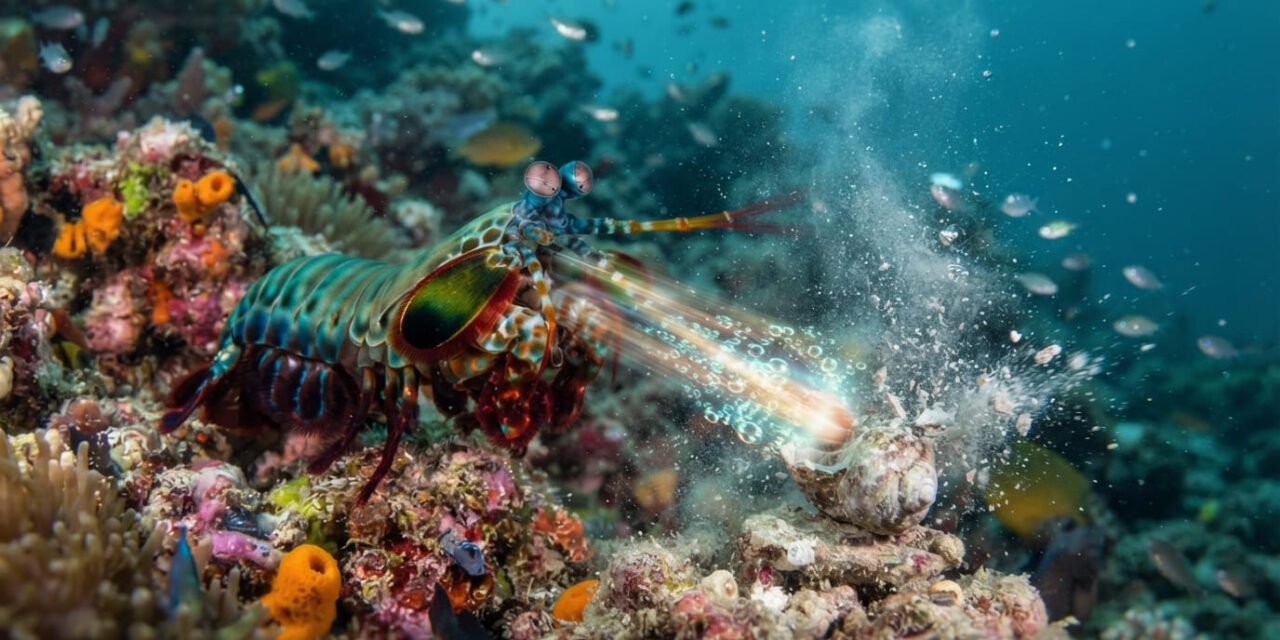
If you go diving in the warm, shallow waters of the Indo-Pacific, perhaps exploring a bustling coral reef off the coast of Indonesia or navigating the seagrass beds near the Philippines, you might see a sudden flash of intense, almost unbelievable color. Scuttling across the white sand, looking like a heavily armored caterpillar painted by a neon sign artist, is a creature that seems to defy the usual muted rules of marine biology.
It is violently green, splashed with brilliant blues, bright oranges, and deep, menacing reds. It has large, stalked eyes that seem to track you with unsettling intelligence.
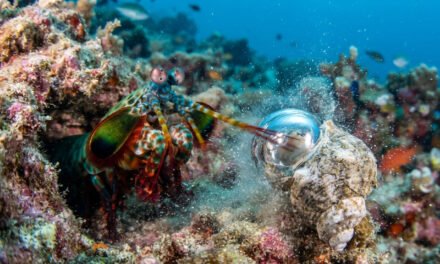
This is Odontodactylus scyllarus, commonly known as the peacock mantis shrimp.
But do not let the stunning colors or the relatively small size they usually max out around four to six inches long fool you. This is not a delicate, beautiful reef ornament. It is one of the most aggressive, mechanically terrifying, and highly evolved predators in the entire ocean. It is an animal that has essentially turned its own front arms into biological firearms.
To understand why aquarium hobbyists are terrified of them, and why marine biologists study them obsessively, you have to look closely at the insane physics of how this animal throws a punch.
The Architecture of a Weapon
First, we need to clear up a biological misconception. Despite its common name, the peacock mantis shrimp is neither a true mantis nor a true shrimp. It belongs to an entirely separate order of crustaceans known as Stomatopoda.
Stomatopods are divided into two distinct groups based on how they hunt: the “spearers” and the “smashers.” The spearers have front arms lined with sharp, barbed spikes that look just like the front legs of a praying mantis, which they use to impale soft-bodied fish.
Odontodactylus scyllarus is a smasher.
Instead of spears, the smasher’s specialized front appendages, called dactyl clubs, look like heavy, calcified boxing gloves. When the animal is resting, it keeps these clubs tucked neatly under its body, resembling a boxer holding their guard tight to their chest.
But when it spots a meal, that tight guard drops. The mantis shrimp hunts heavily armored prey. It prefers animals that most other predators leave alone because they are too difficult to crack open. Its absolute favorite meals are thick-shelled gastropods (like marine snails), heavy bivalves, and various hard-shelled crabs from the family Portunidae.
When a peacock mantis shrimp spots a crab, it doesn’t try to pry the shell open with delicate claws. It just walks right up to it and punches it.
The Physics of the Bullet Punch
Calling the mantis shrimp’s strike a “punch” is almost a massive understatement. It is an explosive release of stored kinetic energy that borders on the impossible.
If a human boxer wants to throw a fast punch, they rely purely on muscle contraction. Our muscles are great for sustained movement, but they simply cannot contract fast enough to produce truly extreme speed.
The mantis shrimp gets around the speed limit of muscle contraction by using a biological spring-and-latch system. Inside the arm of the mantis shrimp is a saddle-shaped structure that acts exactly like a heavy-duty metal spring. When the shrimp prepares to strike, it flexes its muscles backward, tightly compressing this saddle. A tiny physical latch locks the compressed spring securely in place.
The shrimp can hold this terrifying amount of tension for minutes at a time without breaking a sweat, just waiting for the exact right moment.
When the crab moves into range, the shrimp releases the latch. The compressed saddle snaps forward, throwing the heavy dactyl club out at speeds reaching 50 miles per hour (around 80 kilometers per hour). The strike happens in about two milliseconds. To put that into perspective, it takes you roughly 100 to 150 milliseconds to blink your eye. The shrimp’s club moves so fast that the human eye physically cannot track the motion; it just looks like a blur.
The impact force is catastrophic for the crab. The club strikes with thousands of Newtons of force, enough to easily shatter the thickest crab shell or punch straight through the heavy shell of a clam.
Cavitation and Boiling Water
But the blunt force trauma is actually only the first part of the attack. The true destructive power of Odontodactylus scyllarus comes from what happens to the water itself when the club is moving that fast.
Because the club is traveling at such an extreme velocity through a dense liquid, it literally tears the water apart. The rapid movement creates a zone of violently low pressure immediately behind the club. This low pressure causes the surrounding water to instantly boil, forming microscopic bubbles of water vapor.
This phenomenon is called cavitation. If you have ever seen the propeller of a speedboat become pitted and damaged over time, that is cavitation eating away at the metal.
When these tiny cavitation bubbles collapse a microsecond later, they generate an intense shockwave. The collapse is so violent that it produces a tiny, momentary flash of light, called sonoluminescence, and a burst of heat that can briefly reach temperatures close to that of the surface of the sun.
This means that when the peacock mantis shrimp punches a crab, the crab actually gets hit twice. First, it takes the devastating physical impact of the club itself. Then, an instant later, it gets hit by the shockwave of collapsing cavitation bubbles. Even if the shrimp somehow misses the physical punch by a millimeter, the resulting shockwave is often powerful enough to stun or outright kill the prey anyway.
This incredible, explosive power is exactly why most aquariums refuse to house them. If a peacock mantis shrimp gets annoyed at a passing fish or decides it wants to rearrange its tank, it can easily shatter standard, quarter-inch-thick aquarium glass with a single strike, draining the tank and flooding the room.
The Problem with Hitting Too Hard
Having the ability to throw a punch that boils water is an incredible evolutionary advantage, but it comes with a massive design problem. If you hit something that hard, how do you keep your own weapon from shattering?
If a human threw a punch at a brick wall at 50 miles per hour, every bone in their hand and arm would instantly turn to powder.
Biologists and engineers have spent years studying the dactyl club of Odontodactylus scyllarus to figure out why it doesn’t explode on impact. It turns out, the club is a masterpiece of complex material engineering. It is made of several different layers of chitin and specialized minerals.
The outermost layer is heavily mineralized with hydroxyapatite, the same hard mineral found in human teeth and bones. But the inner layers are what make the club truly special. The chitin fibers inside the club are arranged in a highly complex, spiraling pattern called a bouligand structure. This spiral arrangement acts exactly like an advanced shock absorber.
When the club hits a solid crab shell, microscopic cracks begin to form in the weapon. However, instead of traveling straight through the club and splitting it in half, the cracks are forced to follow the twisting, spiraling path of the internal fibers. This drastically slows the cracks down and dissipates the energy of the impact, preventing the club from failing.
Engineers are currently studying this exact spiraling structure to try and design stronger, lighter body armor and more durable airplane hulls.
The Most Complex Eyes on Earth
While the punch gets all the attention, the peacock mantis shrimp has another biological superpower that makes it a lethal hunter: its eyes.
When you look closely at Odontodactylus scyllarus, its eyes look alien. They sit on stalks, and each eye is divided into three distinct sections. More importantly, the eyes can move completely independently of each other. The shrimp can track a crab with its left eye while simultaneously watching for a predatory octopus with its right eye.
But it isn’t just their mobility that makes them special. Human eyes possess three types of color-receptive cones, allowing us to see a blend of red, green, and blue. Dogs have two.
The peacock mantis shrimp has up to sixteen different types of photoreceptors.
They can see an entirely different reality than we do. They can see deep into the ultraviolet spectrum. They can see circularly polarized light, which is something no other animal on the planet is known to do. This complex vision allows them to easily spot transparent prey hiding against the bright, reflective sand of the reef.
Interestingly, this massive influx of visual information doesn’t seem to make them better at distinguishing between colors. Instead, researchers believe it acts more like a biological barcode scanner. Because they have so many receptors, their brain doesn’t have to spend processing power mixing colors together like ours does. They just instantly recognize specific visual patterns, allowing them to react with lightning speed when a target moves.
The Aggressive Hermit
Despite their incredible physical abilities, peacock mantis shrimp are surprisingly secretive. They are solitary, highly aggressive, and extremely territorial.
They spend hours every day excavating and maintaining complex burrows in the sand and rubble at the base of the coral reef. A shrimp will fiercely defend its burrow against any intruder, regardless of size. If another mantis shrimp approaches, they will often engage in a tense, violent standoff. Because a single punch from a rival could be instantly fatal, they usually try to resolve disputes through aggressive posturing.
They will rear up, exposing the bright, threatening colors on their carapace, and flick their heavy clubs as a warning. If the bluff fails, they will actually try to punch the heavily armored tail of their rival, testing their strength without necessarily delivering a fatal blow to the head.
When you look at Odontodactylus scyllarus, you realize that the ocean plays by a completely different set of rules. It is an animal that evolved past the need for venom or sharp teeth. It looked at the thickest, heaviest armor on the reef and simply decided to hit it hard enough to break the water itself. It is a stunning, neon-colored reminder that sometimes, the most complex, highly engineered weapon in the world is just a really fast punch.