If you stand on the coastal dunes of the Namib Desert in southern Africa, you are looking at one of the planet’s most unforgiving environments. The sun beats down with brutal intensity, heating the loose quartz sand until it is too hot to touch. The wind constantly reshapes the landscape, erasing tracks and burying sparse vegetation. It seems impossible for any cold-blooded creature to survive here without roasting during the day or freezing in the sudden, bitter chill of the desert night.
But if you look very closely at a small patch of shade beneath a scrubby bush, you might notice a tiny pair of eyes staring back at you from beneath the sand.
You have just spotted Bitis schneideri, commonly known as the Namaqua dwarf adder.
This is the smallest species of viper in the entire world. A fully grown adult rarely stretches longer than eight to ten inches. But what this snake lacks in size, it completely makes up for with highly specialized, hyper-adapted survival mechanics. It is a tiny, venomous master of the dunes, perfectly engineered to thrive in an environment where moisture is a luxury, and the ground itself is constantly moving.
The Art of the Sidewind
To understand how this tiny viper survives, you first have to look at how it moves.
If you place a typical forest snake, like a rat snake or a python, onto the hot, shifting dunes of the Namib Desert, it will struggle immensely. Most snakes move using what is called lateral undulation; they push their bodies against rocks, roots, or hard earth to propel themselves forward. But on loose sand, there is nothing to push against. The snake just thrashes in place, expending massive amounts of energy while its belly drags across the scorching surface.
Bitis schneideri solved this problem by completely changing its geometry. It is a sidewinder.
When the Namaqua dwarf adder needs to move, it doesn’t slither straight ahead. Instead, it throws its head forward and to the side, lifting the middle of its body entirely off the ground, and then dragging its tail up to meet its head. It repeats this motion rapidly, moving across the dunes at a sharp diagonal angle to the direction it is actually facing.
This strange, looping movement provides two massive advantages in the desert.
First, it is incredibly efficient on loose sand. Because the snake is essentially taking physical “steps” rather than dragging its whole body, it doesn’t slip backward. The downward force of the loop compacts the sand just enough to provide a solid launchpad for the next throw. You can track a sidewinder easily; they leave a highly distinct pattern of parallel, J-shaped tracks across the dunes.
Second, and perhaps more importantly, sidewinding is a brilliant method of thermal regulation. The sand in the Namib can reach temperatures high enough to literally cook a small reptile. By sidewinding, the snake only ever has two small points of its body touching the hot sand at any given moment. The rest of its body is lifted up into the slightly cooler air. This rapid, lifting motion prevents the snake from absorbing lethal amounts of heat through its belly while traveling between shaded bushes.
The Invisible Ambush
While sidewinding allows the snake to travel efficiently, Bitis schneideri actually prefers not to move at all unless it absolutely has to. Moving burns calories, and finding a meal in the sparse desert is difficult. Instead of chasing down fast-moving prey, this tiny viper relies on extreme patience and flawless camouflage.
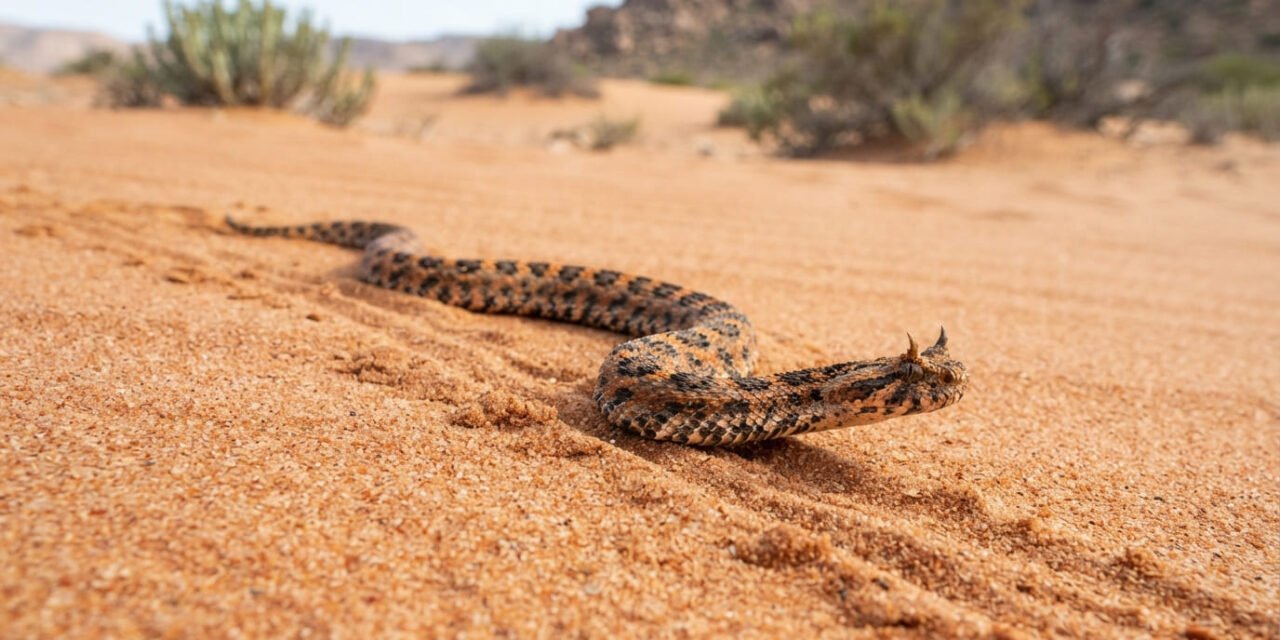
The coloration of the Namaqua dwarf adder is a perfect mirror of its environment. Its heavily keeled, rough scales are usually a pale, dusty yellow, speckled with muted browns and greys. They look exactly like the speckled quartz sand and dried brush of the coastal dunes.
But simply blending in isn’t enough. When the snake finds a good ambush spot, usually on the slip face of a dune or tucked under a small desert succulent, it actively buries itself.
It uses a rapid, shifting motion, shuffling its ribs side to side. Its rough scales act like tiny shovels, displacing the sand and allowing the snake to sink straight down into the dune. Within seconds, the entire snake disappears beneath the surface. The only things left exposed are its nostrils, so it can breathe, and its eyes, which sit high on the top of its head to allow a full field of vision while buried.
This buried posture provides the ultimate thermal blanket. The sand just a few inches below the sunbaked surface is surprisingly cool and insulated. The snake can sit comfortably in this hidden bunker for hours or even days, completely safe from the lethal heat above, just waiting.
A Diet of Desert Survivors
Because Bitis schneideri is so small, its menu is severely limited. It cannot swallow a rat or a large bird like its massive cousin, the puff adder (Bitis arietans).
Instead, it heavily targets the other tiny survivors of the Namib dunes. Its primary prey consists of small, desert-dwelling lizards and geckos. It frequently waits for the barking gecko (Ptenopus garrulus), which emerges in the evenings to call from the entrances of its burrows. It will also strike at small skinks that scurry across the sand searching for insects.
When a small lizard wanders too close to the buried viper, the ambush is sudden and violent.
The snake explodes out of the sand, launching its head forward with terrifying speed. Like all vipers, it possesses long, hollow fangs that fold back against the roof of its mouth when closed. As it strikes, these fangs swing forward like switchblades. It punctures the lizard, injecting a fast-acting, hemotoxic venom, and then immediately releases its grip.
Releasing the prey is a crucial instinct for a small snake. A struggling, biting gecko could easily damage the viper’s fragile eyes or jaw. Instead of wrestling, the snake lets the venom do the heavy lifting. The hemotoxins rapidly break down the lizard’s blood vessels and tissues, ensuring the animal doesn’t get far.
Once the venom takes effect, the snake uses its forked tongue to pick up the chemical scent trail, slowly tracking down the dead lizard and swallowing it whole.
Because the desert is so devoid of standing water, the snake actually relies heavily on these meals for hydration. The bodily fluids of the geckos and skinks provide almost all the moisture the viper needs to survive. On the rare occasions when heavy coastal fogs roll into the desert from the Atlantic Ocean, the snake will flatten its body, allowing the condensation to collect on its rough scales, and then drink the tiny droplets directly off its own back.
The High Cost of Living Small
Being the smallest viper in the world comes with a very steep price. In the brutal hierarchy of the desert, almost everything is bigger than you, which means almost everything wants to eat you.
Bitis schneideri faces a terrifying array of predators. They are constantly hunted from the sky by sharp-eyed raptors like the pale chanting goshawk (Melierax canorus). If they are caught above ground, they are an easy, venomous snack for a hungry honey badger (Mellivora capensis) or a quick-footed yellow mongoose (Cynictis penicillata).
Even their own defense mechanisms are scaled down. When a large puff adder is threatened, it inflates its body and produces a terrifying, deep hiss that warns larger animals to stay back. The Namaqua dwarf adder attempts the same defense. It coils up, inflates its tiny body, and strikes aggressively. But because its lungs are so small, its hiss is barely audible, sounding more like a quiet, raspy wheeze than a genuine threat.
To counter this immense predation pressure, the species relies on a rapid reproductive cycle. While larger vipers might only breed every two or three years, the Namaqua dwarf adder breeds annually. They are viviparous, meaning the female gives birth to live young rather than laying eggs. She usually produces small litters of three to four tiny babies. These snakelets are born fully venomous and completely self-sufficient, immediately slithering off to bury themselves in the sand and start hunting tiny insects and the smallest of lizards.
Unfortunately, this rapid breeding isn’t always enough to offset the mortality rate. They are incredibly short-lived in the wild, with most individuals surviving only two or three years.
The Micro-Predator of the Dunes
It is easy to measure the success of an apex predator by its massive size or overwhelming strength. We look at a lion or a massive python and immediately understand their power.
But the Namaqua dwarf adder proves that survival is often about highly specific efficiency. It is an animal that looked at the scorching, shifting, waterless hell of the coastal dunes and simply adapted its geometry to conquer it. It traded size for the ability to disappear instantly. It learned how to walk sideways to avoid burning its belly, and it figured out how to extract life-saving water from the fog and the bodies of the geckos it hunts.
Bitis schneideri is a masterclass in extreme minimalism. It is a tiny, perfectly tuned, venomous machine, quietly holding its ground in a desert that wants to kill it every single day.