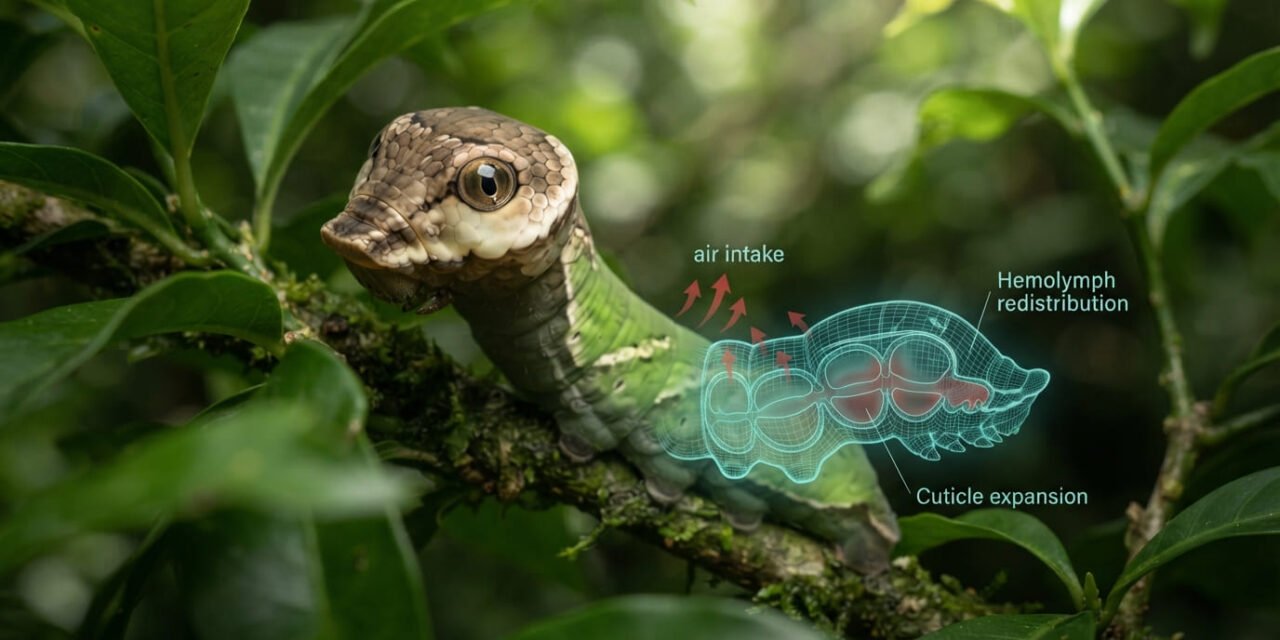
Imagine walking through the warm, damp forests of Central America. The air is thick with the scent of wet clay and wild orchids. You stop to examine a low-hanging branch of a tropical vine, looking closely at the dark green leaves. As you reach out to move a stem, you freeze. Hanging upside down from a twig just inches from your hand is a small, gray-green snake.
Its head is triangular, just like a venomous pit viper. It has two large, glossy, and terrifyingly realistic black eyes that seem to stare right at you. If you get closer, the snake sways its head slowly from side to side. If you touch the branch, it lunges forward in a sudden, violent strike.
You would probably take a quick step backward, heart racing, and decide to leave that branch alone. If you did, you would be the latest victim of an incredible biological puppet show.
The terrifying reptile you just saw was not a snake at all. It was the caterpillar of the hawk moth, Hemeroplanes triptolemus. This soft, slow, and completely harmless insect has no venom, no teeth, and no claws. Yet, it manages to scare away some of the most determined predators in the forest by executing a high-fidelity physical transformation. It turns its own body into a perfect, three-dimensional duplicate of a deadly viper.
The Protein Buffet
To understand why the hawk moth caterpillar needs such an extreme disguise, you have to look at the world from its perspective. In the tropical forest, a caterpillar is essentially a slow-moving sausage packed with rich proteins and fats. They are the ultimate fast food of the jungle.
For forest birds, finding caterpillars is a major goal. A single bird needs to capture dozens of these juicy insects every day to feed itself and its hungry chicks. Because caterpillars are slow and have no armor, they are incredibly easy to capture once they are spotted.
This constant threat puts immense pressure on the hawk moth caterpillar. It cannot run away, and it cannot fly. If it simply sits on a leaf, a passing tanager or flycatcher will spot it and pick it up in a second.
To survive the weeks it takes to grow and transform into a moth, the caterpillar must find a way to stay off the menu. For most of the day, it relies on simple camouflage. Its body is colored in quiet shades of green and brown, allowing it to blend in with the leaves and twigs of its host plant. If a bird flies past, the caterpillar looks like nothing more than a random bump on a vine.
But camouflage is not foolproof. If a bird is searching the leaves carefully, it will eventually spot the caterpillar’s outline. When simple hiding fails, the caterpillar must switch to its backup plan. It stops trying to look like a leaf and starts trying to look like a nightmare.
The Squeezed Balloon
The transformation from a harmless green bug into a deadly snake is a masterpiece of physical manipulation. It starts the moment the caterpillar feels the vibration of an approaching threat.
The caterpillar begins by releasing its grip on the leaf with its front legs, allowing its head and chest segments to hang upside down from the branch. It keeps a tight, iron grip on the wood using only the strong, fleshy suction pads on its rear legs.
Once it is hanging vertically, the caterpillar tucks its true head inward. It folds its front legs tightly against its chest, hiding them completely from view.
Then, the inflation begins.
A caterpillar’s body is essentially a soft tube filled with a clear fluid called hemolymph, which acts as its blood. The caterpillar does not have a hard skeleton to hold its shape; instead, it relies on the pressure of this internal fluid.
To create the snake illusion, the caterpillar contracts the powerful ring-like muscles in the middle of its body. This movement forces the internal fluid forward, rushing it into the head and chest segments.
Think of it like squeezing the bottom half of a long balloon. When you squeeze one end, the air is forced to the other end, causing it to swell up and expand.
In the caterpillar, this sudden surge of fluid inflates the front segments of its body. The skin stretches tight, expanding the narrow green tube into a broad, swollen, and triangular shape. Within seconds, the front of the caterpillar has taken on the exact, unmistakable silhouette of a viper’s head.
The Eyespot Illusion
Having a triangular shape is a good start, but a snake head is not convincing without eyes. This is where the caterpillar’s skin pattern performs its greatest trick.
When the caterpillar is relaxed and feeding, the skin on its chest is folded into tight, wrinkled pleats. These folds hide a secret. Tucked deep within the wrinkles are two large, dark patches of color.
When the caterpillar squeezes its muscles and pumps fluid forward, the skin on its chest stretches flat. As the pleats unfold, they reveal the two hidden patches of color.
These are not simple black dots. The patterns are incredibly detailed, featuring a large black pupil surrounded by a pale, golden-yellow ring. The coloring is arranged to mimic the way light reflects off a wet, glossy eyeball. The spots even have tiny, white highlights that look exactly like the glare of the sun on a real pupil.
To a predator looking down from above, the sudden expansion of the skin looks like two giant, glossy yellow eyes popping open in the leaves. The illusion of depth is so perfect that it tricks the eyes of birds and humans alike, making a flat patch of skin look like a rounded, staring eyeball.
The caterpillar also alters the texture of its skin. By stretching its scales tight, the green and yellow patterns on its back mimic the rough, overlapping scales of a reptile. It even has a dark line running down the center of its “head,” matching the exact color pattern of the venomous vipers that crawl through the leaf litter below.
The Puppet Show Performance
Looking like a snake is only half of the battle. If a predator saw a snake’s head that was completely stiff and lifeless, it might eventually get suspicious and investigate. To make the trap work, the caterpillar must act like a snake.
Once the inflation is complete, the caterpillar begins to sway its swollen front end slowly from side to side. This movement mimics the cautious, searching motion of a real snake tracking a target.
If the threat gets too close, the caterpillar takes the performance to the next level. It contracts its body muscles with a sudden, violent snap, launching its swollen head forward in a rapid strike.
Because it has no mouthparts or fangs on its inflated tail end, the strike is completely harmless. The caterpillar cannot bite or inject venom. But the sheer speed of the movement, combined with the sudden flash of those giant yellow eyes, is a terrifying sight. It is a highly active, high-stakes game of bluff, designed to trigger an immediate, involuntary fear response in the attacker.
The Predator’s Blind Spot
This bluff works because it exploits a hardwired vulnerability in the minds of birds.
In the tropical forest, making a mistake about a snake is lethal. If a bird decides to investigate a suspicious shape and turns out to be wrong, it does not just lose its lunch; it loses its life. A single bite from a real viper can kill a forest bird in minutes.
Because the cost of being wrong is so incredibly high, birds have evolved an innate, powerful dread of snakes. They are genetically programmed to avoid anything that looks like a triangular head and a pair of staring eyes.
The hawk moth caterpillar has spent millions of years studying this mental loophole. By presenting the bird with the ultimate warning sign, it forces the predator to make a choice. The bird can stay and risk dying, or it can fly away and find a safer meal. The bird almost always chooses to fly away.
Even if a bird suspects the snake might be fake, the risk of testing that theory is simply too great. The caterpillar survives not by being stronger or faster, but by being too terrifying to test.
A Temporary Disguise
This spectacular snake costume is only a temporary stage in the insect’s life. After a few weeks of feeding and growing, the caterpillar reaches its full size. It drops from the branch, crawls into the leaf litter on the forest floor, and spins a quiet, brown cocoon.
Inside the dark chamber, the snake’s disguise is discarded. The caterpillar’s body dissolves and rebuilds itself, transforming into a large, elegant hawk moth with long, narrow wings and a thick, fuzzy body.
When the adult moth emerges, it no longer has the ability to inflate its body or show off giant yellow eyes. It leads a quiet, nocturnal life, flying through the canopy to drink nectar from deep tropical flowers. But even as an adult, it carries a reminder of its youthful defense. When the moth rests on a tree trunk, the patterns on its wings blend perfectly with the bark, keeping it safe until the cycle begins again with a new generation of tiny, shape-shifting caterpillars.
Final Thoughts
The hawk moth caterpillar is a wonderful reminder that in the battle for survival, a clever illusion can be far more powerful than a physical weapon. Operating entirely on ancient instinct, this soft, harmless insect manages to execute a defense system that is both a physical masterpiece and a psychological trap.
The next time you walk through a garden or a forest and see a leaf shift, take a second look. It might just be the wind. But if you are in the tropical forests of Central America, there is a tiny chance that the leaf is home to a quiet, green caterpillar, waiting to show you its magic eyelids, turn its body into a balloon, and perform the greatest puppet show in the wild.