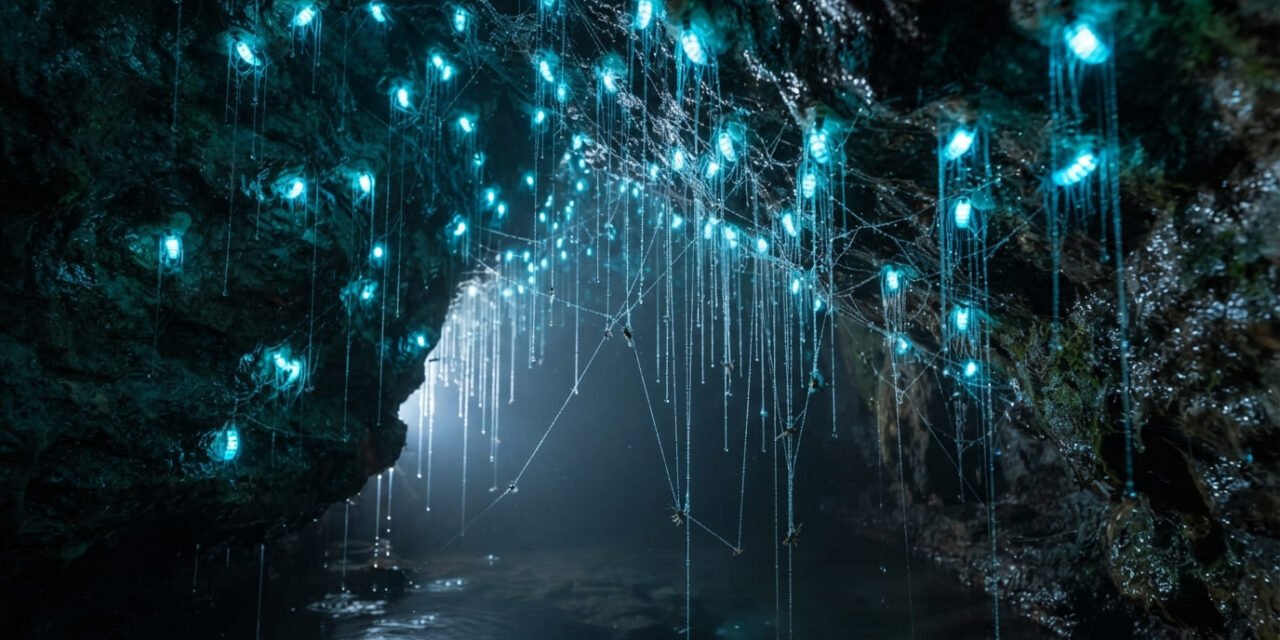
Imagine entering a subterranean cave deep within the limestone hills of New Zealand. You step into a wooden boat and glide silently across a calm underground river. As the light from the cave entrance fades into total darkness, the air turns cool, damp, and perfectly still. You look up at the ceiling overhead, expecting nothing but bare black rock.
Instead, you find yourself staring at a galaxy of blue-green stars.
Thousands of tiny, intense lights dot the cave roof, casting a soft, otherworldly glow over the water below. It looks like a clear midnight sky viewed from a high mountain peak. But you are not looking at outer space. You are standing inside a living trap, suspended hundreds of feet underground.
Every single point of light belongs to a tiny, soft-bodied insect: the New Zealand glowworm (Arachnocampa luminosa).
Despite its common name, this creature is not a true worm, nor is it a beetle like the American firefly. It is the larval stage of a small, delicate fungus gnat. Faced with the challenge of hunting fast, flying insects in total darkness without wings or claws, this subterranean engineer turned its own body into a fishing rig. It hangs from the ceiling, lights up its tail like a lantern, and drops long, sticky lines of silk to catch anything that flies toward the light.
The Problem of the Underground Buffet
To understand why the glowworm’s strategy is so effective, you first have to look at the unique environment of a cave.
Caves like those in Waitomo, New Zealand, offer wonderful protection from bad weather. The temperature inside stays steady all year, the humidity remains near one hundred percent, and there are no large land predators like birds or lizards hunting along the roof.
However, finding food in a cave is remarkably hard. Plants cannot grow in complete darkness, which means there are no leaves, fruits, or seeds to support large populations of plant-eating bugs.
The primary food supply comes from outside. Insects like mayflies, midges, mosquitoes, and small moths hatch in nearby streams or fly into the cave openings to seek shelter. But these flying insects move quickly and unpredictably through the dark air.
A soft, slow-moving larva crawling along the bare rock has zero chance of chasing down a flying midge. If the larva tried to hunt by crawling after its prey, it would burn through its energy reserves and starve long before catching a meal.
The glowworm needed a way to force the food to come to it. It needed a lure to draw insects out of the air, and a trap to hold them fast once they arrived.
The Chemistry of the Biological Lantern
The glowworm’s primary lure is its light. In biology, the production of light by a living organism is called bioluminescence. While many deep-sea fish and jellyfish produce light, the New Zealand glowworm is one of the few land-based creatures to master the craft.
The light is produced in a specialized organ located at the very tip of the larva’s abdomen, connected to its excretion system.
Inside this organ, a precise chemical reaction takes place. The larva produces a light-emitting molecule called luciferin. When luciferin reacts with oxygen in the presence of an enzyme called luciferase, along with adenosine triphosphate, which is the cell’s energy currency, the chemical bonds break apart.
This reaction releases energy almost entirely in the form of cold light.
Unlike a typical household light bulb, which wastes over ninety percent of its energy as heat, the glowworm’s light engine is nearly one hundred percent efficient. Almost zero heat is generated during the process. This is vital, because excess heat would dry out the larva’s delicate skin and ruin the humid atmosphere of the cave.
The light produced by Arachnocampa luminosa is a sharp, brilliant blue-green color, with a peak wavelength around four hundred eighty-eight nanometers. This specific color is not an accident. Blue-green light travels further through dark air and damp cave mist than red or yellow light.
Furthermore, the larva can control the intensity of its glow. When the larva is hungry, it turns the brightness up, glowing intensely to attract attention. If it has just eaten a large meal, it dims the lantern to save energy. If a sudden noise, bright flashlight, or gust of wind threatens the colony, the larva can shut off its light completely in a fraction of a second, hiding in the dark.
The Silk Bead Fishing Lines
The light draws insects toward the ceiling, but light alone cannot catch a meal. To catch the prey, the glowworm builds an elaborate aerial trap that hangs directly beneath its glowing tail.
First, the larva builds a horizontal nest along the cave ceiling. It spins a flexible, transparent tube out of silk and mucus, anchoring it to the rock with strong guy-lines. The larva lives inside this tube, sliding back and forth like a train on a track.
Once the nest tube is secure, the larva begins to fish.
It lets down long threads of fine silk from its body, letting them dangle straight down into the open air. Depending on the size of the larva and the draft inside the cave, these hanging lines can range from a few inches to over two feet in length. A single glowworm may drop a curtain of up to forty individual lines around its nest.
As the larva spins each silk thread, it coats the line with evenly spaced droplets of sticky mucus. Under a microscope, the hanging line looks like a string of glass beads or a miniature pearl necklace.
This mucus is a chemical masterpiece. It contains water, specialized binding proteins, and a high concentration of oxalic acid and urea.
The water and proteins make the droplets exceptionally sticky, so much so that even a single touch can anchor a flying insect. The oxalic acid gives the droplets a sharp acidity. This acid acts as an irritant and a mild nerve poison, dulling the reflexes of the trapped insect so it cannot kick its way free before the larva arrives.
The Starry Night Illusion
Why do flying insects fly straight into these sticky curtains of light?
The answer lies in how night-flying insects navigate. For millions of years, insects like midges and moths have used the moon and stars to orient themselves in the dark. By keeping a distant point of light at a constant angle relative to their eyes, an insect can fly in a straight line through the night sky.
In an open forest or field, a gap in the tree canopy showing the bright night sky means safety and open flying space.
When an insect strays into a dark cave or a shadowy forest gully, its compound eyes scan the darkness for light. When it looks up at the ceiling covered in thousands of glowing glowworm tails, its brain is tricked completely.
To the insect, the ceiling looks like an open canopy filled with distant starlight. It assumes that flying toward the blue-green dots will take it up into the safety of the open night sky.
The insect adjusts its wings, accelerates toward the light, and flies directly into the invisible curtain of sticky silk threads hanging just beneath the lanterns.
Reeling in the Catch and Recycling Resources
The moment a flying insect hits a hanging thread, the trap springs into action.
The prey’s wings and legs get tangled in the sticky mucus droplets. As the insect thrashes to break free, its movements vibrate the silk line. These mechanical vibrations travel up the thread and hit the glowworm resting inside its nest tube above.
The larva feels the tug through its sensory hairs. It does not waste a second.
Leaning out of its silk tube, the glowworm begins to reel in the line. It uses its jaws and front mouthparts to pull the thread upward, winding the silk into a neat ball between its legs. It can reel in a thread in a matter of seconds, pulling the struggling prey up to the ceiling like a fisherman pulling a trout into a boat.
Once the prey reaches the nest, the larva delivers a bite, injecting digestive enzymes that quickly paralyze the insect. It then eats the prey whole or sucks out its liquefied internal tissues.
Building and maintaining dozens of sticky silk lines burns a tremendous amount of energy. The mucus droplets slowly dry out over time, and lines frequently break when large insects fight back.
To prevent energy waste, the glowworm practices total resource recycling. When a line becomes old or damaged, the larva simply reels it in and eats the entire thread, digestion enzymes breaking down the old silk and mucus into raw amino acids that are used to spin new fishing lines the next day.
From Larva to Gnat: The Short Final Act
The glowworm stage is by far the longest part of the insect’s life. The larva spends up to nine months to a year feeding, growing, and building its silk chandeliers.
Once the larva gathers enough energy, it transforms into a pupa, hanging upside down from the cave ceiling inside a clear silk sleeve. Even as a pupa, it continues to glow, though it no longer feeds or spins lines.
After about two weeks, the adult fungus gnat emerges from the pupa shell.
The adult gnat looks nothing like the glowing larva. It is a weak, delicate flyer with long legs and thin wings, looking somewhat like a giant mosquito. It has no functional mouthparts and cannot eat a single bite of food.
Its entire adult life lasts only two to three days. The adult gnat’s sole mission is to find a mate, lay eggs along the cave ceiling, and die.
Because the adult gnats are so weak at flying, many of them accidentally drift into the hanging fishing lines of nearby larvae, sometimes even their own offspring, and end up as food for the next generation.
Lessons for Human Material Science
You should care about the New Zealand glowworm because its unique sticky silk is helping human engineers solve complex material science problems.
In the human world, creating glues that maintain their stickiness in high-humidity or wet environments is exceptionally difficult. Standard industrial tapes and adhesives usually absorb moisture, swell up, and lose their grip when exposed to water or fog.
Engineers studying bio-adhesives are looking closely at the mucus droplets on glowworm threads.
By analyzing how the glowworm’s mucin proteins bind with water molecules to create a long-lasting, flexible gel that stays sticky at one hundred percent humidity, chemists are designing synthetic hydrogel adhesives.
These bio-inspired materials are being tested for medical uses, such as surgical tapes that can seal internal incisions without slipping on wet organs, and specialized underwater glues for repairing ocean cables and marine equipment.
A Quiet Master of the Dark
The New Zealand glowworm is a wonderful reminder that nature’s most spectacular displays often happen in the quietest, darkest places. It is an insect no longer than a matchstick, living in a dark cave on a remote island.
It did not conquer its environment through speed, armor, or sharp teeth. Instead, it used the physics of light, the chemistry of cold luminescence, and the geometry of hanging silk to build an unbeatable survival strategy.
The next time you look up at a clear night sky, remember the starry ceiling of Waitomo. Somewhere deep underground, thousands of tiny translucent architects are lighting their lanterns, dropping their sticky threads, and proving that with the right combination of light and line, even the darkest cave can become a place of quiet beauty and survival.